Unconditional Cash Transfers (UCT) vs Conditional Cash Transfers (CCT)
A cash transfer is money that the government pays directly to a person, usually into their bank account, to support them. When the money comes with no condition attached, it is an unconditional cash transfer (UCT): if you are eligible, you get it, whatever you do with it. When the money is paid only if the person does something specific, such as sending a daughter to school or delivering a baby in a hospital, it is a conditional cash transfer (CCT). Both are tools of welfare, but they work in different ways and lead to different debates.
Why do governments give cash at all?
For many years, governments helped poor people mainly through goods: cheap grain at a ration shop, subsidised fertiliser, free electricity. These "in-kind" subsidies often leaked on the way, through fake ration cards, middlemen or diversion. Cash is simpler. It goes straight to the person, and the person decides what they need most. A family that already has grain may need money for school fees or medicine instead.
How did cash transfers grow?
The modern idea of conditional cash transfers took shape in Latin America. Mexico started its Progresa programme in 1997, and Brazil started Bolsa Família in 2003. Both paid poor families on the condition that children attended school and went for health check-ups. In India, cash transfers became easy to run at scale only after the JAM trinity came together: Jan Dhan bank accounts, Aadhaar identity numbers and Mobile phones.
Direct Benefit Transfer (DBT), launched on 1 January 2013, is the delivery pipe through which most of this money now travels.
India's big conditional transfers
Some well-known CCTs are:
- Janani Suraksha Yojana (JSY), 2005: pays pregnant women from poor families when they deliver the baby in a health facility. The condition (institutional delivery) aims to reduce deaths of mothers and newborns.
- Pradhan Mantri Matru Vandana Yojana (PMMVY), 2017: pays ₹5,000 for the first child, in instalments, linked to conditions such as registering the pregnancy and getting check-ups.
- Kanyashree Prakalpa (West Bengal), 2013: pays an annual scholarship to girls aged 13 to 18 who stay in school and remain unmarried, plus a one-time grant of ₹25,000 at 18 to 19 if they are still studying and unmarried. It won the UN Public Service Award in 2017.
India's big unconditional transfers
Examples include:
- PM-KISAN (launched 24 February 2019): a central scheme that pays ₹6,000 a year to eligible farmer families in three instalments of ₹2,000. There is no condition on how the money is used.
- State income support for farmers: for example, Telangana's Rythu Bandhu (2018) and Odisha's KALIA (2018-19). Several states, such as Andhra Pradesh and Maharashtra, add their own money on top of PM-KISAN.
- Monthly cash for women: many states now pay adult women a fixed monthly amount, for example West Bengal's Lakshmir Bhandar (2021) and Madhya Pradesh's Ladli Behna Yojana (2023). Payments are usually in the range of ₹1,000 to ₹2,500 a month.
- Social security pensions: monthly pensions for the elderly, widows and persons with disabilities. These are also unconditional, because they depend only on who you are, not on what you do.
How does a UCT differ from a CCT in design?
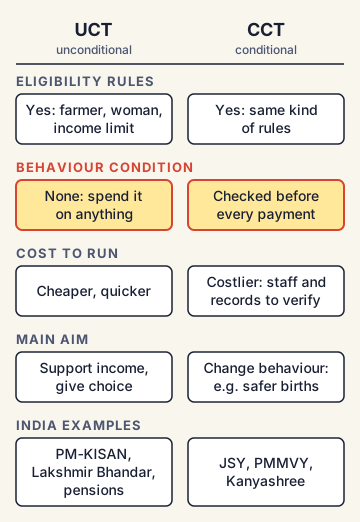
- Who is eligible: both use eligibility rules (a farmer, a woman of a certain age, a family below an income limit).
- The extra step: a CCT also checks behaviour every time before paying (school attendance, a hospital delivery, a vaccination). A UCT does not.
- Cost of running it: CCTs need staff and records to verify conditions, so they are costlier to run. UCTs are cheaper and quicker.
- Purpose: a CCT tries to change behaviour (more girls in school, safer births). A UCT mainly tries to support income and give people choice.
The Universal Basic Income idea
The Economic Survey 2016-17 had a full chapter on Universal Basic Income (UBI), a payment to every citizen with no conditions. It estimated the cost at about 4% to 5% of GDP and suggested starting with smaller versions, such as a basic income for women or for vulnerable groups. Many of today's state schemes for women look like a partial, group-based form of this idea.
How do these schemes affect a state's budget?
A state's regular income (taxes, its share of central taxes, grants) is called its revenue receipts. Its regular spending, such as salaries, pensions, interest and subsidies, is revenue expenditure. These costs repeat every year and do not create any asset like a road or a hospital. When the share of cash transfers and subsidies keeps growing, less money is left for capital expenditure, which builds schools, roads and irrigation.
If revenue spending is bigger than revenue receipts, the state has a revenue deficit: it is borrowing to meet day-to-day costs, like a family taking a loan to pay the monthly grocery bill.
Commonly confused concepts
- UCT vs CCT: a UCT has eligibility rules but no behaviour condition. A CCT pays only after a condition is met.
- UCT vs UBI: a UCT can be targeted at a group (women, farmers). A true UBI goes to everyone, with no targeting at all.
- Cash transfer vs DBT: a cash transfer is the scheme. DBT is the delivery method that sends scheme money (or a subsidy, like the LPG subsidy under PAHAL) straight into bank accounts.
- Subsidy vs transfer: a subsidy lowers the price of something (cheaper power, cheaper fertiliser). A transfer gives money directly, which the person may spend on anything.
- Welfare vs "freebies": there is no legal definition of a "freebie". The term is used in debate for handouts said to have no long-term benefit, while spending on health, education or nutrition is usually seen as welfare. Where one ends and the other begins is a matter of debate.
What have the courts said?
In S. Subramaniam Balaji v. State of Tamil Nadu (2013), the Supreme Court held that promises in an election manifesto are not a "corrupt practice" under Section 123 of the Representation of the People Act, 1951. It also asked the Election Commission to frame guidelines on manifestos. In August 2022, in a case filed by Ashwini Upadhyay, the Supreme Court referred the wider questions about election-time "freebies" to a three-judge bench, noting a need to relook at the 2013 ruling.
Issues, criticism and the way forward
- Fiscal burden: cash transfer spending is a fixed, yearly cost. When it grows faster than revenue, states borrow more or cut capital spending.
- Poor targeting: the 16th Finance Commission observed that many unconditional schemes have a very large, untargeted beneficiary base, which makes them costly and less efficient. It recommended rationalising beneficiary lists.
- Duplication: the same person may receive similar help from the Centre and the state (for example, PM-KISAN plus a state farmer scheme), without coordination.
- The case for UCTs: supporters point out that cash gives women more say in household spending, helps families handle shocks like illness or crop loss, and has low leakage when paid through DBT. Several studies have found that recipients mostly spend the money on food, education and health.
- The case for conditions: CCTs can push behaviour that benefits society, such as girls' schooling. But they cost more to run and can exclude the poorest, who may find it hardest to meet conditions.
- Way forward: experts suggest regular review and "sunset" dates for schemes, clean beneficiary databases, publishing full subsidy costs openly in budgets, and keeping enough money for capital spending.
Concepts to Know
- Revenue receipts: the regular income of a government that does not create a debt, such as taxes, its share of central taxes and grants.
- Revenue deficit: when a government's day-to-day spending is more than its regular income, so it borrows to cover routine costs.
- Capital expenditure: spending that creates long-lasting assets, like roads, buildings and dams, or that reduces debt.
- Targeting: choosing exactly who should get a benefit, so that the money reaches those who need it most.
- JAM trinity: Jan Dhan bank accounts, Aadhaar and Mobile phones used together to identify people and pay them directly.
- CCT examples: Janani Suraksha Yojana (2005), PMMVY (2017, ₹5,000 for the first child), Kanyashree (West Bengal, 2013; UN Public Service Award 2017)
- UCT examples: PM-KISAN (24 February 2019; ₹6,000 a year in three instalments of ₹2,000), state farmer schemes, monthly cash schemes for women, social security pensions
- Global models: Progresa, Mexico (1997); Bolsa Família, Brazil (2003)
- DBT launched 1 January 2013
- Economic Survey 2016-17: UBI chapter; estimated cost 4% to 5% of GDP
- S. Subramaniam Balaji v. State of Tamil Nadu (2013): manifesto promises are not a corrupt practice under Section 123 of the RP Act, 1951; referred for reconsideration to a three-judge bench in August 2022
● Tracked since July 06, 2026 · last seen November 17, 2026 · updates as the daily brief publishes