Power Distribution Companies (DISCOMs)
India's Weakest Link in the Power Chain
A DISCOM (distribution company) is the company that brings electricity to your home, farm or shop. It buys power in bulk from power plants, carries it through local wires, sends you a bill and collects the money. In India, most DISCOMs are owned by state governments. Because every rupee in the power sector finally comes from the bills that DISCOMs collect, their financial health decides the health of the whole power sector.
Why do DISCOMs matter so much?
Think of the power sector as a chain with three links: generation (making electricity), transmission (carrying it over long distances on high-voltage lines) and distribution (delivering it to users). The DISCOM is the last link and the only one that collects money from the public. If it does not pay power plants on time, the plants cannot pay for coal, banks or workers.
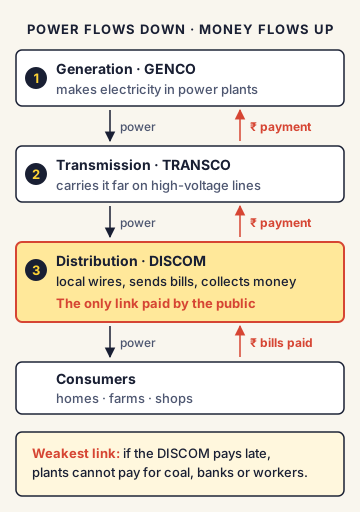
New solar and wind projects also become risky, because investors fear they will not be paid. This is why experts often call DISCOMs the "weakest link" of the power sector.
Who controls them?
Electricity is in the Concurrent List (Entry 38, List III) of the Seventh Schedule, so both Parliament and state legislatures can make laws on it. The main law is the Electricity Act, 2003. Under it:
- State Electricity Regulatory Commissions (SERCs) fix the retail tariff (the price per unit) that each DISCOM can charge its consumers.
- The Central Electricity Regulatory Commission (CERC) regulates tariffs of central power plants and power moving between states.
- Section 65 says that if a state government wants a group of consumers (for example, farmers) to pay less than the tariff fixed by the SERC, the state must pay that subsidy in advance to the DISCOM.
Where did they come from?
Before the 1990s, each state had a single State Electricity Board (SEB) that did everything: generation, transmission and distribution. SEBs ran up huge losses because of free or cheap power, theft and poor billing. From the late 1990s, and especially after the Electricity Act, 2003, states "unbundled" (split up) their SEBs into separate generation, transmission and distribution companies.
Some cities, such as Delhi and Mumbai, have private DISCOMs, and Odisha handed all four of its DISCOMs to a private company in 2020-21, with the state keeping a 49% share.
How does a DISCOM earn and lose money?
In simple terms, a DISCOM buys power, delivers it and collects bills. Two measures show how well it does this:
- AT&C loss (Aggregate Technical and Commercial loss): The share of electricity that the DISCOM bought but never got paid for. Some is lost as heat in wires (technical loss). Some is stolen, not billed, or billed but not collected (commercial loss). If a DISCOM buys 100 units and gets paid for only 85, its AT&C loss is 15%.
- ACS-ARR gap: The difference between the Average Cost of Supply (what it costs to deliver one unit) and the Average Revenue Realised (what the DISCOM actually earns per unit). If supply costs ₹7 a unit and it earns ₹6.50, it loses 50 paise on every unit.
Why have DISCOMs been in debt?
Several reasons add up:
- Cheap or free farm power: Many states give free or very cheap power to farmers. If the state does not pay the subsidy fully and on time, the DISCOM bears the loss.
- Tariffs below cost: Tariff increases are politically sensitive, so they often lag behind rising costs.
- Theft and poor collection: Especially in rural areas, losses from theft and unpaid bills are high.
- Unpaid government bills: Government departments themselves often pay their electricity bills late.
- Costly long-term contracts: Many DISCOMs are tied to old, expensive power purchase agreements (PPAs).
Rescue and reform attempts, step by step
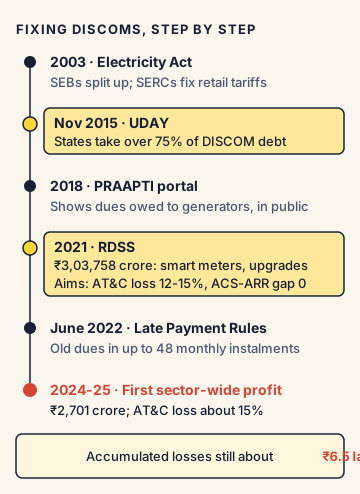
- UDAY (Ujwal DISCOM Assurance Yojana), November 2015: States took over 75% of DISCOM debt as on 30 September 2015 (50% in 2015-16 and 25% in 2016-17). This debt was not counted in the states' fiscal deficit for those two years. DISCOMs in return promised to cut losses.
- PRAAPTI portal (2018): A website that shows, in public, how much each DISCOM owes to power generators, to shame late payers and bring transparency.
- Revamped Distribution Sector Scheme (RDSS), 2021: Outlay of ₹3,03,758 crore, with central support of ₹97,631 crore, originally for 2021-22 to 2025-26. Its targets were to cut national AT&C losses to 12-15% and bring the ACS-ARR gap to zero by 2024-25. It funds prepaid smart meters and network upgrades, but only for DISCOMs that meet reform conditions. Reports say it has been extended to March 2028.
- Electricity (Late Payment Surcharge and Related Matters) Rules, 2022: Notified on 3 June 2022. Old dues of DISCOMs were turned into up to 48 monthly instalments. If a DISCOM still fails to pay on time, its access to power from the grid and exchanges can be regulated (cut back).
Where do DISCOMs stand now?
According to the Ministry of Power, DISCOMs together made a profit of ₹2,701 crore in 2024-25, the first sector-wide profit in many years, after a loss of about ₹25,000 crore the year before. AT&C losses fell to about 15% in 2024-25, from about 22.6% in 2013-14. The ACS-ARR gap has narrowed to a few paise per unit.
But their accumulated losses (losses piled up over past years) are still reported at about ₹6.5 lakh crore. Some analysts point out that part of the improvement comes from accounting changes and delayed recognition of costs, not only from better collection.
Why does this matter for farm solar?
In schemes like PM-KUSUM, a farmer or developer sets up a small solar plant and sells power to the DISCOM. If the DISCOM pays late, the developer must borrow more and pays more interest. Banks then see such projects as risky and lend less. So without timely DISCOM payments, even a well-designed solar scheme struggles to grow.
Commonly confused concepts
- AT&C loss vs T&D loss: T&D (Transmission and Distribution) loss counts only electricity lost in wires and through theft. AT&C loss also adds the money not collected from bills. So AT&C loss is the fuller measure.
- DISCOM vs GENCO vs TRANSCO: A GENCO generates power, a TRANSCO carries it over long distances, and a DISCOM delivers it to consumers and collects bills.
- SERC vs CERC: SERCs fix retail tariffs within a state. CERC deals with central power plants and power moving between states.
- UDAY vs RDSS: UDAY (2015) mainly shifted DISCOM debt to states. RDSS (2021) gives money for meters and network upgrades, linked to performance.
- Cross-subsidy vs direct subsidy: In a cross-subsidy, industrial and commercial users pay higher tariffs so that farmers and poor households can pay less. A direct subsidy is money the state government pays to the DISCOM under Section 65.
Issues, criticism and the way forward
- Repeated bailouts: UDAY and earlier packages gave relief, but losses came back. Critics say rescue without lasting tariff and governance reform only delays the problem.
- Political tariffs: Free power promises can hurt DISCOM finances if subsidies are not paid in advance.
- Late payments hurt clean energy: Payment delays make renewable projects costlier and slow India's energy transition.
- Smart meter rollout: Prepaid smart meters can cut theft and improve collection, but consumers worry about data, cost and sudden disconnection.
- Suggested way forward: pay subsidies on time and through direct benefit transfer where possible; revise tariffs regularly based on cost; separate agricultural feeders (feeder segregation) and solarise them; make regulators more independent; and enforce payment security rules strictly.
Concepts to Know
- Tariff: The price per unit (kilowatt-hour) of electricity that a consumer pays.
- Power Purchase Agreement (PPA): A long-term contract in which a DISCOM agrees to buy power from a plant at a fixed price, often for 25 years.
- Unbundling: Splitting one big electricity board into separate companies for generation, transmission and distribution.
- Agricultural feeder: The local power line that supplies only farm pumps in an area. Separating it from village household lines lets the DISCOM manage farm supply better.
- Payment security mechanism: An arrangement, such as a letter of credit from a bank, that makes sure a power seller gets paid even if the buyer delays.
- Fiscal deficit: The gap between what a government spends and what it earns, which it covers by borrowing.
- Electricity: Concurrent List, Entry 38 of List III
- Electricity Act, 2003: SERCs fix retail tariffs; Section 65 requires the state to pay subsidies in advance
- UDAY (November 2015): states took over 75% of DISCOM debt as on 30 September 2015 (50% in 2015-16, 25% in 2016-17)
- RDSS (2021): outlay ₹3,03,758 crore; central support ₹97,631 crore; targets AT&C loss 12-15% and ACS-ARR gap zero
- Late Payment Surcharge Rules, 2022 (notified 3 June 2022): old dues in up to 48 monthly instalments
- DISCOMs' combined profit in 2024-25: ₹2,701 crore; AT&C losses about 15%
● Tracked since October 28, 2026 · last seen October 28, 2026 · updates as the daily brief publishes