Agrivoltaics (Agri-Photovoltaics)
Growing Crops and Solar Power on the Same Land
Agrivoltaics means using the same piece of land for two jobs at once: growing crops and producing electricity from sunlight. Solar panels are fixed high above the field, or in rows with wide gaps, so that crops can still grow under or between them. The farmer gets two incomes from one field, one from the harvest and one from selling electricity. The word joins "agri" (farming) and "voltaics" (from photovoltaics, the technology that turns sunlight into electricity).
Why do we need it?
Solar power needs a lot of land. A normal ground-mounted solar plant needs about 2 hectares (roughly 5 acres) for every 1 megawatt (MW) of capacity. India has set a target of 500 GW of non-fossil fuel power capacity by 2030, and most of it will come from solar. If all of that is built on open land, it will compete with farming, grazing and forests.
India is a land-scarce country with many small farmers. So covering farmland with only solar panels can hurt food security. Agrivoltaics tries to end this "food versus energy" fight by letting both happen on the same land.
Where did the idea come from?
The idea was first proposed by two German scientists, Adolf Goetzberger and Armin Zastrow, in the early 1980s (1981–82). They suggested raising panels about 2 metres high and keeping wide gaps between rows so that enough light reaches the plants. Fraunhofer ISE, a German solar research institute that Goetzberger founded, later built test plants. In 2004, Japanese engineer Akira Nagashima built an early working system, which the Japanese call "solar sharing".
Since then, countries such as Japan, France, Germany, Italy, the United States and China have built many such plants. In India, the Central Arid Zone Research Institute (CAZRI) in Jodhpur, Rajasthan, set up a 105 kW agrivoltaic system in 2017. It combined crops, solar power and rainwater harvesting from the panels.
How does it work?
Plants need sunlight, but most plants cannot use all of the strong midday sun. Beyond a certain level of light, called the light saturation point, extra light does not help the plant grow more. Agrivoltaics uses this fact. The panels "catch" some of the extra light to make electricity, and the rest reaches the crops. A simple way to picture it: it is like a tall shade net over a vegetable patch that also produces electricity.
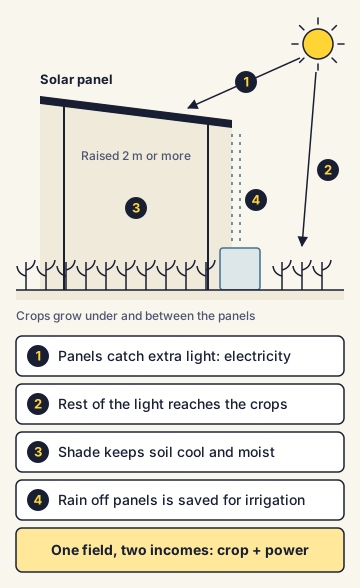
- Shade and water: The partial shade lowers soil temperature and reduces evaporation. So the soil stays moist for longer and less irrigation water is needed. This helps in hot, dry areas.
- Cooler panels: Solar panels work less well when they get very hot. The plants below release water vapour, which cools the air around the panels, so they can produce a little more power.
- Water from panels: Rain falling on panels can be collected in tanks and used to irrigate the crops.
- Crop protection: Panels can shield crops from hail, heavy rain and heat waves.
What are the main designs?
- Elevated (overhead) systems: Panels are mounted on tall stilts (often 2 metres or more) so people and small machines can work under them.
- Interspace systems: Panels are in rows at normal height, and crops grow in the wide gaps between the rows.
- Vertical bifacial systems: Panels stand upright like a fence and catch light on both faces (morning and evening sun), leaving the land between rows open for farming.
- Greenhouse-integrated systems: Panels form part of the roof of a greenhouse.
How do we know if it is a "real" agrivoltaic plant?
The key rule is that farming must remain the main use of the land. Germany's standard DIN SPEC 91434 (2021) is often used as a model. It says:
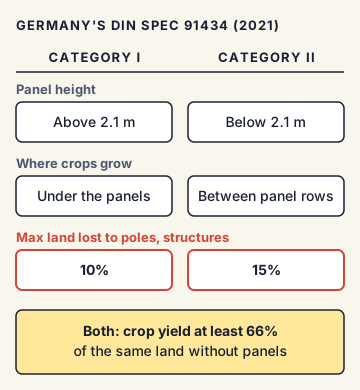
- Category I systems have panels higher than 2.1 metres; Category II systems are below 2.1 metres, with farming between rows.
- The land lost to poles and structures must not be more than 10% (Category I) or 15% (Category II) of the project area.
- Crop yield must be at least 66% of the yield on the same land without panels.
Scientists measure the benefit using the Land Equivalent Ratio (LER). It compares how much crop and power one hectare of agrivoltaics gives, against how much land you would need to grow the same crop and make the same power separately. An LER above 1 means the shared use is more efficient than separate use.
India's position and Indian examples
As of late 2025, agrivoltaics in India was still at an early stage, mostly as pilot projects run by research institutes and individual developers. Many solar plants on farmland under the PM-KUSUM scheme were built mainly for power, and farming stopped after the plant was set up. PM-KUSUM's Component A already allows solar plants on cultivable land if panels are raised on stilts so that crops can grow below.
In March 2026, the Union Minister for New and Renewable Energy said that the planned PM-KUSUM 2.0 would have a dedicated 10 GW agri-PV component. He said studies show farm income can rise from about ₹60,000 per acre per year to more than ₹1 lakh per acre when power income is added to crop income.
Germany supports India through the Indo-German Cooperation on Agrivoltaics (IGCA), which offers technical support and viability gap funding to selected projects.
Commonly confused concepts
- Agrivoltaics vs ground-mounted solar on farmland: In a normal solar farm, the land is used only for power, and farming stops. In agrivoltaics, farming continues as the main use.
- Agrivoltaics vs a solar pump: A solar pump (PM-KUSUM Component B) only uses solar power to run an irrigation pump. Agrivoltaics is about sharing the land itself between crops and panels.
- Agrivoltaics vs floating solar vs canal-top solar: Floating solar puts panels on reservoirs and lakes. Canal-top solar puts panels over irrigation canals (Gujarat built India's first canal-top project in 2012). Both save land, but neither involves growing crops under the panels.
- Agrivoltaics vs agroforestry: Agroforestry grows trees along with crops on the same land. Agrivoltaics grows crops along with solar panels.
Issues, criticism and the way forward
- High cost: Raised structures cost about 25–30% more than normal solar plants. Without support, many projects do not make financial sense.
- Crop choice: Tall crops like sugarcane, and sun-loving staple crops like rice and wheat, may lose yield under shade. More research is needed on which crops suit which climate, soil, panel height and spacing.
- Machines and labour: Tractors and harvesters may not move easily under or between panels.
- Land and tenancy: Long land leases to developers could reduce the farmer's control over their land. Tenant farmers may lose out if landowners lease land for solar.
- No clear legal definition: India does not yet have an official standard that defines an agrivoltaic plant. Without one, a normal solar farm could be passed off as agrivoltaics to get benefits.
- Way forward: Experts suggest an official definition and standard (like Germany's), financial support for the extra cost, assured power prices from states, research on suitable crops, and letting FPOs and cooperatives own projects so small farmers benefit.
Concepts to Know
- Photovoltaic (PV): A technology in which special materials, usually silicon, turn sunlight directly into electricity. A solar panel is a PV module.
- Megawatt (MW) and gigawatt (GW): Units of power capacity. 1 GW = 1,000 MW. 1 MW can roughly meet the needs of a few hundred to about a thousand homes, depending on use.
- Hectare: A unit of land area equal to 10,000 square metres, or about 2.47 acres.
- Non-fossil fuel capacity: Power plants that do not burn coal, oil or gas, such as solar, wind, hydro and nuclear.
- Light saturation point: The level of sunlight beyond which extra light does not make a plant grow faster.
- Viability gap funding (VGF): A one-time grant from the government to cover the part of a project's cost that makes it otherwise unprofitable.
- Farmer-producer organisation (FPO): A company or group formed by farmers to buy inputs, sell produce and run projects together.
- Concept proposed by Adolf Goetzberger and Armin Zastrow (Germany) in 1981–82; Japan's "solar sharing" by Akira Nagashima in 2004
- CAZRI Jodhpur: 105 kW agrivoltaic system, set up in 2017
- Normal ground-mounted solar needs about 2 hectares per MW
- Germany's DIN SPEC 91434 (2021): Category I above 2.1 m; land loss cap 10% (Category I) and 15% (Category II); crop yield at least 66% of reference
- Agrivoltaic plants cost about 25–30% more than conventional ground-mounted solar
- PM-KUSUM 2.0: planned 10 GW agri-PV component (announced March 2026)
- India's target: 500 GW non-fossil fuel power capacity by 2030
● Tracked since October 21, 2026 · last seen October 21, 2026 · updates as the daily brief publishes