Article 293
Borrowing Powers of States
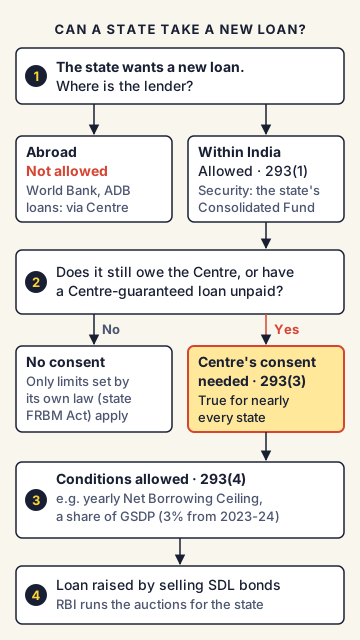
Article 293 of the Constitution decides how Indian states can borrow money. A state can borrow only within India, by pledging its own Consolidated Fund as security, and within limits set by its own legislature. But if a state still owes money to the Centre, or has a loan guaranteed by the Centre, it needs the Centre's consent before taking any new loan. In practice, this consent gives the Centre a strong say over how much every state can borrow each year.
Why does it exist?
Borrowing is like a family taking a loan. A small, careful loan to build a house is good. Too many loans to pay daily bills can trap the family in debt. States spend on most things people use daily: police, schools, hospitals, farms and roads. But many states cannot raise enough taxes for all of this.
So they borrow. If one state borrows too much and cannot repay, it can hurt the whole country's credit and financial stability. Article 293 tries to let states borrow, while keeping a national check on reckless borrowing.
Where did it come from?
The rule comes from the Government of India Act, 1935, which also allowed provinces to borrow only within India and placed controls on them. The Constitution makers kept this system in 1950. Article 292 deals with the Union's own borrowing, and Article 293 with states. Almost every state still has some part of an old loan from the Centre left to repay. So the consent rule in Article 293(3) applies to nearly all states almost all the time.
What does Article 293 say, clause by clause?
- Article 293(1): A state's executive power covers borrowing within the territory of India on the security of its Consolidated Fund, within limits (if any) fixed by its legislature by law. It can also give guarantees within such limits.
- Article 293(2): The Government of India can give loans to states, or guarantee their loans, subject to conditions set by a law of Parliament. The money for such loans is charged on the Consolidated Fund of India.
- Article 293(3): A state cannot raise any loan without the consent of the Government of India if any part of a loan given by the Centre (or its predecessor government), or guaranteed by the Centre, is still unpaid.
- Article 293(4): The Centre can give this consent subject to conditions it thinks fit.
How does it work in practice?
- States cannot borrow from abroad directly. Article 293(1) limits them to borrowing within India. Loans from bodies like the World Bank or Asian Development Bank reach states through the Centre.
- Net Borrowing Ceiling (NBC): Every year the Union Ministry of Finance fixes how much each state can borrow, as a share of its Gross State Domestic Product (GSDP). This is based on the Finance Commission's recommendations. The Centre's legal power to do this comes from Article 293(3) and (4): it gives its consent to a state's loans on the condition that the state stays within this ceiling.
- The 15th Finance Commission path: It suggested a net borrowing limit for states of 4% of GSDP in 2021-22, 3.5% in 2022-23, and 3% from 2023-24 to 2025-26. It also allowed an extra 0.5% of GSDP each year from 2021-22 to 2024-25 for states that carried out power sector reforms.
- State Development Loans (SDLs): Most state borrowing is done by selling bonds called SDLs in the market. The Reserve Bank of India (RBI) manages these auctions for the states.
- State fiscal responsibility laws: Following the 12th Finance Commission (its recommendations covered 2005-10), which linked debt relief to such laws, every state passed its own Fiscal Responsibility and Budget Management (FRBM) law with targets for deficits and debt. These are the "limits fixed by the legislature" that Article 293(1) speaks of.
Off-budget borrowing
Some states borrowed through their own companies or boards (for example, special purpose bodies for roads or power) instead of borrowing directly. Such loans did not show up in the state budget but were often repaid from the state's money. Since 2022, the Centre has counted such off-budget borrowings, when they are serviced from the state budget, within the state's borrowing limit. This became a major point of dispute.
India's position and Indian examples
- State of Kerala v. Union of India: In 2023 Kerala filed an original suit in the Supreme Court under Article 131 (disputes between the Centre and states). It argued that the Centre had gone beyond its power under Article 293 by cutting its borrowing limit and by counting off-budget loans of bodies such as the Kerala Infrastructure Investment Fund Board (KIIFB). On 1 April 2024, a two-judge bench referred the questions to a five-judge Constitution Bench, because Article 293 had never been authoritatively interpreted by the Court before. As of November 2026, the case is pending [Unverified].
- Debt levels: As of 2026, combined state debt is about 28% of GDP. Several states have debt above 35% of their GSDP.
Commonly confused concepts
- Article 292 vs Article 293: Article 292 covers borrowing by the Government of India, within limits Parliament may fix by law. Article 293 covers borrowing by states. The Centre can borrow abroad; states cannot.
- Who fixes which limit: Under Article 293(1), the limits on a state's borrowing are fixed by the state's own legislature, not by Parliament. The yearly Net Borrowing Ceiling is different: the Centre sets it as a condition of its consent under Article 293(3) and (4). A state that has fully repaid every loan from or guaranteed by the Centre would not need this consent at all.
- Article 293 vs Article 280: Article 280 sets up the Finance Commission, which recommends how tax money is shared and suggests fiscal paths. Article 293 is the actual legal power to borrow and the consent rule.
- Fiscal deficit vs net borrowing: The fiscal deficit is the gap that must be filled by borrowing. The Net Borrowing Ceiling is the cap on how much new borrowing the Centre allows a state in a year.
- Article 293 vs Article 131: Article 131 is the route to court for a dispute between states and the Centre. Kerala used Article 131 to challenge the use of Article 293.
Issues, criticism and the way forward
- Federal autonomy: States argue that the consent rule, written in 1950, now lets the Centre control their budgets too closely, especially when the Centre itself is not bound by similar limits.
- Fiscal discipline: The Centre's position is that borrowing limits protect the whole country's credit, and that off-budget loans hide the real size of state debt.
- Rising committed spending: When salaries, pensions, interest and cash transfers take most of the budget, states borrow to pay running costs. This raises debt without creating new assets.
- Way forward: Experts suggest an independent fiscal council to watch both Centre and state finances, clear rules on off-budget borrowing for both, more transparency in state budgets, and a final ruling on Article 293 by the Constitution Bench.
Concepts to Know
- Consolidated Fund of the State: The main account into which all of a state's taxes, loans and other receipts go, and from which all its spending is made. It is set up under Article 266.
- Gross State Domestic Product (GSDP): The total value of all goods and services produced in a state in a year. It is the state-level version of GDP.
- Guarantee: A promise by a government to repay a loan if the actual borrower (like a state company) fails to do so.
- Off-budget borrowing: Borrowing done by a government company or board, not by the government itself, but which the government has to repay. It keeps the debt out of the budget papers.
- Original suit (Article 131): A case that starts directly in the Supreme Court, without going through lower courts, when the dispute is between the Centre and states or between states.
- Article 293(1): states borrow only within India, on the security of their Consolidated Fund, within limits set by state law
- Article 293(2): Centre may lend to or guarantee loans of states, subject to a law of Parliament
- Article 293(3): Centre's consent needed if any part of a loan from or guaranteed by the Centre is still unpaid
- Article 293(4): consent may come with conditions (the yearly Net Borrowing Ceiling is set this way)
- Article 292: Union borrowing; Article 266: Consolidated Funds; Article 280: Finance Commission
- 15th Finance Commission: state net borrowing limit 4% (2021-22), 3.5% (2022-23), 3% (2023-24 to 2025-26); extra 0.5% of GSDP each year from 2021-22 to 2024-25 for power sector reforms
- State of Kerala v. Union of India: Article 131 suit; referred to a five-judge bench on 1 April 2024
- Combined state debt: about 28% of GDP; several states above 35% of their GSDP (as of 2026)
● Tracked since November 17, 2026 · last seen November 17, 2026 · updates as the daily brief publishes