UN Convention on the Rights of the Child (UNCRC)
The United Nations Convention on the Rights of the Child, or UNCRC, is an international treaty that lists the rights every child in the world should have. These include the right to life, a name, education, health, protection from abuse and exploitation, and the right to be heard. A country that joins it promises to make its laws and policies match these rights. It is the most widely accepted human rights treaty in history.
Why does it exist?
Children cannot vote, form unions or easily go to court. So their needs are often ignored, and they are among the first victims of war, poverty, child labour and abuse. Older human rights treaties protected "everyone", but did not deal with the special needs of a growing child. The UNCRC gives children their own clear set of rights and makes governments answerable for them.
Where did it come from?
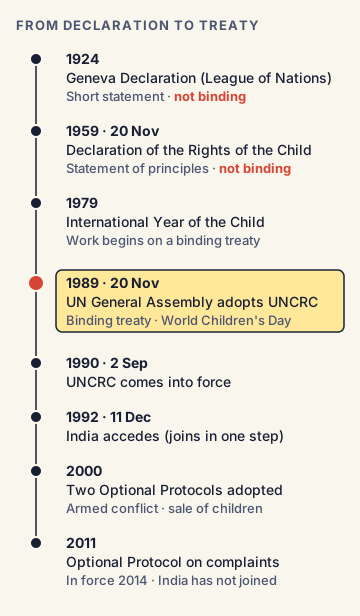
- 1924: The League of Nations adopted the Geneva Declaration of the Rights of the Child, a short, non-binding statement.
- 1959: The UN General Assembly adopted the Declaration of the Rights of the Child on 20 November. It was also non-binding.
- 1979: The UN marked the International Year of the Child, and work began on a binding treaty.
- 20 November 1989: The UN General Assembly adopted the UNCRC, on the 30th anniversary of the 1959 Declaration. This is why 20 November is celebrated as World Children's Day.
- 2 September 1990: It came into force after enough countries ratified it.
What does it contain?
The Convention has 54 articles. Article 1 defines a child as every human being below 18 years, unless the age of majority is reached earlier under national law. The UN Committee on the Rights of the Child treats four articles as general principles that guide all the others:
- Non-discrimination (Article 2): every right applies to every child, whatever their race, religion, sex, disability or family background.
- Best interests of the child (Article 3): in every decision about a child, the child's best interest must be a primary consideration.
- Right to life, survival and development (Article 6).
- Respect for the views of the child (Article 12): children have the right to express their views on matters affecting them, and these views must be given due weight.
The rights are often grouped as rights to survival (food, health), development (education, play), protection (from abuse, child labour, trafficking) and participation (expression, being heard).
The juvenile justice articles
Two articles shape laws like India's JJ Act:
- Article 37: No child shall face torture or cruel punishment. Neither the death penalty nor life imprisonment without the possibility of release shall be given for offences committed by persons below 18. Arrest or detention of a child must be a last resort and for the shortest time possible.
- Article 40: A child accused of breaking the law must be treated with dignity, in a way that supports their return to society. It asks for a minimum age of criminal responsibility, measures to deal with children without judicial proceedings where suitable (diversion), and full respect for the child's privacy at all stages.
Other international standards fill in details: the Beijing Rules (UN Standard Minimum Rules for the Administration of Juvenile Justice, 1985), the Riyadh Guidelines (prevention of juvenile delinquency, 1990) and the Havana Rules (protection of juveniles deprived of liberty, 1990).
The Optional Protocols
These are add-on treaties that countries can join separately:
- On the involvement of children in armed conflict (adopted 2000): limits recruitment and use of children under 18 in hostilities.
- On the sale of children, child prostitution and child pornography (adopted 2000).
- On a communications procedure (adopted 2011, in force 2014): lets individual children or their representatives complain directly to the UN Committee after domestic remedies are exhausted.
How is it monitored?
The Committee on the Rights of the Child, a body of 18 independent experts based in Geneva, monitors the Convention. Every member country must send a report within two years of joining and then every five years. The Committee studies the report, questions the government and issues "concluding observations" (comments and recommendations). It also issues General Comments that explain articles in detail.
For example, General Comment No. 24 (2019) on children's rights in the child justice system encourages countries to set the minimum age of criminal responsibility at at least 14 years. The Committee cannot punish a country; its power is mainly moral and diplomatic pressure.
India's position
India acceded to the UNCRC on 11 December 1992. It ratified the Optional Protocol on the sale of children on 16 August 2005 and the Optional Protocol on armed conflict on 30 November 2005. India has not joined the third Optional Protocol on a communications procedure. At the time of joining, India made a declaration on Article 32 (child labour), saying it would take measures to end child labour progressively, given its economic conditions.
India's report was most recently reviewed by the Committee in 2014 (combined third and fourth periodic report). Many Indian laws and bodies reflect the Convention:
- JJ Act, 2000 and 2015: age of 18, best interest of the child, no death penalty or life without release, privacy, diversion.
- Commissions for Protection of Child Rights Act, 2005: set up the National Commission for Protection of Child Rights (NCPCR) (set up in March 2007) and state commissions.
- Right of Children to Free and Compulsory Education Act, 2009 (with Article 21A).
- Protection of Children from Sexual Offences (POCSO) Act, 2012.
- National Policy for Children, 2013, which defines a child as a person below 18.
Commonly confused concepts
- Convention vs Declaration: The 1959 Declaration of the Rights of the Child was a statement of principles, not binding. The 1989 Convention is a binding treaty for the countries that join it.
- Signing vs ratifying vs acceding: Signing shows the intention to join. Ratifying makes it binding after signing. Acceding means joining in one step without signing first, which is how India joined the UNCRC.
- UNCRC vs UNICEF: The UNCRC is a treaty (a set of rules). UNICEF (United Nations Children's Fund, created in 1946) is a UN agency that works on the ground for children and helps countries carry out the Convention.
- Committee on the Rights of the Child vs NCPCR: The first is a UN expert body that reviews all countries. The NCPCR is India's own statutory body that monitors child rights within India.
- Who has not ratified? As of 2026, the UNCRC has 196 parties. The United States has signed (in 1995) but not ratified it, and is the only UN member that is not a party.
Issues, criticism and the way forward
- Weak enforcement: The Committee can only recommend. Many countries, including large democracies, fall short on child labour, child marriage, malnutrition and children in detention.
- Reservations: Many countries joined with reservations or declarations that limit some articles, which critics say weakens the treaty.
- Juvenile justice tensions: India's 2015 option of trying some 16-18 year olds as adults has been criticised by child rights groups as not fully in line with Articles 37 and 40. India's minimum age of criminal responsibility (7 years) is also below the level recommended by the Committee.
- Gaps on the ground in India: Despite strong laws, problems remain in child labour, child marriage, trafficking, malnutrition and the working of institutions under the JJ Act.
- New challenges: Online abuse, data privacy and the digital world were not foreseen in 1989. The Committee's General Comment No. 25 (2021) applies the Convention to the digital environment.
- Way forward: Experts suggest better data on children, adequate funding of child protection bodies, joining the communications protocol, and making the "best interests of the child" a working test in every decision.
Concepts to Know
- Treaty / Convention: A written agreement between countries that is legally binding on those who join it.
- Optional Protocol: An extra treaty attached to a main treaty, which countries can choose to join or not.
- Accession: Joining a treaty directly, in one step, without signing it first.
- Concluding observations: The comments and recommendations a UN treaty committee issues after studying a country's report.
- Minimum age of criminal responsibility: The age below which a child cannot be held to have committed a crime at all, no matter what they did.
- Adopted by the UN General Assembly: 20 November 1989; in force: 2 September 1990
- 54 articles; child = below 18 (Article 1)
- Four general principles: Articles 2, 3, 6 and 12
- Article 37: no death penalty or life imprisonment without release for under-18s; detention as last resort
- Article 40: child justice, dignity, diversion, privacy, minimum age of criminal responsibility
- Committee on the Rights of the Child: 18 independent experts; reports every 5 years
- Optional Protocols: armed conflict (2000), sale of children (2000), communications procedure (2011, in force 2014)
- India: acceded 11 December 1992; ratified OPSC (16 August 2005) and OPAC (30 November 2005); declaration on Article 32
- 196 parties; US signed (1995) but not ratified
- 20 November: World Children's Day
● Tracked since October 10, 2026 · last seen October 10, 2026 · updates as the daily brief publishes