Juvenile Justice (Care and Protection of Children) Act, 2015
The Juvenile Justice (Care and Protection of Children) Act, 2015, usually called the JJ Act, is India's main law for children below 18 years of age who either need protection or are accused of breaking the law. Its core idea is simple: a child is still growing, so the law should try to correct, care for and bring the child back into society, not just punish.
The Act sets up special bodies, such as Juvenile Justice Boards and Child Welfare Committees, so that children do not go through the normal adult criminal courts and jails.
Why does such a law exist?
Children think and act differently from adults. Their brains are still developing, they are easily influenced by others, and many who commit offences come from poverty, abuse, broken families or the streets. Putting a 14-year-old in a jail with hardened adult criminals usually makes them a hardened criminal too. A separate system gives the child a real chance to change.
The Constitution also asks for this: Article 15(3) lets the State make special provisions for children, and Article 39(e) and (f) (Directive Principles) ask the State to make sure children are not abused and that childhood is protected from exploitation and neglect.
Where did it come from?
India's child justice laws grew in stages:
- Apprentices Act, 1850 and Reformatory Schools Act, 1897: early colonial laws that sent young offenders to training or reform schools instead of jails.
- Children Act, 1960: for Union Territories, with states having their own Children Acts.
- Juvenile Justice Act, 1986: the first single national law. It treated boys below 16 and girls below 18 as juveniles.
- JJ (Care and Protection of Children) Act, 2000: made the age 18 for both boys and girls, in line with the UN Convention on the Rights of the Child, which India joined in 1992.
- JJ Act, 2015: replaced the 2000 Act. It was passed by Parliament in December 2015, got Presidential assent on 31 December 2015 and came into force on 15 January 2016.
The big trigger for the 2015 Act was the December 2012 Delhi gang-rape case. One of the accused was 17 years old. Under the 2000 Act, the maximum he could get was three years in a special home. This led to a public demand to try older teenagers as adults for very serious crimes. The Supreme Court refused to lower the age itself: in Salil Bali v. Union of India (2013) it upheld 18 as the age limit, and in Dr. Subramanian Swamy v. Raju (2014) it said that once Parliament has chosen 18 as the dividing line, courts should not change it.
The Justice J.S. Verma Committee (2013) also did not recommend lowering the age. Parliament then chose a middle path in the 2015 Act (explained below).
Who is a "child" under the Act?
Every person below 18 years is a child (Section 2(12)). The Act deals with two groups:
- Child in conflict with law (Section 2(13)): a child who is alleged or found to have committed an offence, and who was below 18 on the date of the offence. What matters is the age on the day of the offence, not the age at trial.
- Child in need of care and protection (Section 2(14)): a child who is homeless, orphaned, abandoned, abused, working as child labour, begging, at risk of child marriage, and so on.
The older 2000 Act called the first group "juveniles" and the second group "children". The 2015 Act calls both of them "children", to stress that a child who breaks the law is still a child.
Three types of offences
The Act sorts offences by how serious they are under the criminal law:
- Petty offences: maximum punishment up to 3 years in prison.
- Serious offences: punishment of 3 to 7 years in prison. After the 2021 amendment, this also includes offences with a maximum punishment of more than 7 years but no minimum punishment, or a minimum of less than 7 years.
- Heinous offences: offences with a minimum punishment of 7 years or more, such as rape or murder.
The 2021 change came from Shilpa Mittal v. State of NCT of Delhi (2020). The Supreme Court noticed that the 2015 Act had left out offences with a maximum above 7 years but no minimum (like culpable homicide under the old IPC Section 304). It held that such offences cannot be called "heinous", and should be treated as "serious" until Parliament acted. Parliament did so through the 2021 amendment.
The key bodies and who is in them
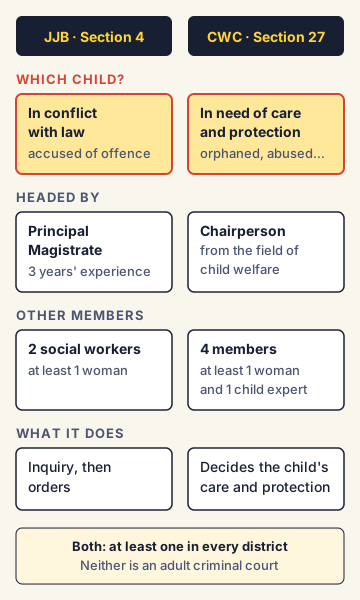
- Juvenile Justice Board (JJB), Section 4: at least one in every district. It handles children in conflict with law. It has a Principal Magistrate (a Metropolitan Magistrate or Judicial Magistrate First Class with at least 3 years' experience) and two social workers, at least one of whom must be a woman. The Board is meant to be child-friendly, not a "mini criminal court".
- Child Welfare Committee (CWC), Section 27: at least one in every district, for children in need of care and protection. It has a Chairperson and four other members, appointed by the state government; at least one must be a woman and one an expert on children's matters.
- Special Juvenile Police Unit and a Child Welfare Police Officer in every police station, to handle children in a child-friendly way.
- Central Adoption Resource Authority (CARA), Section 68: a statutory body for in-country and inter-country adoption.
- Child Care Institutions: observation homes (for children during an inquiry), special homes (for children found to have committed an offence), children's homes, open shelters and places of safety. Every institution must be registered (Section 41).
- National and State Commissions for Protection of Child Rights (NCPCR and SCPCRs) monitor how the Act is put into practice (Section 109).
How does the process work for a child in conflict with law?
- Apprehension: The police bring the child before the JJB within 24 hours (not counting travel time). A child is never put in a police lock-up or jail.
- Bail (Section 12): Bail is the rule. It can be refused only if release would likely bring the child into contact with a known criminal, expose the child to moral, physical or mental danger, or defeat the ends of justice. How serious the offence is does not by itself decide bail.
- Inquiry (Section 14): The Board must finish the inquiry within 4 months from the child's first production, extendable by up to 2 more months. If an inquiry into a petty offence is still not finished after that, the case is closed.
- Orders (Section 18): If the Board finds the child committed the offence, it can choose from advice or admonition, group counselling, community service, a fine, release on probation under supervision, or sending the child to a special home for up to 3 years.
- Social Investigation Report: A probation officer or social worker studies the child's family, school and background, so the Board can choose the right order.
The 16-18 heinous offence route (Section 15)
This is the most debated part of the Act. If a child aged 16 to 18 is accused of a heinous offence, the Board does a preliminary assessment within 3 months. It checks the child's mental and physical capacity to commit the offence, their ability to understand its consequences, and the circumstances. The Board may take help from psychologists. This is not a trial; it only decides who will try the child.
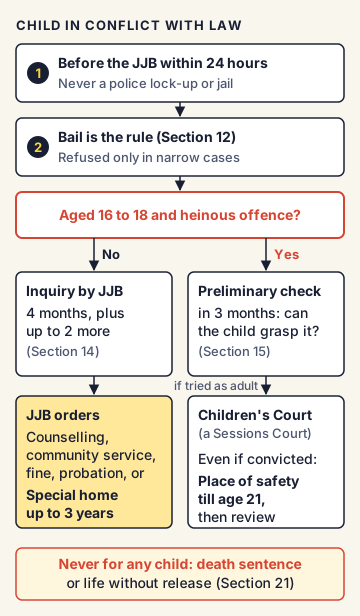
- If the Board decides the child should be tried as an adult, it transfers the case to the Children's Court (a Sessions Court notified under the Act, Section 18(3)).
- The Children's Court decides whether trial as an adult is really needed. Even if convicted, the child stays in a place of safety until age 21, then is reviewed (Sections 19 and 20).
- Section 21: No child in conflict with law can be given the death sentence or life imprisonment without the possibility of release.
Other protective rules
- Section 3 lists 16 general principles, including the presumption of innocence, the best interest of the child, family responsibility, non-stigmatising language, privacy, and a "fresh start".
- Section 24: A child dealt with under the Act suffers no disqualification (for example, for a government job) because of the finding, and the records are to be destroyed after the set period, except for a 16-18 child convicted as an adult in a Children's Court.
- Section 74: No newspaper, TV, social media or other publication may disclose the name, address, school, photo or any detail that can identify a child in conflict with law or in need of care and protection. Breaking this rule can bring up to 6 months in prison, a fine of up to ₹2 lakh, or both.
- Section 94 (age determination): If there is doubt about age, the Board first looks at the school birth certificate or matriculation certificate, then a birth certificate from a corporation, municipality or panchayat. Only if neither exists is a medical ossification test (bone X-ray) used, and it must be done within 15 days.
The 2021 amendment
The Juvenile Justice (Care and Protection of Children) Amendment Act, 2021 came into force on 1 September 2022. It:
- gave the power to issue adoption orders to the District Magistrate (including the Additional District Magistrate) instead of civil courts, to cut delays, with appeals to the Divisional Commissioner;
- redefined serious offences as explained above;
- made all offences against children under the Act triable by the Children's Court;
- added disqualifications for CWC members, such as a record of human rights or child rights violations.
Commonly confused concepts
- Juvenile Justice Board vs Child Welfare Committee: The JJB deals with children who are accused of offences. The CWC deals with children who need care and protection. A JJB is headed by a magistrate; a CWC is headed by a chairperson from the field of child welfare.
- Observation home vs special home vs place of safety: An observation home keeps a child during the inquiry. A special home is where a child found to have committed an offence is placed (up to 3 years). A place of safety is for a 16-18 child accused or convicted of a heinous offence and tried as an adult.
- Juvenile Justice Board vs Children's Court: The JJB conducts inquiries for most children. The Children's Court (a Sessions Court) tries only those 16-18 children whom the JJB has sent for trial as adults, and also tries offences against children under the Act.
- JJ Act vs POCSO Act, 2012: The JJ Act deals with children who commit offences or need care. The POCSO Act deals with sexual offences committed against children.
- Age of criminal responsibility vs age of juvenility: Under Section 20 of the Bharatiya Nyaya Sanhita, 2023 (earlier IPC Section 82), nothing done by a child below 7 is an offence at all. A child between 7 and 12 is protected if they did not have enough maturity to understand the act. Age 18 is the separate line for being dealt with under the JJ Act instead of the adult system.
- Heinous vs serious offence: "Heinous" depends on the minimum punishment (7 years or more). An offence with a high maximum but no minimum is "serious", not "heinous".
Issues, criticism and the way forward
- Trying 16-18 year olds as adults: Supporters say it deters older teenagers from grave crimes and gives justice to victims. Critics, including the Parliamentary Standing Committee on Human Resource Development (2015), argued it goes against the idea of reform, Article 14 (because it treats children of the same age differently) and the UN Convention on the Rights of the Child. Child rights experts also point out that children tried as adults often lack good legal help.
- Pendency: As data from the India Justice Report showed, more than half of the cases before Boards were pending in 2023. Long delays keep children in uncertainty and in institutions longer than needed.
- Bodies only on paper: A 2019 review by the National Legal Services Authority (NALSA) found that only 17 of 35 states and Union Territories had all the basic bodies required by the Act. Many Boards lack full members, and probation officer posts lie vacant, so Social Investigation Reports are delayed.
- Poor conditions in institutions: A 2018 review committee on Child Care Institutions found many failed to give basic care such as proper bedding and nutrition, and many were not registered despite the legal requirement.
- Weak rehabilitation and aftercare: Help often stops when a child leaves an institution, so many fall back into crime.
- Privacy breaches: Names and photos of children still appear in media reports and online, against Section 74.
- Adoption orders by the District Magistrate: Some experts question whether an administrative officer, rather than a court, should decide a permanent legal relationship like adoption.
- Way forward: Experts and the Supreme Court's Juvenile Justice Committee have suggested filling posts and training staff, measuring success by lives rebuilt (return to school, work, no re-offending), legal aid from the first hour (NALSA's child-friendly legal services scheme of 2024 provides for this), diversion and community service in place of institutions, strong aftercare, and regular independent audits.
Concepts to Know
- Restorative justice: An approach that focuses on repairing harm, making the offender take responsibility, and bringing them back into society, instead of only punishing them.
- Diversion: Dealing with a child's offence outside formal court processes, for example through counselling or community service, so the child is not labelled a criminal.
- Probation officer: An officer who studies a child's background, prepares reports for the Board and supervises the child after release.
- Ossification test: A medical X-ray of bones to estimate a person's age from how far the bones have joined and hardened. It gives only an approximate age range.
- Parens patriae: A legal idea that the State acts as the guardian of those who cannot protect themselves, such as children. It is a basis for child protection laws.
- Directive Principles of State Policy (DPSP): Guidelines in Part IV of the Constitution that the State should follow while making laws. Courts cannot directly enforce them.
- Act No. 2 of 2016; Presidential assent 31 December 2015; in force from 15 January 2016; replaced the JJ Act, 2000
- Child = below 18 years (Section 2(12)); child in conflict with law (Section 2(13)); child in need of care and protection (Section 2(14))
- Petty: up to 3 years; serious: 3-7 years (plus, since 2021, max above 7 with no minimum or minimum below 7); heinous: minimum 7 years or more
- JJB (Section 4): Principal Magistrate with 3 years' experience + 2 social workers (at least 1 woman)
- CWC (Section 27): Chairperson + 4 members (at least 1 woman, 1 child expert)
- Inquiry: 4 months + up to 2 months; preliminary assessment for 16-18 heinous: 3 months (Section 15)
- Maximum stay in special home: 3 years; no death penalty or life without release (Section 21)
- Identity disclosure (Section 74): up to 6 months' prison, fine up to ₹2 lakh, or both
- CARA: statutory body under Section 68
- Amendment Act 2021 (Act 23 of 2021): in force 1 September 2022; DM issues adoption orders
- Cases: Salil Bali (2013), Subramanian Swamy v. Raju (2014), Shilpa Mittal (2020)
- Constitutional basis: Articles 15(3), 39(e), 39(f)
● Tracked since March 06, 2026 · last seen October 10, 2026 · updates as the daily brief publishes