UGC (Promotion of Equity in Higher Education Institutions) Regulations, 2026
These are rules made by the University Grants Commission (UGC) to make sure that no student or staff member in a college or university is treated unfairly because of caste, religion, gender, disability or similar reasons. They require every higher education institution to set up a full system to prevent discrimination, receive complaints and act on them within fixed time limits.
They were notified on January 13, 2026, and replaced the older 2012 regulations. In January 2026 the Supreme Court put them on hold, so the 2012 rules still apply for now.
Why were these rules made?
India's Constitution promises equality to every citizen. But many students from Scheduled Castes (SC), Scheduled Tribes (ST) and other weaker groups report insults, social exclusion, unfair grading and harassment on campus. A few such cases ended in student suicides, which shocked the country. The older rules of 2012 were mostly advisory: they asked colleges to act but had weak follow-up. The 2026 rules tried to turn these advice-type rules into compulsory duties with deadlines and penalties.
Where did they come from?
The story builds up in steps:
- 2012: The UGC issued the UGC (Promotion of Equity in Higher Educational Institutions) Regulations, 2012. They asked every institution to appoint an Anti-Discrimination Officer, set up an Equal Opportunity Cell, and decide a discrimination complaint within 60 days. In practice, many institutions did not follow them seriously.
- January 2016: Rohith Vemula, a PhD scholar at the University of Hyderabad, died by suicide. His death started a national debate on caste discrimination in higher education.
- May 2019: Dr Payal Tadvi, a postgraduate medical student in Mumbai from the Tadvi Bhil Scheduled Tribe community, died by suicide after alleged caste-based harassment by seniors.
- 2019, the petition: Their mothers, Radhika Vemula and Abeda Salim Tadvi, filed a public interest petition in the Supreme Court: Abeda Salim Tadvi v. Union of India (Writ Petition (Civil) No. 1149 of 2019). They asked for a strong system to end caste discrimination on campuses. The Court issued notice in September 2019.
- 2023 to 2025: The Court asked the UGC what steps it had taken and asked for data on complaints under the 2012 rules. In early 2025 it said it wanted a "very strong and robust mechanism", and the UGC released a draft of new regulations.
- January 13, 2026: The UGC notified the final 2026 Regulations.
- January 29, 2026: The Supreme Court stayed them after petitions said they were one-sided and vague.
What is the legal basis?
The UGC is a statutory body (a body created by a law of Parliament) under the UGC Act, 1956. Section 26 of this Act lets the UGC make regulations, for example on standards in universities. Regulations made under an Act are a form of delegated legislation: Parliament makes the main law, and an expert body fills in the details. Such regulations bind institutions, but courts can strike them down if they break the Constitution or go beyond the parent Act.
How was the system meant to work?
The 2026 rules set up a layered system inside every institution:
- Duty of the institution: Every higher education institution must keep a fair and inclusive campus free of discrimination. The Head of the Institution (Vice-Chancellor, Director or Principal) is mainly responsible.
- Equal Opportunity Centre (EOC): Every institution must set one up. It runs equity programmes, guides students from weaker groups in studies, money matters and emotional well-being, and keeps an online portal to report discrimination. Small colleges with too few staff can use their university's EOC.
- Equity Committee: This committee hears complaints and supports the EOC. It must include members from SC, ST, Other Backward Classes (OBC), persons with disabilities and women, along with faculty, staff, students and civil society experts.
- Equity Squads: Mobile teams that keep watch over places on campus where discrimination is more likely, such as hostels.
- Equity Ambassadors: One contact person in each department, hostel and facility.
- 24x7 Equity Helpline: A helpline open at all hours, with the caller's identity kept confidential.
- Undertaking: Students and staff must sign a promise to support equity when they join.
The complaint timeline, step by step
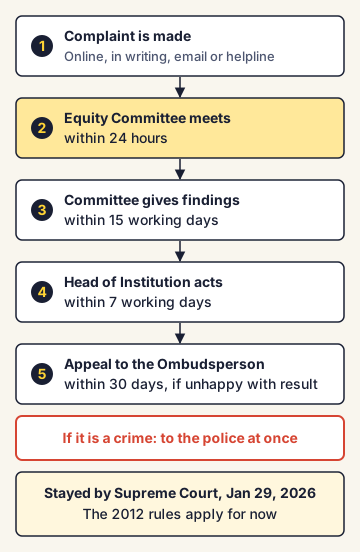
- A complaint can be made online, in writing, by email or through the helpline.
- The Equity Committee must meet within 24 hours of the report.
- It must give its findings within 15 working days.
- The Head of the Institution must act on them within 7 working days.
- A person unhappy with the result can appeal to the Ombudsperson within 30 days. (An ombudsperson is an independent official who hears complaints against an institution.)
- If the matter is a crime, it must be sent to the police at once.
What penalties did the rules set for institutions?
A National-level Monitoring Committee of the UGC would review how the rules are followed. An institution that does not comply could face:
- being barred from UGC schemes;
- losing the power to award degrees;
- being stopped from running distance or online programmes;
- removal from the UGC's lists under Section 2(f) and Section 12B of the UGC Act. (Being on these lists makes an institution recognised and eligible for central grants, so removal is a serious financial blow.)
What was different from the draft and from 2012?
- OBCs included: The 2026 rules clearly named OBCs, along with SCs and STs, in the meaning of caste-based discrimination. The 2012 rules did not name OBCs clearly in this way.
- False-complaint clause dropped: An earlier draft allowed action, such as fines or disciplinary steps, against people who knowingly filed false complaints. The final rules removed it. The stated reason was that such a clause could scare genuine victims from complaining.
- From advice to duty: The 2012 rules were largely advisory. The 2026 rules fixed timelines and penalties.
Why did the Supreme Court stay them?
Petitioners raised two main objections:
- One-sided definition: The rules define "caste-based discrimination" as discrimination against members of SC, ST and OBC communities only. Petitioners argued that a general-category student facing caste-based abuse would get no protection, which they said breaks Article 14 (equality before law) and Article 15 (no discrimination on grounds of caste, religion and so on).
- Risk of misuse: With the false-complaint clause gone, critics feared that the rules could be used to target people unfairly.
A bench led by Chief Justice Surya Kant and Justice Joymalya Bagchi found the rules, at first sight ("prima facie"), "vague" and "capable of misuse", and warned that they could divide society. It kept the 2012 rules in force in the meantime and suggested that a committee of distinguished jurists re-examine the wording.
India's position and wider context
The Constitution gives several protections linked to this issue:
- Article 14: equality before law and equal protection of laws.
- Article 15(1): the State cannot discriminate on grounds of religion, race, caste, sex or place of birth.
- Article 15(4) and 15(5): the State can make special provisions, including reservation in admissions, for SCs, STs and socially and educationally backward classes.
- Article 17: abolishes untouchability.
- Article 46: a Directive Principle asking the State to promote the educational and economic interests of weaker sections, especially SCs and STs. The SC and ST (Prevention of Atrocities) Act, 1989 is a criminal law that punishes caste-based atrocities against SCs and STs. The UGC regulations are different: they are campus rules for preventing and handling discrimination, not a criminal law. The National Education Policy (NEP) 2020 also calls for equity and inclusion of "socio-economically disadvantaged groups" in higher education.
Commonly confused concepts
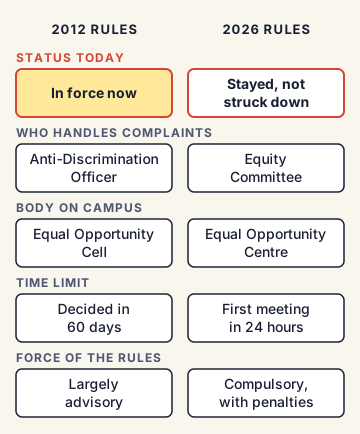
- 2012 vs 2026 regulations: 2012 had an Anti-Discrimination Officer, an Equal Opportunity Cell and a 60-day limit, and was largely advisory. 2026 has an Equal Opportunity Centre, an Equity Committee, Equity Squads, a 24x7 helpline, a 24-hour first meeting and penalties.
- UGC regulations vs the Atrocities Act: The regulations are administrative rules for institutions, made by the UGC. The Atrocities Act is a criminal law made by Parliament, enforced by police and special courts.
- Stay vs striking down: A stay pauses a rule while the court hears the case. Striking down means the court finally declares it invalid. The 2026 rules are stayed, not struck down.
- Regulations vs guidelines: Regulations made under an Act are binding. Guidelines are advice and are generally not binding.
- Equity vs equality: Equality means treating everyone the same. Equity means giving each person what they need for a fair chance, which may mean extra support for those starting behind.
Issues, criticism and the way forward
- Need for strong protection: Supporters point to the deaths of students like Rohith Vemula and Payal Tadvi and to weak follow-up under the 2012 rules. They argue that firm deadlines and penalties are needed, and that a false-complaint clause would silence genuine victims.
- Fairness and clarity: Critics argue that a definition covering only SC, ST and OBC students leaves others without protection, and that vague wording can lead to misuse.
- Capacity of institutions: Many colleges lack trained staff to run committees, squads and helplines, especially small and rural colleges.
- Balance of rights: Any new version must protect vulnerable students and also give every accused person a fair hearing (the principles of natural justice).
- Way forward: Suggestions include a caste-neutral protection clause that still names historically targeted groups, clear definitions of what counts as discrimination, safeguards against misuse without scaring genuine complainants, training of staff, and public data on complaints. A committee of academics and jurists, as proposed by the Court and the Centre, is expected to look at these points.
Concepts to Know
- Notified: When a rule is officially published in the Gazette of India, it comes into force from that date or a date stated in it.
- Delegated legislation: Rules, regulations and bye-laws made by an authority that Parliament has empowered through a law.
- Prima facie: A Latin phrase meaning "at first look", before a full hearing.
- Public interest litigation (PIL): A case filed in court to protect the rights of the public or a group, not just the person filing it.
- Ombudsperson: An independent official who hears complaints from people against an institution.
- Natural justice: Basic fairness rules: nobody should be a judge in their own case, and every person must be heard before being punished.
- Notified: January 13, 2026, under the UGC Act, 1956; replaced the 2012 Regulations
- Stayed by the Supreme Court: January 29, 2026; 2012 Regulations continue meanwhile
- Case: Abeda Salim Tadvi v. Union of India, W.P. (C) No. 1149 of 2019
- Bodies: Equal Opportunity Centre, Equity Committee, Equity Squads, Equity Ambassadors, 24x7 Equity Helpline
- Timeline: committee meets within 24 hours; findings in 15 working days; Head acts in 7 working days; appeal to Ombudsperson within 30 days
- Penalties: debarment from UGC schemes, loss of degree-granting power, removal from Section 2(f) and 12B lists
- 2012 rules: Anti-Discrimination Officer, Equal Opportunity Cell, 60-day limit
● Tracked since November 05, 2026 · last seen November 05, 2026 · updates as the daily brief publishes