Twin Conditions for Bail
How Special Laws Make Bail Harder (UAPA, PMLA, NDPS)
Updated 6 Nov 2026: Added 2026 rulings: the 24-hour clock starts at detention, an Article 22(2) breach overrides bail limits, and UAPA bail went to a larger bench.
Normally in India, a person accused of a crime can get bail (release from jail while the trial goes on) unless there is a strong reason to keep them inside. But some special laws, made for serious crimes like terrorism, money laundering and drug trafficking, put extra hurdles before bail. These hurdles are popularly called the "twin conditions" (or "twin test").
In simple words, the judge must first be convinced that the accused is probably not guilty, and that they will not commit a crime while on bail. This flips the usual rule, so bail under these laws becomes the exception rather than the rule.
What is the normal rule on bail?
Indian law starts from the idea that a person is innocent until proven guilty. Courts have long said "bail is the rule, jail is the exception", a principle linked to State of Rajasthan v. Balchand (decided in the late 1970s). An accused who is kept in jail cannot meet a lawyer freely, may lose a job, and may spend years inside before being found innocent.
So for most offences, a judge looks at simple questions: Will the accused run away? Will they threaten witnesses or destroy evidence? How serious is the charge? Under the new criminal law, the Bharatiya Nagarik Suraksha Sanhita (BNSS), 2023, the main bail powers are in Sections 478 to 483 (for example, Section 480 for non-bailable offences and Section 483 for bail by the High Court or Sessions Court).
In Satender Kumar Antil v. CBI (July 2022), the Supreme Court repeated that bail is the norm and gave guidelines to make bail easier in ordinary cases.
Why do special laws make bail harder?
Parliament felt that some crimes are so dangerous, or the accused so powerful, that ordinary bail rules are not enough. A terror suspect released on bail may run away or plan another attack. A rich money launderer may move money abroad or influence witnesses. A big drug trafficker may restart the trade. So for these crimes, the law shifts the weight: instead of the State proving why the person should stay in jail, the accused must show something close to innocence at the very start.
Where did the idea come from?
The idea first appeared in anti-terror laws. The Terrorist and Disruptive Activities (Prevention) Act (TADA), 1987, had a strict bail clause; its validity was upheld in Kartar Singh v. State of Punjab (1994). Similar clauses then entered the drugs law (NDPS), the money laundering law (PMLA) and, later, the anti-terror law (UAPA). Over time, some State laws against organised crime (like Maharashtra's MCOCA) also copied the model.
The three main laws, side by side
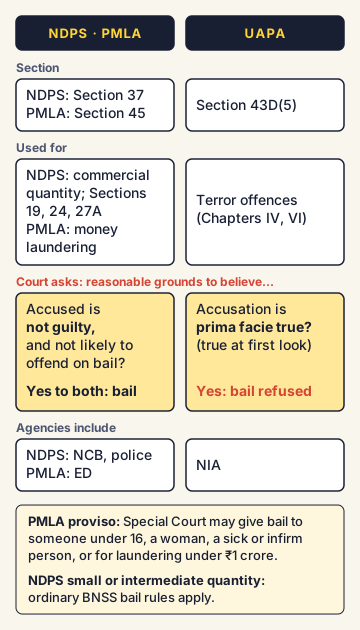
- NDPS Act, 1985, Section 37: For offences involving a commercial quantity of drugs (and offences under Sections 19, 24 and 27A), bail is allowed only if (a) the Public Prosecutor gets a chance to oppose it, and (b) where the prosecutor opposes, the court is satisfied that there are reasonable grounds to believe the accused is not guilty and is not likely to commit any offence while on bail. For small and intermediate quantities, ordinary BNSS bail rules apply.
- PMLA, 2002, Section 45: The same twin conditions apply for money-laundering offences. There is a proviso (an exception clause): a person under 16 years, a woman, a person who is sick or infirm, or a person accused of laundering less than ₹1 crore (alone or with co-accused) may be given bail if the Special Court so directs.
- UAPA, 1967, Section 43D(5): For terror offences (Chapters IV and VI of the Act), bail must be refused if the court, after reading the case diary or the police report, feels there are reasonable grounds to believe the accusation is "prima facie true" (true at first look). Strictly, this is one condition, but it works in the same way and is often grouped with the twin conditions.
How does it work in court? A simple example
Imagine two people are arrested. One is accused of ordinary cheating. The judge asks: "Is there a good reason to keep him in jail?" If not, bail is given. The other is accused under the PMLA. Now the judge must ask: "Am I satisfied that he is probably not guilty?" This has to be decided at the start, before any trial, mostly on the papers of the agency.
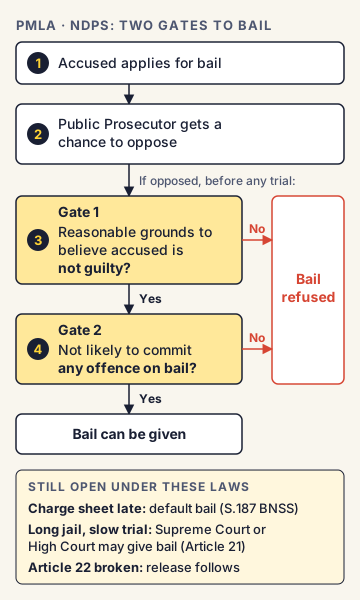
Since the agency's papers usually point towards guilt, getting bail becomes very hard. This is why people under these laws often spend years in jail as undertrials (people whose trial is not yet over).
What have the courts said?
- Nikesh Tarachand Shah v. Union of India (2017): struck down the old PMLA Section 45(1) as violating Articles 14 and 21, mainly because it linked the twin conditions to unrelated "scheduled offences" with a punishment of more than 3 years.
- 2018 amendment: Parliament amended Section 45 (and added the ₹1 crore exception) to cure the defect.
- Vijay Madanlal Choudhary v. Union of India (July 2022): a three-judge bench upheld the amended twin conditions under the PMLA. A review of this judgment was later admitted.
- NIA v. Zahoor Ahmad Shah Watali (2019): at the bail stage under UAPA, courts should look at the case broadly and not weigh evidence in detail; this made bail very hard.
- Union of India v. K.A. Najeeb (2021): even under UAPA, constitutional courts (the Supreme Court and High Courts) can give bail if a person has been in jail for very long and the trial will not end soon, because Article 21 (right to life and personal liberty) comes first.
- Vernon Gonsalves v. State of Maharashtra (2023): said the court must look at the quality of evidence, not just accept the agency's version.
- Gurwinder Singh v. State of Punjab (2024): said that under UAPA, "jail is the rule and bail is the exception".
- Prem Prakash v. Union of India (August 2024): held that "bail is the rule" applies even under the PMLA; Section 45 restricts bail but is not an absolute bar.
- Gulfisha Fatima v. State (NCT of Delhi) (January 2026): a two-judge bench refused bail to Umar Khalid and Sharjeel Imam under UAPA in the Delhi riots conspiracy case. It said delay must be weighed with the facts of each case. Time in jail alone does not automatically win bail.
- State of Punjab v. Sukhwinder Singh @ Gora (2026): held that recording satisfaction on the NDPS Section 37 conditions is mandatory, and long jail time alone does not automatically dilute them. It also said the Article 21 right to a speedy trial must be read along with Section 37, not in place of it.
- Syed Iftikhar Andrabi v. NIA (May 2026): another two-judge bench gave bail to a UAPA accused held for over six years. It said "bail is the rule and jail is the exception" applies under UAPA too. It held that K.A. Najeeb binds smaller benches, and it disagreed with Gurwinder Singh and Gulfisha Fatima.
- Tasleem Ahmed v. State (NCT of Delhi) (May 2026): after this disagreement, the Court asked the Chief Justice of India to set up a larger bench (a bench with more judges). Its job is to make clear how K.A. Najeeb works with Section 43D(5).
- Sujit Das v. Union of India (November 2026), the clock: Article 22(2) says an arrested person must reach a magistrate within 24 hours, not counting travel time. The Court held that this clock starts when the person's liberty is actually taken away, not when the police record a formal arrest.
- Sujit Das, the effect on bail: if the 24-hour limit is missed, the person must be released. Section 37 "or similar such provisions under the special statutes" must give way. The Court gave bail in this commercial quantity case, and said a statute, special or otherwise, cannot guide how we read the Constitution.
- Sujit Das, the doubt on Sukhwinder Singh @ Gora: the bench said that judgment's view on speedy trial "may be hit by the principle of per incuriam", because K.A. Najeeb came from three judges. A smaller bench must follow a larger one. It did not overrule that judgment, because both benches had two judges.
India's position and practice
The government's position is that these laws deal with crimes that threaten national security and the economy, so stricter bail is needed and Parliament has the power to make it. Courts have mostly upheld the laws but have created safety valves: long delay in trial (K.A. Najeeb), violation of arrest safeguards under Article 22, and the provisos written into the laws themselves.
Agencies that use these laws include the National Investigation Agency (NIA) for UAPA, the Enforcement Directorate (ED) for PMLA, and the Narcotics Control Bureau (NCB) and State police for NDPS.
Commonly confused concepts
- Twin conditions vs default bail: Default bail (Section 187 BNSS, earlier Section 167(2) CrPC) is an automatic right to bail if the agency does not file its charge sheet in time (60 or 90 days normally; 180 days under NDPS and UAPA, extendable in some cases). It is available even under special laws. Twin conditions apply to regular bail on merits.
- Regular bail vs anticipatory bail: Regular bail is sought after arrest; anticipatory bail (Section 482 BNSS) is sought before arrest, fearing arrest. In Vijay Madanlal Choudhary, the Court held that the PMLA twin conditions apply to anticipatory bail too.
- Bail restrictions vs Article 22 safeguards: Twin conditions decide whether a person should be released on bail. Article 22(2) decides whether the detention itself is lawful. If Article 22 is broken, release follows regardless of the bail test. Sujit Das (November 2026) applied this in an NDPS case: the 24-hour limit was missed, so Section 37 could not keep the accused in jail.
- UAPA "prima facie true" vs PMLA/NDPS "not guilty": Under UAPA the court asks whether the charge looks true at first sight; under PMLA and NDPS it asks whether there are reasonable grounds to believe the accused is not guilty.
Issues, criticism and the way forward
- Presumption of innocence turned around: Critics say asking a judge to find the accused "probably not guilty" before the trial goes against the basic idea that a person is innocent until proven guilty.
- Very low conviction rates: Official data has shown that only a small share of PMLA and UAPA cases end in conviction, while accused persons spend years in jail. Critics say the process itself becomes the punishment.
- Slow trials: Special courts are overloaded, so long pre-trial custody becomes common.
- The government's view: Strict bail stops dangerous accused from fleeing, tampering with evidence or repeating crimes, and these offences often have cross-border links.
- Way forward suggested by courts and experts: fast-track special courts, time limits for trial, regular review of long undertrial cases, strict use of arrest safeguards, and applying the K.A. Najeeb principle so that Article 21 is not defeated by delay.
Concepts to Know
- Bail: Temporary release of an accused person from custody while the case goes on, usually with conditions such as a bond or reporting to the police.
- Undertrial: A person held in jail whose trial has not yet finished. They have not been found guilty.
- Public Prosecutor: The government's lawyer who argues the case against the accused in court.
- Prima facie: A Latin phrase meaning "at first look". A prima facie case is one that seems true before a full trial checks it.
- Proviso: An extra clause in a law that creates an exception to the main rule.
- Commercial quantity: Under the NDPS Act, a large amount of a drug, fixed by government notification, that shows it is meant for trade, not personal use.
- Constitutional courts: The Supreme Court (Article 32) and High Courts (Article 226), which can protect fundamental rights directly.
- Magistrate: A judge in the lower criminal courts. The police must bring an arrested person before a magistrate, who decides if the person can be held any longer. Under Sujit Das, the magistrate must record the actual date and time of detention and check the 24-hour limit.
- Per incuriam: A Latin phrase meaning "through lack of care". Courts use it for a judgment that missed a binding earlier ruling or law, so that judgment need not be followed.
- NDPS Act, 1985: Section 37 (twin conditions for commercial quantity and Sections 19, 24, 27A offences)
- PMLA, 2002: Section 45 (twin conditions); proviso for under-16, women, sick or infirm, and laundering under ₹1 crore
- UAPA, 1967: Section 43D(5) ("prima facie true" bar for Chapter IV and VI offences)
- Nikesh Tarachand Shah (2017): old PMLA Section 45(1) struck down; restored by the 2018 amendment
- Vijay Madanlal Choudhary (2022): amended PMLA twin conditions upheld
- Watali (2019) strict UAPA test; K.A. Najeeb (2021) long incarceration allows bail under Article 21
- Prem Prakash (2024): "bail is the rule" applies under PMLA too
- Andrabi (May 2026): K.A. Najeeb binds smaller benches; "bail is the rule" applies under UAPA too
- Tasleem Ahmed (May 2026): larger bench asked to clarify K.A. Najeeb and Section 43D(5)
- Sujit Das (November 2026): the Article 22(2) 24-hour clock starts at detention; if it is broken, Section 37 and similar bail limits give way
- Satender Kumar Antil v. CBI (2022): bail is the norm; guidelines on bail
- BNSS, 2023: bail in Sections 478 to 483; default bail in Section 187
- 6 Nov 2026Added 2026 rulings: the 24-hour clock starts at detention, an Article 22(2) breach overrides bail limits, and UAPA bail went to a larger bench.
● Tracked since November 05, 2026 · last seen November 05, 2026 · updates as the daily brief publishes