D.K. Basu v. State of West Bengal (1997)
Arrest Procedure Guidelines
D.K. Basu v. State of West Bengal is the Supreme Court case that laid down 11 basic rules the police must follow whenever they arrest or detain anyone. The aim was to stop torture and deaths in police custody. These rules turned the broad promises of Article 21 and Article 22 into a clear, step-by-step checklist for every arrest. Many of them are now part of India's criminal procedure law.
Why were these rules needed?
A person in police custody is completely in the hands of the police. No family member, lawyer or judge can see what is happening. In such a closed setting, beatings, forced confessions and even deaths can happen and be hidden. Custodial violence also hurts the justice system itself, because a confession taken by force is unreliable. The Court felt that general constitutional rights were not enough; officers needed concrete duties that could be checked later.
Where did the case come from?
In 1986, Dr. D.K. Basu, Executive Chairman of Legal Aid Services, West Bengal, wrote a letter to the Chief Justice of India. He listed newspaper reports of deaths in police custody and asked the Court to act. The Court treated the letter as a writ petition, a form of Public Interest Litigation (PIL) (a case filed for the public good, not for one person's private benefit).
The judgment was delivered on 18 December 1996 by a bench of Justices Kuldip Singh and A.S. Anand (written by Justice Anand). It is reported as (1997) 1 SCC 416, which is why it is usually called the 1997 case.
What are the 11 requirements?
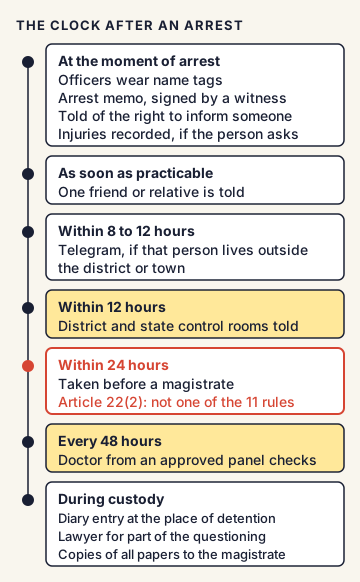
- Identification: Police officers who arrest or question a person must wear clear, visible name tags with their designation. Their details must be recorded in a register.
- Memo of arrest: The arresting officer must prepare an arrest memo at the time of arrest. It must be signed by at least one witness (a family member or a respected local person) and countersigned by the arrested person, and must show the date and time of arrest.
- Informing a friend or relative: The arrested person can have one friend, relative or well-wisher told about the arrest and where they are being kept, as soon as practicable.
- If the relative lives far away: If that person lives outside the district or town, the police must send the information by telegram within 8 to 12 hours of the arrest, through the district Legal Aid Organisation and the local police station.
- Told of this right: The arrested person must be told about this right to have someone informed, as soon as they are arrested.
- Diary entry: An entry must be made in the diary at the place of detention, showing the arrest, the name of the person informed, and the names of the officers holding the arrested person.
- Inspection memo: If the arrested person asks, they must be examined at the time of arrest and any injuries recorded in an "Inspection Memo". Both the arrested person and the officer sign it, and the arrested person gets a copy.
- Medical check every 48 hours: A trained doctor from an approved panel must examine the arrested person every 48 hours while in custody.
- Copies to the magistrate: Copies of all documents, including the arrest memo, must be sent to the local (Illaqa) magistrate.
- Meeting a lawyer: The arrested person may meet their lawyer during questioning, though not for the whole questioning.
- Police control room: Information about the arrest and place of custody must reach the district and state police control rooms within 12 hours, and be shown on a notice board there.
How were the rules enforced?
The Court said an officer who breaks these rules faces departmental action (punishment inside the police service) and can also be punished for contempt of court. These requirements are in addition to the existing rights under the Constitution, such as production before a magistrate within 24 hours.
How did they become law?
The Code of Criminal Procedure (Amendment) Act, 2008 wrote many of these rules into the CrPC as new sections. When the CrPC was replaced by the Bharatiya Nagarik Suraksha Sanhita (BNSS), 2023 (in force from 1 July 2024), the same duties moved to new section numbers:
| Duty | Old CrPC section | BNSS, 2023 section |
|---|---|---|
| Arrest memo, identification of officer | 41B | 36 |
| Designated police officer and control room display | 41C | 37 |
| Right to meet a lawyer during questioning | 41D | 38 |
| Informing a relative or friend of the arrest | 50A | 48 |
| Medical examination of the arrested person | 54 | 53 |
| Not to be detained beyond 24 hours | 57 | 58 |
Related landmark cases
D.K. Basu belongs to a family of judgments on arrest and custody:
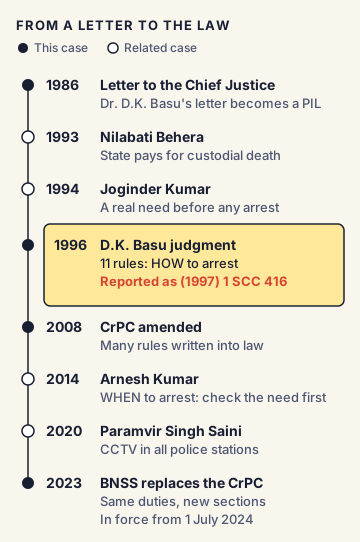
- Nilabati Behera v. State of Orissa (1993): the State must pay compensation when a person dies in custody because of a violation of Article 21. D.K. Basu repeated this principle.
- Joginder Kumar v. State of U.P. (1994): the police must not arrest just because they have the power to; there must be a real need. The arrested person also has the right to have someone told of the arrest.
- Arnesh Kumar v. State of Bihar (2014): for offences punishable with up to 7 years in jail, arrest should not be automatic; the police must first check whether it is really necessary.
- Paramvir Singh Saini v. Baljit Singh (2020): CCTV cameras must be installed in all police stations and in the offices of central agencies that arrest and question people.
Commonly confused concepts
- Arrest vs detention: Arrest is the formal taking of a person into custody by legal authority. Detention means a person's freedom to leave is taken away in fact. The Supreme Court has held that for the 24-hour rule, both count the same: the clock starts the moment freedom is curtailed.
- Police custody vs judicial custody: In police custody, the accused is held at the police station for questioning. In judicial custody, the accused is held in jail under the magistrate's control. Under Section 187 of the BNSS, police custody can total up to 15 days. It may be taken in parts during the first 40 days (where the total custody limit before a charge sheet is 60 days) or the first 60 days (where that limit is 90 days).
- Punitive detention vs preventive detention: Punitive detention is punishment after a crime is proved. Preventive detention stops a person from doing a possible future harmful act. D.K. Basu covers all arrests and detentions; Article 22(1) and (2) do not apply to preventive detention.
- D.K. Basu vs Arnesh Kumar: D.K. Basu tells police how to arrest (the procedure). Arnesh Kumar tells them when they should arrest at all (the need).
Issues, criticism and the way forward
- Weak compliance: Even decades later, reports by the National Human Rights Commission (NHRC) and others show that custodial deaths continue, and arrest memos are often filled in late or backdated.
- Paper arrests: A common problem is holding a person "informally" for hours or days and recording a later arrest time. This hides the real start of custody and dodges the 24-hour rule.
- No anti-torture law: India signed the UN Convention against Torture in 1997 but has not ratified it, and has no separate law against torture.
- Outdated tools: Some rules, like the telegram, are out of date. Courts and experts suggest using phone, SMS, email and online arrest registers instead.
- Way forward: Experts suggest working CCTV in every police station, independent medical checks, strict action against officers who break the rules, police reforms as directed in Prakash Singh v. Union of India (2006), and training magistrates to question the arrest record closely.
Concepts to Know
- Custodial violence: Torture, beating or death of a person while held by the police or other authorities.
- Writ petition: A direct request to the Supreme Court (Article 32) or a High Court (Article 226) to protect a fundamental right or legal right.
- Contempt of court: Disobeying a court's order or showing disrespect to a court; it can be punished with a fine or jail.
- Remand: An order by a magistrate allowing an accused to be kept in custody (police or judicial) for some more days.
- Illaqa magistrate: The magistrate who has charge of the local area where the arrest took place.
- BNSS: The Bharatiya Nagarik Suraksha Sanhita, 2023, the new law on criminal procedure that replaced the Code of Criminal Procedure (CrPC), 1973.
- Case began with a letter by Dr. D.K. Basu (Legal Aid Services, West Bengal) in 1986, treated as a writ petition
- Judgment: 18 December 1996, Justices Kuldip Singh and A.S. Anand; reported as (1997) 1 SCC 416 and AIR 1997 SC 610
- 11 requirements: name tags, arrest memo with a witness, informing a relative, telegram within 8 to 12 hours if outside the district, diary entry, inspection memo, medical check every 48 hours, copies to magistrate, lawyer during questioning, control room within 12 hours
- Breach: departmental action plus contempt of court
- Codified by the CrPC (Amendment) Act, 2008 (Sections 41B, 41C, 41D, 50A); now BNSS Sections 36, 37, 38, 48
- 24-hour rule: Article 22(2); CrPC Section 57, now BNSS Section 58
● Tracked since March 05, 2026 · last seen November 05, 2026 · updates as the daily brief publishes