Treasury Bills (T-Bills)
Treasury Bills, or T-bills, are very short-term loans that the Government of India takes from the market. They last for less than one year. The government does not pay interest on them in the usual way. Instead, it sells each bill at a price lower than its face value and pays back the full face value at the end. The difference is the investor's earning. Because the central government stands behind them, T-bills are considered among the safest investments in India.
Why do T-bills exist?
The government's income and spending do not match day to day. Taxes come in big lumps (for example, around advance-tax dates), while salaries, pensions and other bills must be paid every week. T-bills help the government fill these short gaps without printing money. Think of a family that gets a large bonus once a year but pays school fees and bills every month: it may take a short loan to manage the months in between.
What types are there?
- 91-day, 182-day and 364-day T-bills: These are the regular T-bills issued by the central government.
- Cash Management Bills (CMBs): Introduced in 2009 for very short gaps, with tenures of less than 91 days. They are issued only when the government needs them.
- 14-day intermediate T-bills: These are not sold in the market. State governments with spare cash can invest in them through the RBI.
How does a T-bill work? A simple example
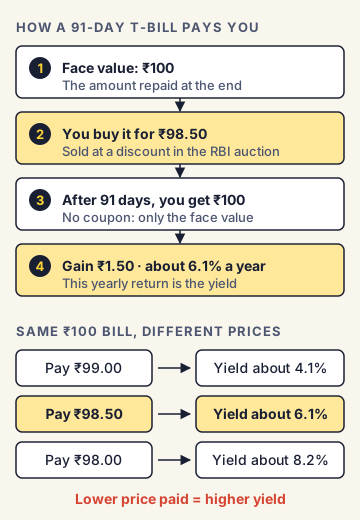
Suppose a 91-day T-bill has a face value of ₹100. In the auction, you buy it for ₹98.50. After 91 days, the government pays you ₹100. Your gain is ₹1.50. In yearly terms, this works out to about 6.1%. The lower the price you pay, the higher your yield. So price and yield move in opposite directions. If investors demand a higher return, they bid a lower price, and the yield rises.
Who sells them, and how?
- The RBI sells T-bills on behalf of the central government. The RBI is the government's debt manager.
- Auctions are usually held on Wednesdays, with payment on the next working day. All three tenors are often auctioned together, according to a calendar announced in advance.
- Auctions are price-based and use a multiple-price method: winning bidders pay the price they actually bid. The highest price that still clears the amount on offer is called the cut-off price; its matching yield is the cut-off yield.
- Banks, primary dealers, mutual funds, insurance companies, companies and individuals can take part. Small investors and certain bodies like state governments can bid non-competitively: they get the cut-off price without naming a price themselves. Since 2021, individuals can also buy through the RBI Retail Direct portal.
Where did they come from?
For decades, the government used ad hoc T-bills, from 1954-55, to automatically fund its budget deficits. The RBI simply created money to buy them. This is called monetisation of the deficit, and it pushed up inflation. Under a 1994 agreement between the RBI and the government, this system was phased out. From 1 April 1997, ad hoc T-bills were stopped and replaced by Ways and Means Advances (WMA), which are short, limited overdrafts from the RBI. Since then, T-bills are sold only through market auctions, so the market sets their price.
Why do T-bill yields matter?
T-bill yields are a key signal for the whole economy:
- They are a benchmark for other short-term rates, such as certificates of deposit (CDs) and commercial paper (CPs).
- They show what the market expects about future interest rates. If people expect the RBI to raise the repo rate soon, they will not lend to the government for six months or a year at today's low rate. They will demand more, so T-bill yields rise above the repo rate.
- They reflect liquidity. When banks have lots of spare cash, they rush to buy T-bills, so yields fall. When cash is tight, yields rise.
- T-bills count as approved securities for banks' Statutory Liquidity Ratio (SLR), so banks always need to hold some of them.
Commonly confused concepts
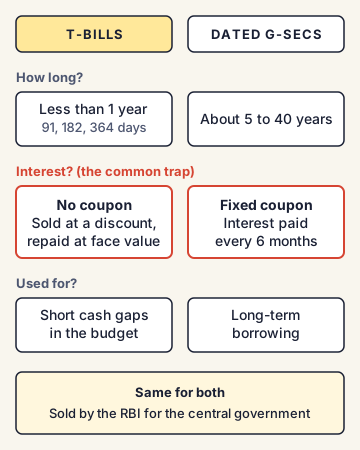
- T-bills vs dated government securities (G-secs): T-bills last less than a year and pay no coupon; they are sold at a discount. Dated G-secs last from about 5 to 40 years and pay a fixed interest (coupon) every six months.
- T-bills vs Cash Management Bills: Both are short-term and sold at a discount. CMBs are for less than 91 days and are issued only when there is a temporary cash need.
- T-bills vs Ways and Means Advances: T-bills are borrowing from the market. WMA is a temporary overdraft from the RBI itself, with limits fixed by the RBI and the government.
- Yield vs coupon: The coupon is the fixed interest written on a bond. The yield is the actual return you earn based on the price you pay. T-bills have no coupon but do have a yield.
- Treasury Bill vs Treasury Bond (US): In the US, "Treasury bills", "notes" and "bonds" are different maturities. In India, long-term government borrowing is called dated G-secs, not "treasury bonds".
Issues, criticism and the way forward
- Crowding out: When the government borrows heavily through T-bills, it can push up short-term rates for companies too.
- Volatility around policy changes: As this episode shows, T-bill yields can jump quickly when rate expectations change, raising the government's borrowing costs.
- Retail participation: Despite RBI Retail Direct, very few ordinary savers buy T-bills directly. Better awareness could widen the investor base.
- Way forward: Clear communication by the RBI on its policy path, a predictable borrowing calendar from the government, and deeper money markets help keep T-bill yields stable.
Concepts to Know
- Face value: The amount written on the bill, which the government pays back at the end.
- Yield: The yearly return an investor earns, based on the price paid and the amount received at the end.
- Basis point: One-hundredth of one percentage point. 100 basis points = 1%.
- Primary dealers: Big financial firms, approved by the RBI, that commit to buy government securities in auctions and help trade them.
- Liquidity: How much spare cash banks have. "Surplus liquidity" means banks have more cash than they need.
- Monetisation of the deficit: When the central bank creates new money to fund the government's spending. It can push up inflation.
- Tenors: 91, 182 and 364 days; CMBs for under 91 days (introduced 2009)
- Zero-coupon: issued at a discount, repaid at face value
- Sold by the RBI on behalf of the central government; auctions usually on Wednesdays; multiple-price, price-based auctions
- Ad hoc T-bills (from 1954-55) ended on 1 April 1997; replaced by Ways and Means Advances
- RBI Retail Direct (2021) lets individuals buy T-bills
- T-bills are SLR-eligible securities
● Tracked since October 14, 2026 · last seen October 14, 2026 · updates as the daily brief publishes