Cash Reserve Ratio (CRR)
The Cash Reserve Ratio is the share of a bank's deposits that it must keep as cash with the Reserve Bank of India. The bank cannot lend this money and earns no interest on it. If the CRR is 3% and a bank holds ₹100 crore of eligible deposits, it must park ₹3 crore with the RBI. By raising or lowering the CRR, the RBI can take cash out of the banking system or put cash back in.
Why does it exist?
CRR has two jobs. First, it is a safety buffer: a part of the public's deposits always stays with the central bank. Second, and more important today, it is a tool to control liquidity (how much spare cash banks have). If banks have too much spare cash, they lend freely and push short-term interest rates below the RBI's policy rate. This weakens the RBI's control. A CRR hike locks away that cash.
Where does it come from?
CRR is set under Section 42 of the RBI Act, 1934, read with Section 18 of the Banking Regulation Act, 1949. For many years, the RBI paid some interest on part of these balances. Since the fortnight beginning 24 June 2006, the RBI pays no interest on CRR balances. Over time, the CRR has varied widely; it was as high as 15% in the early 1990s.
In 2025, the RBI cut the CRR by 100 basis points in four steps of 25 basis points, bringing it to 3% of NDTL from the fortnight beginning 29 November 2025.
How does it work, step by step?
- Every bank calculates its NDTL (Net Demand and Time Liabilities), which is basically its total deposits and similar liabilities.
- The CRR is applied to the NDTL to find how much cash must be kept with the RBI.
- Banks maintain this on an average basis over a two-week period (fortnight). So a bank can keep a bit less on some days and a bit more on others, as long as the average is met.
- But there is a daily minimum. Usually, a bank must keep at least 90% of the required amount every single day. This gives banks some freedom to manage day-to-day cash.
The daily maintenance rule explained simply
Suppose a bank must keep an average of ₹100 crore with the RBI. With a 90% daily minimum, it can drop to ₹90 crore on a busy day and use ₹10 crore to lend in the overnight market. If the daily minimum is raised to 99%, it can drop only to ₹99 crore. So banks lose that flexibility, and less spare cash flows into the overnight market.
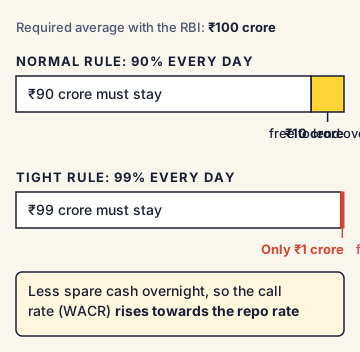
Overnight rates then rise towards the RBI's target. The RBI last raised the daily minimum to 99% in July 2013, during a period of pressure on the rupee.
How CRR fits with other RBI tools
The RBI's main operating target is the Weighted Average Call Rate (WACR), the average rate at which banks lend to each other overnight. The RBI wants the WACR close to the repo rate. When banks have too much cash, the WACR falls below the repo rate. The RBI can then:
- Absorb cash through Variable Rate Reverse Repo (VRRR) auctions (short-term, reversible).
- Sell government bonds through Open Market Operations (OMOs) (more lasting).
- Raise the CRR or tighten the daily CRR rule (a direct lock on cash).
Commonly confused concepts
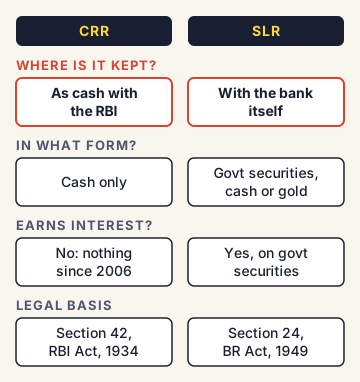
- CRR vs SLR: CRR money is kept as cash with the RBI and earns nothing. SLR (Statutory Liquidity Ratio) is kept by the bank itself in safe forms like government securities, cash or gold, and government securities earn interest. SLR is set under Section 24 of the Banking Regulation Act, 1949.
- CRR vs repo rate: The repo rate changes the price of money (interest rate). CRR changes the quantity of money available with banks.
- CRR rate vs daily maintenance requirement: The CRR rate (3%) decides how much must be kept on average. The daily requirement (90% or 99%) decides how far a bank can dip below that on any single day.
- CRR vs Liquidity Coverage Ratio (LCR): LCR is a Basel III rule requiring banks to hold enough high-quality liquid assets to survive 30 days of stress. It is a safety rule, not a monetary policy tool.
Issues, criticism and the way forward
- A hidden cost on banks: Because CRR earns no interest, it works like a tax on banks. Banks may pass this cost to borrowers through higher lending rates or to depositors through lower deposit rates.
- A blunt tool: CRR changes affect all banks at once and can move large amounts of cash quickly. This can cause sudden swings in short-term rates.
- Global practice: Many central banks have cut reserve requirements to zero or very low levels and rely on interest rate corridors instead. The RBI keeps CRR as a backup tool for liquidity control.
- Way forward: Use CRR sparingly, communicate changes clearly, and rely mainly on the Liquidity Adjustment Facility for day-to-day fine-tuning.
Concepts to Know
- NDTL (Net Demand and Time Liabilities): Roughly, the total deposits a bank holds (savings, current and fixed deposits) plus some other liabilities, minus certain amounts owed by other banks.
- Fortnight: A period of two weeks. Banks report and maintain CRR over fortnights.
- Call money market: The market where banks lend to and borrow from each other for one day (overnight).
- Open Market Operations (OMOs): The RBI buying or selling government bonds in the market to add or remove cash from the banking system.
- VRRR (Variable Rate Reverse Repo): An auction in which the RBI borrows spare cash from banks for a few days, taking it out of the system for that time.
- Legal basis: Section 42 of the RBI Act, 1934 (read with Section 18 of the Banking Regulation Act, 1949)
- CRR rate: 3% of NDTL as of October 2026 (after four 25 basis point cuts in September–November 2025)
- No interest paid on CRR balances since the fortnight beginning 24 June 2006
- Normal daily minimum: 90% of the requirement; raised to 99% from the fortnight beginning 16 October 2026 (last used in July 2013)
- SLR: Section 24 of the Banking Regulation Act, 1949
- RBI's operating target: Weighted Average Call Rate (WACR), kept close to the repo rate
● Tracked since March 12, 2026 · last seen October 14, 2026 · updates as the daily brief publishes