Three-Tier Public Health System in India
Sub-Centres, PHCs, CHCs and District Hospitals
India's government health system is built in levels, like a ladder. At the bottom are small centres close to people's homes that treat common problems. As a patient's illness becomes more serious, they move up to bigger hospitals with more doctors and machines. These levels are called primary, secondary and tertiary care, and together they form what is often called the three-tier public health system.
Why is the system built in levels?
Think of a school system: a village primary school, a block-level high school and a city college. Not every village needs a college, but every village needs a primary school. In the same way, every village needs basic care for fever, pregnancy and vaccination, but only a few big hospitals need heart surgeons and MRI machines. Building in levels spreads limited money, doctors and equipment in the most useful way. Most problems are solved at the bottom; only serious cases are referred (sent) upward.
Where did it come from?
The plan goes back to the Health Survey and Development Committee, known as the Bhore Committee, chaired by Sir Joseph Bhore. Its report in 1946 laid the base for a primary health care system in rural India, including the idea of Primary Health Centres. Over the years, the system grew:
- 1952: the first Primary Health Centres were set up along with the Community Development Programme.
- 2005: the National Rural Health Mission (NRHM) was launched to repair and staff rural health facilities. It later became part of the National Health Mission (NHM) in 2013, along with the new National Urban Health Mission (NUHM).
- 2007: the Indian Public Health Standards (IPHS) were first issued. These are the official rules on what each level of facility must have (staff, beds, services). They were revised in 2012 and again in 2022.
- 2018: under Ayushman Bharat, Sub-Centres and Primary Health Centres began to be upgraded into Health and Wellness Centres, which were later renamed Ayushman Arogya Mandirs.
How does it work, level by level?
Here is the ladder, from the bottom up, with the IPHS 2022 norms:
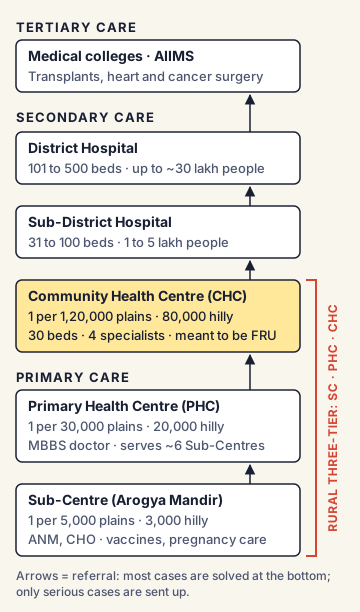
- Sub-Centre (now Ayushman Arogya Mandir, Sub Health Centre). The first contact point between the village and the health system. One for every 5,000 people in plains and 3,000 in hilly, tribal or difficult areas. It is run mainly by an Auxiliary Nurse Midwife (ANM), a male health worker and a Community Health Officer. It handles vaccination, pregnancy check-ups, family planning, common illnesses and screening for diseases like diabetes and high blood pressure.
- Primary Health Centre (PHC). One for every 30,000 people in plains and 20,000 in hilly, tribal or difficult areas. It has a medical officer (an MBBS doctor), a few beds and basic tests. It acts as the referral point for about six Sub-Centres.
- Community Health Centre (CHC). One for every 1,20,000 people in plains and 80,000 in hilly, tribal or difficult areas. It is a 30-bed hospital that should have four specialists: a surgeon, a physician (general medicine), a gynaecologist (women's health and childbirth) and a paediatrician (child specialist). It is the referral point for about four PHCs. It is meant to work as a First Referral Unit (FRU), which means it should handle emergency childbirth, caesarean sections and blood transfusions. A CHC counts as an FRU only when it can actually give these services, so not every CHC is an FRU.
- Sub-Divisional or Sub-District Hospital (SDH). At the taluka or sub-division level, with 31 to 100 beds, serving roughly 1 to 5 lakh people. It offers more specialists and surgeries than a CHC.
- District Hospital (DH). The top public hospital of a district, with 101 to 500 beds, serving up to about 30 lakh people. It provides most specialist care and supports all the facilities below it.
- Tertiary care. Medical college hospitals and super-speciality institutes such as AIIMS treat the most complex cases (cancer surgery, heart surgery, transplants).
In simple terms: Sub-Centres and PHCs give primary care; CHCs, SDHs and District Hospitals give secondary care; medical colleges and super-speciality hospitals give tertiary care.
India's position: the numbers
According to the Health Dynamics of India (Infrastructure and Human Resources) 2022-23 report of the Ministry of Health and Family Welfare:
- 1,69,615 Sub-Centres
- 31,882 Primary Health Centres (25,354 of them in rural areas)
- 6,359 Community Health Centres
- 1,340 Sub-Divisional Hospitals
- 714 District Hospitals
By January 2024, more than 1.64 lakh Ayushman Arogya Mandirs were working, above the target of 1.5 lakh.
The biggest gap: specialists at CHCs
In March 2023, rural CHCs had only 4,413 of the 21,964 specialists they needed. So 17,551 posts were missing, a shortfall of about 80%. This gap has stayed at around 17,500 specialists for nearly a decade. It means that many CHCs exist as buildings but cannot perform the surgeries and specialist treatments they were designed for. Patients then skip them and travel to district hospitals or private hospitals, which become overcrowded or expensive.
How is it funded and run?
Health is a state subject (Entry 6, List II of the Seventh Schedule), so states own and run these facilities. The Centre supports them mainly through the National Health Mission, a Centrally Sponsored Scheme, and through programmes like PM-JAY, under which public hospitals can earn money for treating insured patients. The National Health Policy, 2017 set a target of raising government health spending to 2.5% of GDP by 2025. It also said two-thirds or more of these resources should go to primary care.
Commonly confused concepts
- Primary vs secondary vs tertiary care: primary care is basic, first-contact care (Sub-Centre, PHC); secondary care is specialist care at mid-level hospitals (CHC, SDH, DH); tertiary care is highly specialised care at medical colleges and super-speciality hospitals.
- "Three-tier" has two uses: in this article, the three tiers are the three levels of care (primary, secondary, tertiary). The Health Ministry also calls its rural network a three-tier system: Sub-Centre, PHC and CHC. In that second use, all three tiers are rural centres, and district hospitals and medical colleges are not among them. So the CHC is the top tier of the rural network and also the first level of secondary (specialist) care.
- PHC vs CHC: a PHC has a general doctor and serves about 30,000 people in plains; a CHC is a 30-bed hospital with four specialists serving about 1,20,000 people in plains.
- Health and Wellness Centre vs Ayushman Arogya Mandir: the same thing; the name was changed.
- Ayushman Arogya Mandir vs PM-JAY: both are pillars of Ayushman Bharat. Arogya Mandirs give free primary care and screening; PM-JAY is insurance for hospital (secondary and tertiary) care.
- NRHM vs NHM: NRHM (2005) was for rural areas; NHM (2013) is the umbrella that combines NRHM with the National Urban Health Mission.
- IPHS vs NQAS: IPHS sets what a facility must have; the National Quality Assurance Standards (NQAS) check the quality of services it actually gives.
Issues, criticism and the way forward
- Missing specialists: about 80% of required specialists are missing at rural CHCs. Doctors are often unwilling to work in remote areas because of poor housing, schooling and career growth.
- Bypassing the lower levels: patients often skip PHCs and CHCs because of absent staff or broken equipment, and go straight to district hospitals, which become overloaded.
- Low public spending: India's government health spending has long been below the 2.5% of GDP target, so people pay a large share of health costs from their own pockets.
- Urban gaps: urban areas have only about two-thirds of the PHCs they need.
- Way forward: experts suggest filling specialist posts through better pay and hardship allowances, contracting specialists, training general doctors in key skills, using telemedicine, meeting IPHS standards, and sending more funds to public facilities (for example, through PM-JAY claims) so they can maintain equipment and staff.
Concepts to Know
- Referral: when a health worker or doctor sends a patient to a higher-level facility because the illness needs more expert care.
- First Referral Unit (FRU): a hospital (usually a CHC or above) that can handle emergencies such as complicated childbirth, caesarean operations and blood transfusion at any hour.
- Auxiliary Nurse Midwife (ANM): a trained health worker, usually a woman, who looks after mothers and children and gives vaccines at the village level.
- Community Health Officer (CHO): a trained nurse or Ayurveda practitioner who runs an Ayushman Arogya Mandir at the Sub-Centre level.
- Out-of-pocket expenditure: money that a patient pays directly from their own pocket for treatment, not covered by the government or insurance.
- Centrally Sponsored Scheme: a scheme designed and partly funded by the Centre but run by the states, which also share the cost.
- Bhore Committee report: 1946; first PHCs: 1952; NRHM: 2005; NHM: 2013; IPHS first issued 2007, revised 2012 and 2022
- Sub-Centre: 1 per 5,000 (plains) / 3,000 (hilly, tribal or difficult areas)
- PHC: 1 per 30,000 (plains) / 20,000 (hilly, tribal or difficult areas); referral unit for about 6 Sub-Centres
- CHC: 1 per 1,20,000 (plains) / 80,000 (hilly, tribal or difficult areas); 30 beds; 4 specialists; meant to work as a First Referral Unit
- Sub-District Hospital: 31-100 beds; District Hospital: 101-500 beds (IPHS 2022)
- Facilities (Health Dynamics of India 2022-23): 1,69,615 SCs; 31,882 PHCs; 6,359 CHCs; 1,340 SDHs; 714 DHs
- Specialists at rural CHCs (March 2023): 4,413 in place of 21,964 required; 17,551 missing, about 80%
- Ayushman Arogya Mandirs: more than 1.64 lakh by January 2024 (target 1.5 lakh)
- Health: State List, Entry 6, Seventh Schedule
● Tracked since November 18, 2026 · last seen November 18, 2026 · updates as the daily brief publishes