National Health Authority
The Agency That Runs Ayushman Bharat
The National Health Authority (NHA) is the central government body that runs India's biggest health insurance scheme, Ayushman Bharat Pradhan Mantri Jan Arogya Yojana (PM-JAY). It also builds India's digital health system, the Ayushman Bharat Digital Mission. Think of the NHA as the "head office" of PM-JAY: it makes the rules, fixes the treatment rates, checks for fraud and runs the IT system. The states run the scheme on the ground through their own State Health Agencies.
Why does it exist?
A health insurance scheme for more than 50 crore people is a huge business. Someone must decide which hospitals can join, what each treatment costs, how claims are checked and paid, and how cheating is caught. If each state did all of this in its own way, there would be no common standard, and a patient from one state could not be treated in another.
The government therefore wanted one expert body at the national level with enough freedom to take quick decisions. That body is the NHA.
Where did it come from?
- 23 May 2018: The government set up the National Health Agency as a registered society to prepare for PM-JAY.
- 23 September 2018: PM-JAY was launched.
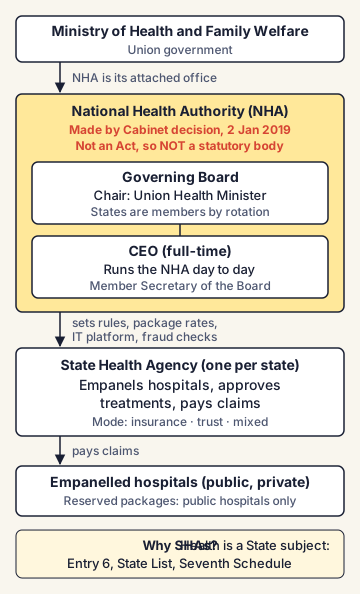
- 2 January 2019: The Union Cabinet decided that the agency needed "full functional autonomy" (the freedom to run its own work). The society was dissolved and replaced by the National Health Authority, set up as an attached office of the Ministry of Health and Family Welfare. The earlier system, where decisions passed through several levels, was replaced by one Governing Board chaired by the Health Minister, so decisions could be taken faster. So "autonomy" here means freedom to run its own work quickly. It does not mean the NHA is outside the government.
- 27 September 2021: The Ayushman Bharat Digital Mission (ABDM) was launched nationwide, with the NHA as its implementing agency.
Note one important point: the NHA was created by a Cabinet decision, not by an Act of Parliament. So it is not a statutory body.
How is it organised?
- Governing Board: This is the top decision-making group. It is chaired by the Union Minister for Health and Family Welfare. States are also represented on the board, by turns (on a rotational basis).
- Chief Executive Officer (CEO): A full-time CEO heads the NHA and runs it day to day. The CEO also acts as the Member Secretary of the Governing Board.
- State Health Agencies (SHAs): Each state that runs PM-JAY has its own SHA. The SHA runs the scheme in that state: it empanels hospitals, approves treatments and pays claims.
What does the NHA do?
- Designs the scheme rules: who is eligible, how hospitals are empanelled (formally added to the list of hospitals allowed to treat scheme patients), and how claims are paid.
- Fixes the treatment packages and their rates: the Health Benefit Package (HBP) list. This list grew from 1,393 packages in HBP 1.0 (2018) to 1,961 procedures across 27 specialities in HBP 2022.
- Decides which packages are reserved for public hospitals, along with the states.
- Runs the IT platform that issues Ayushman cards, checks beneficiaries and processes claims.
- Fights fraud: it watches for fake claims and unneeded surgeries, and it can penalise or remove (de-empanel) hospitals that cheat.
- Runs the Ayushman Bharat Digital Mission: this gives each person a digital health ID, called the ABHA (Ayushman Bharat Health Account) number, so health records can be stored and shared safely.
How does a "reserved package" work?
Every PM-JAY treatment has a package code and a fixed price. For most packages, the patient can go to any empanelled hospital, public or private. For a reserved package, only a public hospital can claim money from the scheme. A private hospital cannot book that package code. There are two main reasons for reserving a package:
- To stop misuse. Some procedures are easy to do when they are not needed, or even to fake on paper. If only public hospitals can claim for them, the private profit motive for misuse goes away.
- To use and strengthen public hospitals. If a public hospital can do a treatment well, reserving it sends the patient, and the money, there.
What happens to the money a public hospital earns?
When a public hospital treats a PM-JAY patient, the scheme pays it just as it pays a private hospital. Under NHA guidance, this money can be used for the hospital's infrastructure, running costs, better quality of services and incentives (small extra payments) for its staff. So every PM-JAY patient in a public hospital also brings extra funds to that hospital. This is why the NHA sees PM-JAY as a tool to strengthen public health infrastructure, not just as insurance.
How does the NHA fit in with health being a state subject?
Under the Seventh Schedule of the Constitution, "public health and sanitation; hospitals and dispensaries" is Entry 6 of the State List. So health care is mainly the job of the states. That is why the NHA does not run PM-JAY inside a state by itself. Each state has its own SHA to do that. States can also choose how to run the scheme:
- Insurance mode: the SHA pays a premium to an insurance company, which pays the hospital claims.
- Trust (assurance) mode: the SHA pays the claims directly from government money.
- Mixed mode: a mix of both.
States may also add their own families and their own packages on top of PM-JAY, often merging it with their own state health scheme.
Commonly confused concepts
- National Health Authority vs National Health Accounts: Both are shortened to "NHA". The National Health Authority runs PM-JAY and ABDM. The National Health Accounts are estimates of how much India spends on health, and who pays for it. They are prepared by the National Health Systems Resource Centre (NHSRC).
- National Health Authority vs National Health Mission (NHM): The NHM (2013, combining the National Rural Health Mission of 2005 and the National Urban Health Mission of 2013) funds public health services such as primary care, maternal and child health and disease control. It is run by the Health Ministry with the states. The NHA runs the insurance scheme for hospital care.
- NHA vs State Health Agency: The NHA is the national rule-maker. The SHA is the state-level body that runs the scheme on the ground.
- PM-JAY vs Ayushman Arogya Mandirs: Both are part of Ayushman Bharat. PM-JAY pays for hospital (secondary and tertiary) care. Ayushman Arogya Mandirs give primary care close to home.
Issues, criticism and the way forward
- Fraud and misuse: Audits have found private hospitals booking packages that were reserved for public hospitals, sometimes by "upcoding" (billing a treatment under a different, allowed code). The Comptroller and Auditor General (CAG), in its 2023 performance audit of PM-JAY, also pointed to such problems in some states.
- Low rates for private hospitals: Many private hospitals say PM-JAY package rates are too low. This keeps some big hospitals out of the scheme.
- Weak public hospitals: Reserving more packages helps only if public hospitals have enough doctors, beds, medicines and equipment. Otherwise patients may face long waiting times, or may not be treated at all.
- Centre-state balance: Health is a state subject, so the NHA must work through states. States choose whether to follow some NHA proposals, so the scheme works differently in different states.
- Way forward: Experts suggest stronger digital fraud checks, regular updating of package rates, better staffing of public hospitals, and using the claim money earned by public hospitals to fill their gaps.
Concepts to Know
- Attached office: A government office linked to a ministry that helps carry out the ministry's policies. It is part of the government itself, not a separate company or society.
- Registered society: An organisation registered under the Societies Registration Act, 1860. Governments often use this form to create bodies that need some freedom from routine rules.
- Statutory body: A body created by an Act of Parliament or a State Legislature. The NHA is not one, because it was created by a Cabinet decision.
- Empanelment: The process by which a hospital is checked and formally added to the list of hospitals allowed to treat scheme patients.
- Health Benefit Package (HBP): The master list of treatments covered by PM-JAY, with a fixed rate for each one.
- Reimbursement / claim: The money the scheme pays a hospital after it treats a patient.
- Upcoding: Billing a treatment under a different or costlier code than the one actually done, to get more money or to get around a rule.
- National Health Agency set up as a registered society: 23 May 2018
- Reconstituted as the National Health Authority by Cabinet decision: 2 January 2019; attached office of the Ministry of Health and Family Welfare; not a statutory body
- Governing Board chaired by the Union Health Minister; states represented by rotation; full-time CEO is Member Secretary
- Implements AB PM-JAY (launched 23 September 2018) and the Ayushman Bharat Digital Mission (launched nationwide 27 September 2021)
- State Health Agencies run PM-JAY in states; modes: insurance, trust and mixed
- HBP 1.0 (2018): 1,393 packages; HBP 2022: 1,961 procedures in 27 specialities
- Health is a State List subject: Entry 6, List II, Seventh Schedule
● Tracked since November 18, 2026 · last seen November 18, 2026 · updates as the daily brief publishes