Tax Collected at Source (TCS) by E-Commerce Operators under GST (Section 52)
Tax Collected at Source, or TCS, under GST is a small amount that an online shopping platform must hold back from the money it pays to the sellers on its platform, and deposit with the government. The rule is in Section 52 of the Central Goods and Services Tax (CGST) Act, 2017. The platform is called an e-commerce operator (ECO): for example, a marketplace like Amazon, Flipkart or Meesho.
TCS is not an extra tax. It is an advance part of the seller's own GST, which the seller later uses to pay its tax bill.
Why does TCS exist?
Lakhs of small sellers sell through online platforms. Many of them may not report all their sales to the tax department. But the platform has a full digital record of every sale and collects the money from the buyer. So the law makes the platform collect a small part of the tax at the moment it pays the seller.
This creates a clear record of each seller's sales, which tax officers can match with what the seller reports. Think of it like a school that keeps a copy of every student's marks: if a student reports wrong marks at home, the copy shows the truth.
Where did it come from?
Section 52 was part of the CGST Act when GST began on 1 July 2017. But the government delayed starting it, to give platforms and sellers time to prepare. It finally came into force on 1 October 2018, through Notification No. 51/2018-Central Tax. On the same day, a related rule for TDS (Tax Deducted at Source) by government departments under Section 51 also began.
How does TCS work, step by step?
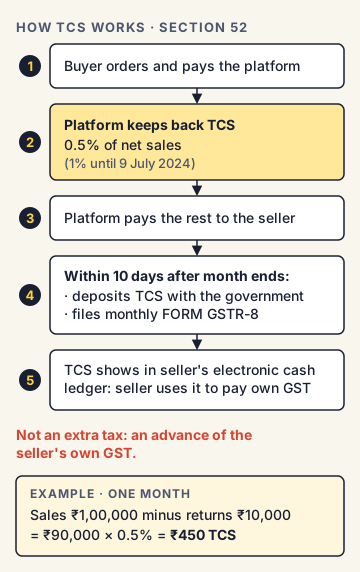
- A buyer orders a product from a seller on a platform and pays the platform.
- Before passing the money to the seller, the platform keeps back the TCS amount.
- The platform deposits this TCS with the government within 10 days after the end of the month.
- Within the same 10 days, the platform files a monthly statement called FORM GSTR-8. It lists the sales made through it by each seller and the TCS collected.
- The TCS then shows up in the seller's electronic cash ledger (the seller's online GST wallet). The seller uses it to pay its own GST.
How much is collected?
The law allows a rate of up to 1%. From the start, the rate was 1% (0.5% CGST plus 0.5% SGST for sales within a state, or 1% IGST for sales between states). From 10 July 2024, it was cut to 0.5% (0.25% CGST plus 0.25% SGST, or 0.5% IGST), through Notification No. 15/2024-Central Tax.
The rate is applied on the net value of taxable supplies: total taxable sales made through the platform in a month, minus the value of goods returned in that month. For example, if a seller sells goods worth ₹1,00,000 in a month and goods worth ₹10,000 are returned, TCS at 0.5% is charged on ₹90,000, which is ₹450.
Which other duties does Section 52 place on platforms?
- The platform must file an annual statement before 31 December after the end of the financial year.
- It can correct mistakes in a monthly statement, with interest, within a fixed time limit.
- A tax officer of the rank of Deputy Commissioner or above can ask the platform for details of sales made through it, or of stock kept in its warehouses that sellers have declared as their place of business. The platform must reply within 15 working days.
- If it does not, it can be fined up to ₹25,000.
Why does it affect registration?
GST normally asks a business to register only once its yearly turnover crosses a limit (₹40 lakh for goods in most states, ₹20 lakh in some; ₹20 lakh for services, ₹10 lakh in special category states). But Section 24(ix) says that anyone selling through a platform that must collect TCS has to register whatever their turnover. Section 24(x) makes the platform itself register too. This was a big hurdle for tiny online sellers. Two relaxations followed:
- Services: Under Notification No. 65/2017-Central Tax, people supplying services through platforms do not need to register while their turnover is below the normal limit.
- Goods, within one state: From 1 October 2023 (Notification No. 34/2023-Central Tax), small sellers below the turnover limit can sell goods through platforms without registering, but only within one state and not across states. They need a PAN and an enrolment number from the GST portal, and the platform does not collect TCS on these sales.
Selling goods to buyers in another state still needs GST registration in every state where the seller has a place of business. This is the gap the new rule 14B fills, by letting a small seller register in another state using the platform's warehouse as its address.
Commonly confused concepts
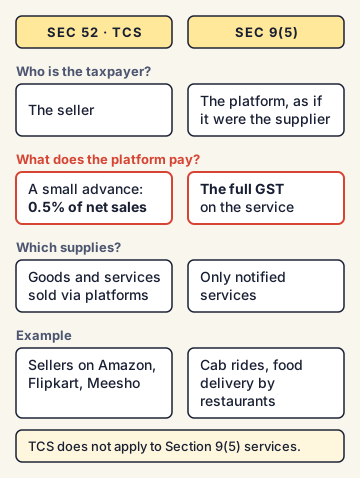
- TCS under GST vs Section 9(5) of the CGST Act: Under TCS, the seller remains the taxpayer; the platform only collects a small advance. Under Section 9(5), for certain notified services (such as cab rides, food delivery by restaurants and some hotel stays), the platform itself pays the full GST as if it were the supplier. TCS does not apply to services covered by Section 9(5).
- TCS (Section 52) vs TDS (Section 51) under GST: TCS is collected by e-commerce platforms. TDS is deducted by government departments and certain public bodies when they pay their suppliers. Both came into force on 1 October 2018.
- GST TCS vs income tax deduction by platforms: Under the income tax law (Section 194-O of the Income-tax Act, 1961), platforms also deduct a small income tax from sellers' payments. Its rate was cut from 1% to 0.1% from 1 October 2024. This is a tax on income, not GST, and it is a different law.
- TCS under GST vs TCS under income tax: Income tax also uses the term TCS, for example on foreign remittances sent under the Liberalised Remittance Scheme. It has nothing to do with GST.
Issues, criticism and the way forward
- Working capital burden: TCS locks up a small part of the seller's money until it is used against the GST bill. For low-margin sellers, even this matters. The cut to 0.5% in 2024 was meant to ease this.
- Compulsory registration: Making every online goods seller register, regardless of size, was seen as unfair compared to offline shops, which can stay unregistered below the turnover limit. The 2023 relaxation helped, but only for sales within one state.
- Multi-state hurdle: A small seller who wants to sell across India needs a separate registration in each state, which usually needs a physical place of business there. The new rule 14B is designed to remove this barrier.
- Compliance load on platforms: Platforms must handle TCS, monthly and annual statements, and officer notices for lakhs of sellers.
- Way forward: The GST Council's 2026 reforms rely on technology: automatic, system-based registration and data from platforms, so that small sellers face fewer forms and fewer visits to tax offices.
Concepts to Know
- E-commerce operator (ECO): Any person who owns or runs a digital platform (website or app) for selling goods or services online. Under GST, the platform is different from the seller who lists goods on it.
- Electronic cash ledger: An online account on the GST portal that shows the cash a business has deposited for GST. It works like a prepaid wallet used to pay GST.
- Input tax credit (ITC): The GST a business has already paid on its purchases, which it can subtract from the GST it collects on its sales. This avoids tax on tax.
- Notification: An official order issued by the government under a law to bring a rule into force or to change a rate.
- CGST, SGST and IGST: On a sale within a state, GST is split into Central GST (CGST) and State GST (SGST). On a sale from one state to another, a single Integrated GST (IGST) is charged.
- Special category states: States, mostly in the North-East and hilly regions, that get a lower GST registration limit.
- Legal basis: Section 52, CGST Act, 2017
- In force from 1 October 2018 (Notification No. 51/2018-Central Tax)
- Rate: up to 1% allowed by law; 1% until 9 July 2024; 0.5% from 10 July 2024 (Notification No. 15/2024-Central Tax)
- Charged on net value of taxable supplies (sales minus returns in the month)
- Deposit and monthly statement (FORM GSTR-8): within 10 days after the month ends
- Annual statement: before 31 December after the financial year
- Officer notice: Deputy Commissioner or above; reply in 15 working days; penalty up to ₹25,000
- Section 24(ix): compulsory registration for suppliers through TCS-collecting platforms; Section 24(x): compulsory registration for the platforms
- Notification No. 65/2017-Central Tax: services through platforms exempt from registration below threshold
- Notification No. 34/2023-Central Tax: from 1 October 2023, small sellers of goods can sell within one state through platforms without registration
- Income tax deduction by platforms (Section 194-O, Income-tax Act, 1961): cut from 1% to 0.1% from 1 October 2024
● Tracked since October 22, 2026 · last seen October 22, 2026 · updates as the daily brief publishes