GST Registration Under the CGST Act
GST registration is the process by which a business gets itself recorded with the tax department and receives a unique number called the GSTIN (Goods and Services Tax Identification Number). Only a registered business can legally collect GST from its customers, pass on input tax credit to its buyers, and claim credit for the tax it paid on its own purchases. You can think of the GSTIN as the business's "tax Aadhaar": every invoice, return and payment is tied to it.
Why does registration exist?
GST is a tax collected in small pieces at every step of the supply chain. For this chain to work, the government must know who is collecting tax and who is claiming credit. Registration does this. It also protects small businesses: those below a turnover limit do not need to register at all, so a small kirana shop is not buried in paperwork.
At the same time, registration is the gate through which fraud can enter. A fake business with a GSTIN can issue fake invoices and help others claim credit that was never paid. So the law tries to make the gate easy for honest businesses but hard for fake ones.
Where does the law come from?
Registration rules are in Chapter VI (Sections 22 to 30) of the Central Goods and Services Tax (CGST) Act, 2017, and in Rules 8 to 26 of the CGST Rules, 2017. Every state has a matching State GST Act. GST itself came into force on 1 July 2017, after the Constitution (101st Amendment) Act, 2016. Changes to registration rules are first discussed and recommended by the GST Council.
Who must register? (the turnover limit)
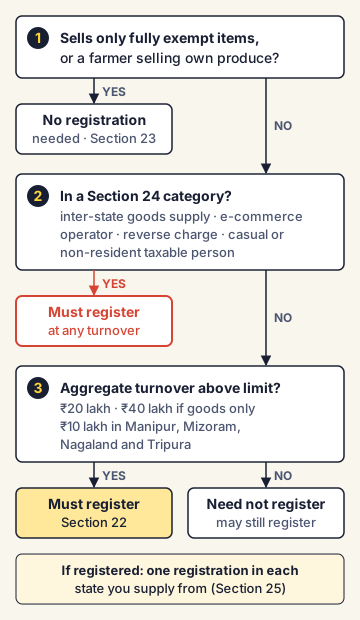
- Under Section 22, a supplier must register if its aggregate turnover in a financial year crosses ₹20 lakh.
- In the special category states named in the law (Manipur, Mizoram, Nagaland and Tripura), the limit is ₹10 lakh.
- For businesses that supply only goods, the limit was raised to ₹40 lakh from 1 April 2019 (Notification 10/2019-Central Tax). Each state could choose whether to adopt this higher limit, so a few states kept lower limits.
- Aggregate turnover means the total value of all supplies (taxable, exempt and exports) made by all businesses having the same PAN across India. GST itself is not counted.
Who must register even with a small turnover? (Section 24)
Some businesses must register no matter how small they are, because their activity carries more risk or crosses state lines. The main ones are:
- People making inter-state taxable supplies of goods (from one state to another). Small service providers selling across states are exempt up to the normal turnover limit (Notification 10/2017-Integrated Tax).
- Casual taxable persons (for example, a trader who sets up a stall at a trade fair in another state) and non-resident taxable persons.
- People who pay tax under reverse charge (where the buyer, not the seller, pays the GST).
- E-commerce operators (online marketplaces like a shopping app) and, in general, sellers who sell through them.
- Input Service Distributors and persons who deduct or collect tax at source (TDS/TCS).
Since 1 October 2023, small sellers supplying goods through e-commerce platforms within one state only can sell without full registration, using an enrolment number linked to their PAN (Notification 34/2023-Central Tax). But this relief does not cover sales to other states.
Who need not register? (Section 23)
A person supplying only goods or services that are fully exempt from GST, and an agriculturist selling produce from his own cultivation, need not register.
Registration is state-wise
- Under Section 25, a business must register in each state or union territory from which it makes taxable supplies. GST is shared between the Centre and each state, so every state needs to know the supplies made from its territory.
- Each registration is treated as a "distinct person" (Section 25(4)). So the same company's Mumbai unit and Chennai unit are separate taxpayers for GST.
- Registration is PAN-based. A business may also register voluntarily below the limit, which many do so that their buyers can claim input tax credit.
This state-wise rule is why online sellers face a heavy burden. When a small seller stores stock in an e-commerce platform's warehouses in, say, five states, its goods are supplied from five states. It then needs five registrations, each with a principal place of business (a physical address) in that state. For a small home-based seller, this is often impossible, so many simply stay within their home state.
How does registration work, step by step?
- The applicant fills Form GST REG-01 online on the GST portal with PAN, mobile number, email, business address and bank details (Rule 8).
- The applicant goes through Aadhaar authentication (Rule 8(4A)). The system may also pick high-risk applicants for biometric Aadhaar verification and photographs at a GST Suvidha Kendra.
- An officer checks the application. Under Rule 9, the officer must decide within 7 working days. If Aadhaar authentication is not done, or the system flags the applicant as high-risk, physical verification of the business place is done and the limit becomes 30 days.
- If the officer does not act in time, registration is deemed approved.
- The certificate (Form GST REG-06) is issued with the GSTIN.
The fast lane (from 1 November 2025)
After the 56th GST Council meeting (September 2025), new Rules 9A and 14A brought automatic registration within 3 working days. It covers applicants picked as low-risk by data analytics, and small applicants who declare that their monthly output tax on supplies to registered buyers will not exceed ₹2.5 lakh. The scheme is optional.
How to read a GSTIN
It has 15 characters (Rule 10):
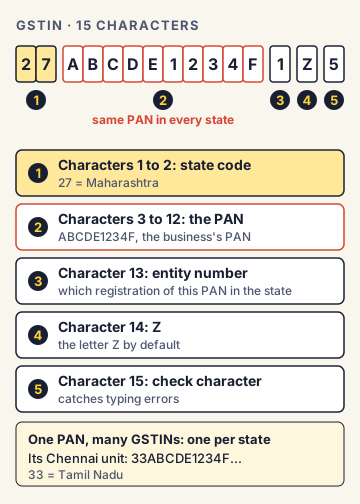
- 1 to 2: state code (for example, 27 = Maharashtra)
- 3 to 12: the business's PAN
- 13: entity number (how many registrations this PAN has in that state)
- 14: the letter "Z" by default
- 15: a check character used to catch typing errors
Cancellation and revocation
Under Section 29, registration can be cancelled by the business itself (for example, if it closes down) or by the officer (for example, if returns are not filed for a long time or the registration was got by fraud). Under Section 30, a business can apply to revoke (undo) a cancellation.
Commonly confused concepts
- Registration vs composition scheme: Registration is about being inside the GST system at all. The composition scheme (Section 10) is an option for small registered businesses: they pay tax at a low fixed rate on turnover and file simpler returns, but cannot collect GST from buyers or claim input tax credit. The limit is ₹1.5 crore turnover for goods (₹75 lakh in some special category states) and ₹50 lakh for service providers.
- Registration limit vs prosecution limit: ₹20 lakh/₹40 lakh is the turnover at which you must register. Amounts like ₹1 crore or ₹2 crore are thresholds for criminal cases for tax evasion. They have nothing to do with each other.
- Intra-state vs inter-state supply: Intra-state means seller and place of supply in the same state (CGST + SGST). Inter-state means different states (IGST). An inter-state goods supplier must register even with tiny turnover; an intra-state one need not.
- GSTIN vs PAN: PAN is one per business for income tax. A business can have many GSTINs (one per state, sometimes more), all built on the same PAN.
Issues, criticism and the way forward
- Fake registrations: Fraudsters use stolen identity documents to create shell firms that issue fake invoices. This is why officers ask many questions and do physical checks. But honest applicants then face delays and rejections. The challenge is to use data and risk scoring to stop the bad ones without troubling the good ones.
- Officer discretion: Small businesses complain of repeated queries for documents such as rent agreements or electricity bills. Automated approval reduces this.
- Multi-state burden on small online sellers: Needing a physical address and a separate registration in each state limits small sellers to their home state. This works against the goal of a single national market that GST was meant to create.
- Revenue concerns of states: States want to see and tax the supplies made from their territory. Any "register once, sell everywhere" model must still make sure each state gets its correct share of tax, for example through warehouse declarations by e-commerce platforms.
- Way forward: Experts and the Finance Ministry point to more automation, risk-based checks, biometric verification for high-risk cases only, and a single-registration model for small e-commerce sellers.
Concepts to Know
- Input tax credit (ITC): The GST a business has already paid on its purchases, which it can subtract from the GST it owes on its sales.
- Aggregate turnover: The total value of all sales of a business across India under one PAN in a year, not counting GST.
- Reverse charge: A case where the buyer, not the seller, pays the GST to the government.
- E-commerce operator: A company that runs an online platform where other sellers sell goods or services.
- Principal place of business: The main address of a business in a state, which must be stated in the GST registration.
- Shell firm: A company that exists only on paper and does no real business, often used for fraud.
- Registration law: Sections 22 to 30, CGST Act, 2017; Rules 8 to 26, CGST Rules, 2017
- Turnover limit: ₹20 lakh (₹10 lakh in Manipur, Mizoram, Nagaland, Tripura); ₹40 lakh for goods-only suppliers in states that adopted it (from 1 April 2019)
- Compulsory registration regardless of turnover: Section 24 (inter-state goods supply, casual and non-resident taxable persons, reverse charge, e-commerce operators and others)
- Registration is needed in each state from which taxable supplies are made (Section 25); each is a distinct person
- Approval time: 7 working days, or 30 days with physical verification (Rule 9); 3 working days under automated registration (Rules 9A and 14A, from 1 November 2025)
- GSTIN: 15 characters; first two digits = state code, next ten = PAN
- Intra-state e-commerce sellers can operate with an enrolment number since 1 October 2023
- Composition scheme: ₹1.5 crore (goods), ₹50 lakh (services)
● Tracked since October 06, 2026 · last seen October 06, 2026 · updates as the daily brief publishes