Zero-Rated Supplies Under GST
Exports and SEZ Supplies
A zero-rated supply is a sale on which the final GST burden is zero, and the seller can still recover all the GST it paid on its inputs. Under India's GST, only two kinds of supply are zero-rated: exports of goods or services, and supplies to Special Economic Zones (SEZs). The idea is simple: India should export goods and services, not taxes.
Why does it exist?
Every country wants its exports to compete in world markets. If an Indian product carried Indian tax into a foreign market, it would cost more than a rival product from a country that removes such taxes. The foreign buyer will also pay tax in their own country. So the global practice is that the country where goods are consumed taxes them, and the exporting country removes its own tax fully.
Zero-rating does exactly this. It also fits GST's basic idea of being a destination-based tax: the tax goes to the place of consumption, and for exports that place is outside India.
What does the law say?
The main provision is Section 16 of the Integrated Goods and Services Tax (IGST) Act, 2017:
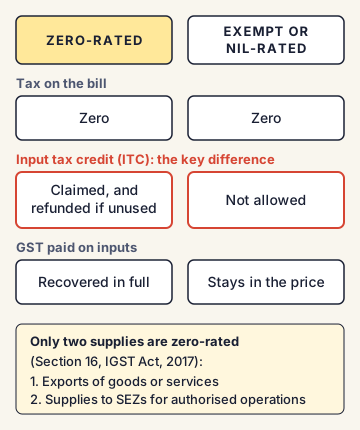
- Section 16(1) says zero-rated supply means (a) export of goods or services or both, and (b) supply of goods or services or both for authorised operations to an SEZ developer or SEZ unit.
- Section 16(2) says credit can be claimed on inputs for making zero-rated supplies, even if the supply is exempt.
- Section 16(3) gives the two ways to claim the benefit (explained below).
When is a service an "export"?
Goods are exported when they physically leave India. Services are trickier, because nothing crosses a border. So Section 2(6) of the IGST Act sets five conditions, and all five must be met:
- The supplier is located in India.
- The recipient is located outside India.
- The place of supply is outside India.
- Payment is received in convertible foreign exchange (or in Indian rupees where the RBI allows).
- The supplier and recipient are not merely establishments of a distinct person, that is, not just two branches of the same company.
The fifth condition matters a lot. Under Explanation 1 to Section 8 of the IGST Act, an office in India and an office outside India of the same company are treated as separate "distinct persons". But Section 2(6)(v) says supplies between such establishments do not count as exports. So when an Indian IT company served its own overseas branch, it could not claim export status.
How does an exporter claim the benefit? Two routes
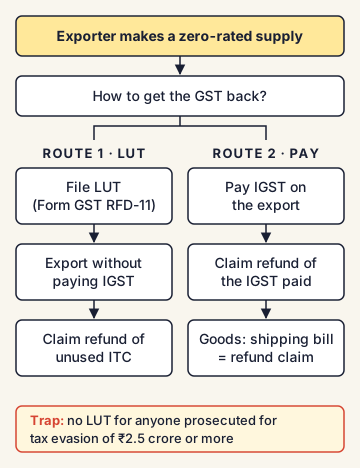
- Route 1: Export without paying tax under a Letter of Undertaking (LUT). The exporter files an LUT (Form GST RFD-11) promising to export, then supplies without charging IGST. It later claims a refund of its unutilised ITC. An LUT cannot be used by a person prosecuted for tax evasion of ₹2.5 crore or more.
- Route 2: Pay IGST and claim a refund of that IGST. The exporter pays IGST on the export and later gets it back. For goods, the shipping bill itself is treated as the refund claim, and the refund flows automatically through customs.
Where does the SEZ fit in?
An SEZ is an area inside India that is treated like foreign territory for tax and trade purposes. It was created under the Special Economic Zones Act, 2005. Supplies from the rest of India into an SEZ are treated like exports and are zero-rated, but only if they are for the SEZ's authorised operations (the business it is approved to do there).
How are refunds made faster?
The 56th GST Council meeting (3 September 2025) recommended a 90% provisional refund for zero-rated supplies too, based on automated risk evaluation. The same meeting recommended removing Section 13(8)(b) of the IGST Act, which had treated the place of supply of intermediary services (such as brokers and agents arranging deals for foreign clients) as India. After the change, effective 30 March 2026 through the Finance Act, 2026, such services to foreign clients can qualify as exports.
Commonly confused concepts
- Zero-rated vs exempt vs nil-rated: All three show zero tax on the bill. But on a zero-rated supply the seller can claim and get a refund of input credit. On exempt or nil-rated supplies, input credit is not allowed, so hidden tax stays in the price.
- Zero-rated supply vs deemed export: Deemed exports (Section 147 of the CGST Act) are supplies where goods do not leave India, such as supplies to Export Oriented Units or against an Advance Authorisation. They are notified by the government and get refunds, but they are not zero-rated under Section 16 of the IGST Act.
- SEZ vs EOU: An SEZ is a whole notified area treated as outside India's customs territory. An Export Oriented Unit (EOU) is a single unit anywhere in India that commits to export its output.
- Import of services vs export of services: Import is when an Indian business receives a service from abroad. Here the Indian buyer often pays GST under reverse charge (the buyer, not the seller, pays the tax).
Issues, criticism and the way forward
- Refund delays: For years, exporters complained of slow refunds that locked up working capital. Faster, system-driven provisional refunds aim to fix this.
- Narrow definition of service exports: The "distinct person" condition hurt IT, ITeS and global capability centres that serve foreign offices of the same group.
- Intermediary disputes: Section 13(8)(b) led to long litigation and was finally removed in 2026.
- Fraud risk: Fake exports have been used to claim large refunds, so tax officers still need strong risk checks.
- Way forward: Using data already with customs, the RBI's export monitoring systems and GSTN to process refunds automatically. Another step would be aligning GST rules on export payments with RBI rules, so honest exporters do not need to upload stacks of documents.
Concepts to Know
- Convertible foreign exchange: Foreign currency that can be freely exchanged in world markets, such as US dollars or euros.
- Place of supply: The legal "location" of a sale under GST. It decides whether a supply is within a state, between states, or an export.
- Letter of Undertaking (LUT): A written promise by an exporter that it will complete the export and follow the rules, so it can export without first paying IGST.
- Intermediary: A broker or agent who arranges a supply between two other parties but does not supply the main goods or services itself.
- Reverse charge: A system where the buyer, instead of the seller, pays GST to the government.
- Legal basis: Section 16, IGST Act, 2017; export of services defined in Section 2(6); export of goods in Section 2(5)
- Zero-rated supplies: (a) exports; (b) supplies to SEZ developers or units for authorised operations
- Five conditions for export of services; condition (v): not merely establishments of a distinct person (Explanation 1 to Section 8)
- Two routes: LUT (Form GST RFD-11) without tax plus ITC refund, or pay IGST and claim refund
- Refund of unutilised ITC on zero-rated supplies under Section 54(3)(i), CGST Act
- 90% provisional refund for zero-rated supplies recommended by the 56th Council (3 September 2025)
- Section 13(8)(b) (intermediary services) omitted with effect from 30 March 2026
- SEZs set up under the Special Economic Zones Act, 2005; deemed exports under Section 147, CGST Act
● Tracked since October 05, 2026 · last seen October 05, 2026 · updates as the daily brief publishes