Systematic Voters' Education and Electoral Participation (SVEEP)
Systematic Voters' Education and Electoral Participation, or SVEEP, is the Election Commission of India's (ECI) flagship programme for voter education. Its aim is simple: every eligible citizen should register as a voter, and every registered voter should cast a vote at every election, in an informed and ethical way. SVEEP uses posters, films, school clubs, social media, celebrity "icons", rallies and door-to-door contact to tell people why, how and where to vote.
It is not a law or a separate body. It is a planned programme that the ECI runs through election officers in every state and district.
Why does it exist?
Holding elections is not enough if many people do not take part. For years, the ECI noticed clear gaps: many young people never registered, women voted less than men in many areas, and educated city voters often stayed home on polling day (called urban apathy). Some voters also did not know how to use an EVM, where their booth was, or that selling a vote is a crime.
Think of a hospital that offers free check-ups but nobody knows about them: the service exists, but people do not use it. SVEEP is the "information campaign" that makes sure citizens use their right to vote.
What is its constitutional basis?
No article mentions SVEEP by name. Its base comes from the ECI's general duties:
- Article 324 gives the ECI the "superintendence, direction and control" of elections to Parliament, state legislatures, and the offices of President and Vice-President.
- Article 325 says no one can be left out of the voter list because of religion, race, caste or sex.
- Article 326 says elections to the Lok Sabha and state Assemblies will be held on the basis of adult suffrage (every citizen aged 18 or more can vote).
Together, these create a duty on the ECI to hold elections that are free, fair and inclusive, which means no group is left out. SVEEP is how the ECI carries out the "inclusive" part.
Where did it come from?
SVEEP started in 2009. Its first planned activities were used in the Jharkhand Assembly elections at the end of 2009. Since then it has moved in phases:
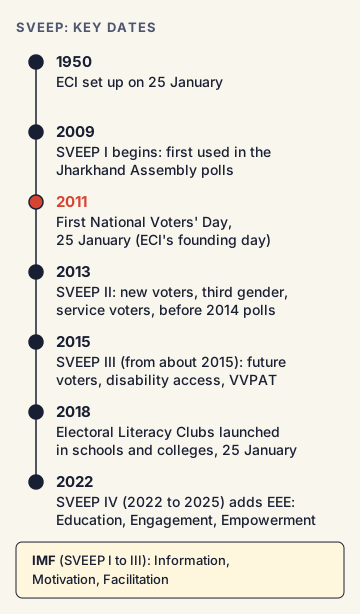
- SVEEP I (2009 to 2013): focus on registration, the gender gap, youth and urban apathy. National Voters' Day began in this phase, and the voter helpline 1950 was started.
- SVEEP II (2013 to 2014): focus on new voters, marginal groups, the third gender, service voters (armed forces staff) and better facilities at polling booths, before the 2014 Lok Sabha election.
- SVEEP III (from about 2015): focus on future voters, accessibility for persons with disabilities, Electoral Literacy Clubs, overseas electors, social media and EVM-VVPAT awareness.
- SVEEP IV (2022 to 2025): focus on closing the gender gap, bringing in non-voters and marginalised groups, youth and urban apathy, and ethical, informed voting.
How does it work? The IMF-EEE framework
SVEEP I to III followed an IMF model: Information (telling people the facts: dates, booths, documents), Motivation (convincing them that their vote matters) and Facilitation (making voting easier, for example ramps, wheelchairs and separate queues). SVEEP IV added EEE: Education, Engagement and Empowerment, so that voters do not only turn up but also understand democracy and vote thoughtfully.
Who runs it on the ground?
SVEEP follows the election machinery from top to bottom:
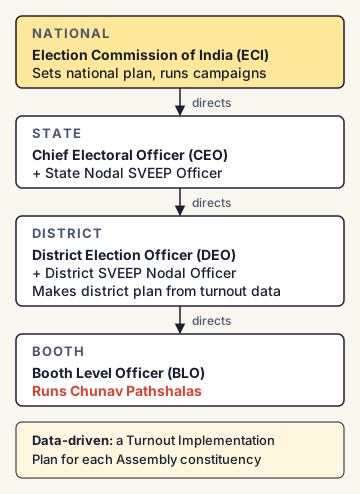
- ECI sets the national plan and runs national campaigns.
- State level: the Chief Electoral Officer (CEO) of the state, helped by a State Nodal SVEEP Officer.
- District level: the District Election Officer, helped by a District SVEEP Nodal Officer, makes a district plan based on local turnout data.
- Booth level: the Booth Level Officer (BLO) runs Chunav Pathshalas (election classes) for local people.
Planning is based on data. Officers study which constituencies and booths had low turnout, run surveys on voters' knowledge and attitudes, and prepare a Turnout Implementation Plan for each Assembly constituency.
The main tools of SVEEP
- Electoral Literacy Clubs (ELCs): launched on 25 January 2018 in schools (for future voters) and colleges (for new voters). Students learn about registration, EVMs and the value of voting through games and activities.
- Chunav Pathshala: election classes at the polling station level for people outside schools and colleges.
- Voter Awareness Forums: groups set up in government offices, companies and other organisations to spread awareness among employees.
- Campus Ambassadors: students who lead voter awareness on their campuses.
- National and state icons: well-known people, such as sportspersons and film actors, who appeal to voters.
- Partnerships: with universities, media houses, companies, public sector units and civil society organisations (CSOs) and NGOs, as well as youth bodies like the NSS, NYKS and NCC.
National Voters' Day
The ECI was set up on 25 January 1950, a day before the Constitution came into force. Since 2011, 25 January is celebrated every year as National Voters' Day. New voters receive their voter ID cards, and awards are given to the best-performing officers and partners.
India's position and results
Turnout in Lok Sabha elections rose from about 58% in 2009 to about 66% in 2014, and about 67.4% in 2019, the highest so far. In 2024, turnout at polling stations was 65.79%. Experts give some credit to SVEEP for the rise and for the narrowing gap between men and women voters, although many other factors also affect turnout. State Election Commissions, which run panchayat and municipal elections, often run their own awareness drives on similar lines.
Commonly confused concepts
- SVEEP vs Model Code of Conduct: SVEEP is about educating and encouraging voters. The Model Code of Conduct is a set of rules for parties and candidates during elections.
- ECI's SVEEP vs State Election Commission campaigns: SVEEP belongs to the ECI, which runs Lok Sabha, Assembly, President and Vice-President elections. Panchayat and municipal elections are run by State Election Commissions under Articles 243K and 243ZA, which plan their own voter awareness.
- Voter education vs election campaigning: voter education is non-partisan: it tells people how and why to vote, without saying whom to vote for. Campaigning asks for votes for a particular candidate or party.
- National Voters' Day (25 January) vs National Panchayati Raj Day (24 April): the first marks the ECI's founding; the second marks the 73rd Amendment coming into force in 1993.
- Ethical voting vs compulsory voting: SVEEP encourages voting without fear or bribes. India does not make voting compulsory for national or state elections.
Issues, criticism and the way forward
- Turnout has not grown much since 2014: national turnout stayed around 66% to 67%, and urban areas and young voters still lag. Critics say awareness alone cannot fix deeper causes such as migration for work, missing names in voter lists and loss of trust.
- Migrant voters: crores of people work away from home and cannot easily travel to vote. Awareness cannot solve this without solutions like remote voting.
- Quality of participation: sending more people to the booth is not enough if votes are bought with cash or gifts. Bribing voters is a corrupt practice under Section 123 of the Representation of the People Act, 1951. SVEEP IV gives more weight to ethical voting.
- Role of citizen groups: some argue the official programme works best when it partners with independent civil society groups, which often reach poor and rural voters better. Others point out that poll bodies must regulate such groups to make sure they stay non-partisan.
- Way forward: experts suggest year-round electoral literacy in schools, better use of data to target low-turnout booths, stronger partnerships with civil society, and steps for migrants.
Concepts to Know
- Turnout: the share of registered voters who actually vote. If 100 people are on the list and 65 vote, turnout is 65%.
- Urban apathy: the habit of many city voters, often educated, of not voting because they feel it makes no difference or find it inconvenient.
- Adult suffrage: the right of every adult citizen (18 years or more in India) to vote, without conditions of property, education, caste or gender.
- Gender gap (in voting): the difference between the share of men and women who register or vote.
- Civil society organisation (CSO): a non-government, non-profit group of citizens working for a public cause, such as NGOs, citizens' movements and community groups.
- Non-partisan: not supporting any party or candidate.
- Booth Level Officer (BLO): a local government employee who maintains the voter list for one polling booth area and helps voters there.
- SVEEP: ECI's flagship voter education programme, started in 2009 (first used in the end-2009 Jharkhand Assembly polls)
- Phases: SVEEP I (2009 to 2013), II (2013 to 2014), III (from about 2015), IV (2022 to 2025)
- Framework: IMF (Information, Motivation, Facilitation) plus EEE (Education, Engagement, Empowerment) from SVEEP IV
- Electoral Literacy Clubs launched 25 January 2018; Chunav Pathshalas at booth level; Voter Awareness Forums in organisations
- National Voters' Day: 25 January, celebrated since 2011 (ECI founded 25 January 1950); voter helpline 1950
- Lok Sabha turnout: about 58% (2009), about 66% (2014), about 67.4% (2019), 65.79% (2024)
- Constitutional base: Articles 324, 325, 326
● Tracked since November 03, 2026 · last seen November 03, 2026 · updates as the daily brief publishes