Subduction Zones and Volcanic Arcs
A subduction zone is a place where one of the Earth's huge tectonic plates slides down under another plate and sinks into the hot layer below. As the sinking plate goes deep, it causes rock above it to melt, and this melted rock rises to form a line of volcanoes called a volcanic arc. Most of the world's explosive volcanoes and biggest earthquakes happen at subduction zones.
What are tectonic plates?
The Earth's outer shell is not one solid piece. It is broken into about a dozen large pieces and many small ones, called tectonic plates. They float on a hot, slowly flowing layer below and move a few centimetres a year, about as fast as your fingernails grow. Where two plates meet is called a plate boundary. There are three types:
- Divergent: plates move apart (for example, the Mid-Atlantic Ridge). New crust forms here.
- Convergent: plates move towards each other. Subduction zones are a kind of convergent boundary.
- Transform: plates slide past each other sideways (for example, the San Andreas Fault in the US).
Why does one plate sink?
Plates are of two kinds. Oceanic plates are thin but heavy (dense). Continental plates are thick but lighter. When two plates push into each other, the heavier oceanic plate bends and sinks under the other one. Where it bends down, a deep, narrow valley forms on the sea floor, called an ocean trench. The Mariana Trench in the Pacific, the deepest place on Earth (about 11 km), is one such trench.
How do the volcanoes form?
Step by step:
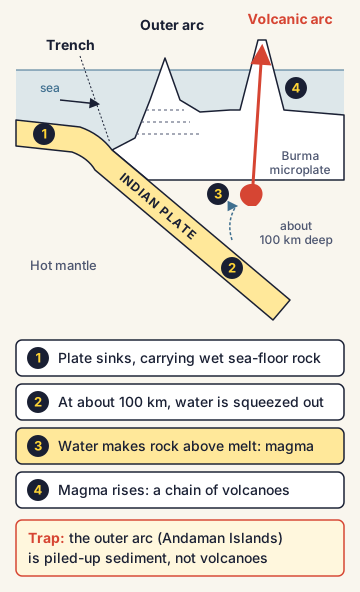
- The sinking plate carries wet sea-floor rock and sediment down with it.
- At a depth of roughly 100 km, heat and pressure squeeze the water out.
- This water rises into the hot rock above and lowers its melting point, just as salt helps ice melt at a lower temperature. The rock partly melts and forms magma.
- The magma is lighter than the rock around it, so it rises and erupts at the surface.
- Over time, a chain of volcanoes forms parallel to the trench. This chain is the volcanic arc.
Two kinds of arcs
- Island arc: formed when an oceanic plate sinks under another oceanic plate. The volcanoes rise from the sea as a curved chain of islands. Examples: Japan, the Aleutian Islands, Indonesia, and the Andaman volcanoes.
- Continental arc: formed when an oceanic plate sinks under a continent. The volcanoes form a mountain range on land. Examples: the Andes in South America and the Cascades in the US.
- When two continents collide, neither sinks easily, so there are mountains but almost no volcanoes. The Himalayas, formed by the Indian plate pushing into the Eurasian plate, are the classic example.
The Pacific Ring of Fire
The edges of the Pacific Ocean are surrounded by subduction zones, from New Zealand and Indonesia to Japan, Alaska and the Andes. This horseshoe-shaped belt is called the Ring of Fire. It has about three-quarters of the world's active volcanoes, and about 90% of the world's earthquakes happen along it.
India's example: the Andaman arc
In the Bay of Bengal, the Indian plate is sliding under a smaller plate to its east called the Burma microplate (a piece of the Eurasian side). This happens along the Andaman-Sunda trench, which runs west of the islands down to Sumatra in Indonesia. This one system creates three belts, from west to east:
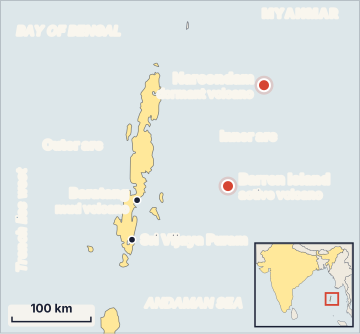
- The trench, deep under the sea, west of the islands.
- The outer arc: the Andaman and Nicobar Islands themselves. These are not volcanoes. They are piled-up sea-floor sediment and rock (an accretionary prism) pushed up by the collision. This is also why Baratang has mud volcanoes.
- The inner volcanic arc, further east in the Andaman Sea: Barren Island and Narcondam Island, which are true volcanoes. UNESCO's entry calls them the "Andaman Subduction Volcanoes".
East of these volcanoes, the Andaman Sea floor is slowly being pulled apart. Geologists call this a back-arc basin.
Barren Island: India's only active volcano
- It lies in the Andaman Sea, about 138 km from Sri Vijaya Puram (formerly Port Blair), the capital of the Andaman and Nicobar Islands.
- Its summit rises about 354 m above the sea, but the whole volcano rises from a sea floor about 2,250 m deep, so most of it is under water.
- Its first recorded eruption was in 1787. After a long quiet period, it became active again in 1991, and it has erupted many times since, including in 1994-95, 2005-06 and the late 2010s.
- It is the only confirmed active volcano in India and in South Asia. It has no permanent human population.
Narcondam Island: a dormant volcano
- It lies about 240 km north-east of the capital. Its name is thought to come from "Naraka-Kundam", meaning a pit of hell.
- It rises steeply from deep water to about 710 m, with a forested top. It covers about 6.8 sq km.
- It is home to the Narcondam hornbill, a bird found nowhere else on Earth. It is listed as Endangered on the IUCN Red List and protected under Schedule I of the Wild Life (Protection) Act, 1972.
- The island is protected as the Narcondam Island Wildlife Sanctuary (about 681 hectares).
Active, dormant and extinct: what do they mean?
- Active: has erupted in recent history and may erupt again (Barren Island).
- Dormant: has not erupted for a long time but could erupt again (Narcondam).
- Extinct: is not expected to erupt ever again.
Why subduction zones matter for India: earthquakes and tsunamis
The plates in a subduction zone do not slide smoothly. They get stuck and build up strain for decades or centuries, then suddenly slip. This causes a megathrust earthquake. On 26 December 2004, such a slip along the Sumatra-Andaman subduction zone caused a magnitude 9.1 earthquake. It pushed the sea floor up and set off the Indian Ocean tsunami, which killed about 2,30,000 people across many countries, including India's coasts and the Andaman and Nicobar Islands. After this, India set up the Indian Tsunami Early Warning Centre (ITEWC) at INCOIS, Hyderabad, in 2007.
Commonly confused concepts
- Outer arc vs inner arc in the Andamans: The Andaman and Nicobar Islands (outer arc) are uplifted sediment, not volcanoes. Barren and Narcondam (inner arc) are the actual volcanoes.
- Subduction zone vs collision zone: In subduction, one plate sinks and volcanoes form (Andaman, Japan). In continent-continent collision, plates crumple upward into mountains with almost no volcanoes (Himalayas).
- Barren Island vs Baratang: Barren erupts lava and ash from magma; Baratang erupts only mud and gas.
- Trench vs ridge: A trench is where old crust sinks (convergent). A mid-ocean ridge is where new crust forms (divergent).
Issues, criticism and the way forward
- Hazard: The Andaman region is in Seismic Zone V, the highest earthquake-risk zone in India, and faces tsunami risk. Large projects in the islands must plan for this.
- Fragile island life: Both volcano islands are protected areas, and entry needs permission from wildlife wardens. The Narcondam hornbill lives only on one small island, so any disturbance could wipe it out.
- Strategic and development pressure: Plans for infrastructure in the islands (for example, a Coast Guard radar proposal on Narcondam that was first rejected in 2012 and later cleared, and the Great Nicobar project) create a debate between security, development and conservation.
- Way forward: Experts call for continuous volcano and earthquake monitoring, strict protection of the two islands, and science-based tourism. A World Heritage tag could bring more global support for research and protection.
Concepts to Know
- Tectonic plate: A huge, rigid slab of the Earth's outer shell that moves slowly over the hot layer beneath it.
- Magma and lava: Magma is melted rock under the ground. When it comes out on the surface, it is called lava.
- Megathrust earthquake: A very large earthquake that happens when two plates locked together in a subduction zone suddenly slip.
- Endemic species: A plant or animal that is found naturally in only one place in the world.
- Schedule I (Wild Life (Protection) Act, 1972): The list of animals that get the highest level of legal protection in India. Hunting them brings the strongest punishment.
- INCOIS: Indian National Centre for Ocean Information Services, Hyderabad, under the Ministry of Earth Sciences. It runs India's tsunami warning system.
- Plate boundaries: divergent, convergent (subduction is one type) and transform
- Island arcs (ocean under ocean): Japan, Aleutians, Andaman; continental arcs (ocean under continent): Andes, Cascades
- Ring of Fire: about 75% of active volcanoes and about 90% of earthquakes
- Andaman: Indian plate subducts under the Burma microplate along the Andaman-Sunda trench
- Barren Island: India's only active volcano; summit about 354 m; first recorded eruption 1787; reactivated in 1991; about 138 km from Sri Vijaya Puram
- Narcondam Island: dormant volcano, about 710 m high, about 6.8 sq km; Narcondam hornbill (Endangered, Schedule I); wildlife sanctuary of about 681 ha
- 26 December 2004: magnitude 9.1 Sumatra-Andaman earthquake and Indian Ocean tsunami
● Tracked since October 20, 2026 · last seen October 20, 2026 · updates as the daily brief publishes