Mud Volcanoes
How the Earth Erupts Mud
A mud volcano is a small hill or cone that throws out mud, water and gas instead of hot lava. The mud comes from soft rock layers a few kilometres below the ground, where gas and water are trapped under high pressure. When cracks open up, this pressure pushes the mixture to the surface, a bit like a soda bottle fizzing out when you open it after shaking it. Mud volcanoes are usually cool to the touch and are not linked to molten rock.
Why do mud volcanoes form?
Deep underground, layers of clay and sand pile up very fast, often faster than the water inside them can escape. Gas (mostly methane) is also produced as buried plant and animal matter breaks down. This trapped water and gas build up huge pressure. When an earthquake, a moving fault or the squeezing of rocks opens a crack, the pressure finds a way out and pushes the mud up. The source layers are usually about 1 to 5 km below the surface.
Where do they occur?
Mud volcanoes are found in two main kinds of places:
- Subduction zones and their "accretionary prisms", where one tectonic plate slides under another and scrapes off thick piles of wet sediment. The Andaman and Nicobar Islands and the Makran coast of Pakistan and Iran are examples.
- Oil and gas regions, where thick sediment layers hold large amounts of gas. This is why mud volcanoes are often a sign of possible oil and gas below.
How is a mud volcano different from a real volcano?
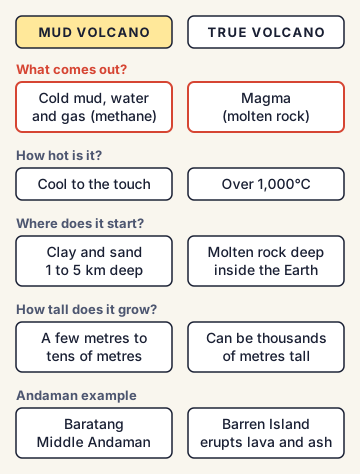
- A true (igneous) volcano erupts magma, which is molten rock from deep inside the Earth (called lava once it reaches the surface). It can be over 1,000°C.
- A mud volcano erupts cold mud, water and gas from sediment layers only a few kilometres deep. It has no magma.
- A true volcano can build mountains thousands of metres high. Most mud volcanoes are only a few metres to a few tens of metres tall.
Famous examples around the world
- Azerbaijan has the largest number of mud volcanoes in the world, roughly 300 to 400, about a third of the world's total.
- Lusi in East Java, Indonesia, began erupting in May 2006 and is often called the world's largest mud eruption. It buried villages and forced tens of thousands of people to move. Scientists still debate whether a nearby gas well or an earthquake triggered it.
- Chandragup (also called Baba Chandrakup) in Balochistan, Pakistan, is a mud volcano on the route to the Hinglaj temple and is visited by Hindu pilgrims.
India's example: Baratang
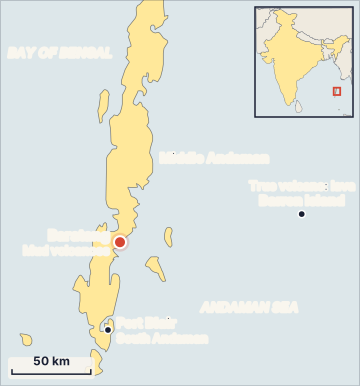
Baratang Island lies in Middle Andaman, between South and Middle Andaman. It is the only place in India with active mud volcanoes. The Geological Survey of India (GSI) lists the Baratang mud volcanoes as a geo-heritage site. They erupt from time to time: a large eruption was recorded in March 1983, and on 2 October 2025 a fresh eruption at Jarawa Creek built a mound about 3 to 4 metres high and spread mud over more than 1,000 sq metres. Baratang also has limestone caves, which is why the UNESCO entry calls it a "karst-mud-volcano complex".
What is karst, and why are there caves at Baratang?
Karst is a landscape made when rainwater slowly dissolves limestone rock. Rainwater picks up carbon dioxide and becomes a very weak acid. Over thousands of years, it eats away at limestone along cracks, forming caves, sinkholes and underground streams. Inside the caves, dripping water leaves behind lime and builds icicle-like shapes:
- Stalactites hang down from the cave ceiling.
- Stalagmites grow up from the cave floor.
- When the two meet, they form a pillar or column.
In India, well-known karst caves include Borra Caves (Andhra Pradesh), the caves of Meghalaya, and the limestone caves of Kanger Valley National Park (Chhattisgarh), along with Baratang.
Commonly confused concepts
- Mud volcano vs geyser: A geyser shoots out hot water and steam heated by magma below (for example, in Yellowstone in the US). A mud volcano pushes out cold mud and gas because of pressure in sediment layers.
- Mud volcano vs mud pot: A mud pot (or mud pool) is a bubbling pool of hot, acidic mud in a volcanic area, heated by magma. A mud volcano is not heated by magma.
- Mud volcano vs Barren Island: Both are in the Andamans, but Barren Island is a true volcano that erupts lava and ash. Baratang's volcanoes erupt only mud and gas.
Issues, criticism and the way forward
- Safety: Sudden eruptions can hurt visitors. After the 2025 eruption, tourist access to the site was stopped for some time.
- Tourism pressure: Baratang is a popular day trip, and the road to it passes through the Jarawa Tribal Reserve. Too much tourism can harm both the fragile site and the protected Jarawa community, who are a Particularly Vulnerable Tribal Group (PVTG).
- Methane: Mud volcanoes release methane, a strong greenhouse gas, so scientists study them as a natural source of climate-warming gases.
- Way forward: Experts suggest regular scientific monitoring by GSI, controlled eco-tourism with visitor limits, and better public information. UNESCO notes that well-managed eco-tourism could support local livelihoods and conservation.
Concepts to Know
- Methane: A colourless gas made of carbon and hydrogen. It is the main part of natural gas and traps much more heat than carbon dioxide over short periods.
- Accretionary prism: A wedge-shaped pile of sediment scraped off a sinking tectonic plate and pushed up against the edge of the plate above it, like snow piling up in front of a snow plough.
- Geo-heritage site: A site that the Geological Survey of India marks as important for understanding the Earth's history, so that it can be protected and studied.
- Limestone: A soft rock made mostly of calcium carbonate, often formed from shells and skeletons of old sea creatures.
- PVTG (Particularly Vulnerable Tribal Group): A sub-category of Scheduled Tribes with very small populations, low literacy and pre-agricultural ways of life, who need special protection. India has 75 PVTGs.
- Mud volcanoes erupt mud, water and gas (mainly methane), not magma; the source layers are about 1 to 5 km deep
- Azerbaijan has the most mud volcanoes in the world (roughly 300 to 400)
- Lusi (East Java, Indonesia) began erupting in May 2006
- Baratang Island (Middle Andaman) has India's only active mud volcanoes; GSI lists them as a geo-heritage site
- Baratang eruptions: a large one in March 1983; a fresh one on 2 October 2025 at Jarawa Creek
- Karst: limestone landscape shaped by dissolving rainwater; stalactites hang from the ceiling, stalagmites rise from the floor
● Tracked since October 20, 2026 · last seen October 20, 2026 · updates as the daily brief publishes