Sirpur
Ancient Temple Town of Chhattisgarh
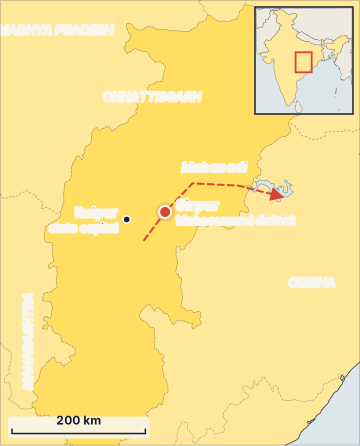
Sirpur is a village on the banks of the Mahanadi river in Mahasamund district of Chhattisgarh, about 78 km from Raipur. About 1,400 years ago it was Shripura, the capital of an ancient kingdom called Dakshina Kosala (South Kosala). Excavations here have revealed Hindu temples, Buddhist monasteries, Jain shrines, a market and a bath house, built between roughly the 5th and 12th centuries CE. It is one of the best places in India to see how different religions lived side by side in one ancient city.
Why is Sirpur important?
Most early Indian sites show either temples or monasteries. Sirpur shows a whole working city: places of worship of three religions, homes of priests, a palace complex, a market and a river port area. This is why UNESCO's entry calls it a cultural and archaeological landscape: it shows how a spiritual centre grew into a cultural and economic hub, supported by kings of different faiths and by trade.
Where did it come from? The history
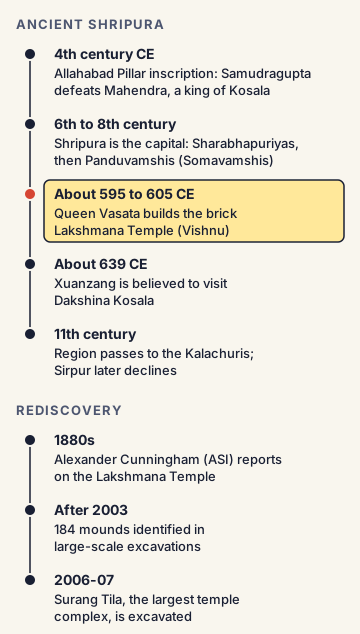
- The region of Dakshina Kosala roughly covered today's Chhattisgarh and western Odisha. A king of Kosala named Mahendra appears in the list of kings defeated by Samudragupta, recorded in the 4th-century Allahabad Pillar inscription.
- Sirpur (Shripura) was the capital first under the Sharabhapuriya dynasty and then under the Panduvamshi (also called Somavamshi) dynasty, roughly in the 6th to 8th centuries CE.
- The Panduvamshi king Mahashivagupta Balarjuna ruled for a long period in the late 6th and 7th centuries. He was called "Balarjuna" (young Arjuna) for his skill with weapons. He was a Shaiva (worshipper of Shiva) but gave generous grants to Buddhist monasteries too.
- The Chinese Buddhist pilgrim Xuanzang (Hiuen Tsang) is believed to have visited Dakshina Kosala around 639 CE. He wrote of about 100 monasteries and some 10,000 Mahayana monks in Kosala. Some historians point out that his account does not name the capital, so the link to Sirpur is a strong identification rather than a proven fact.
- In the 11th century, the region passed to the Kalachuri dynasty. Sirpur later declined. Scholars still debate whether an earthquake or invasions and plunder caused this.
How was it rediscovered?
The British archaeologist Alexander Cunningham, first head of the Archaeological Survey of India (ASI), reported on the Lakshmana temple in the 1880s, which brought the site to wide attention. Excavations took place in the 1950s and again later. After 2003, large-scale digging identified 184 mounds. The finds include:
- 22 Shiva temples and 5 Vishnu temples
- 10 Buddhist viharas (monasteries) and 3 Jain viharas
- A market from the 6th to 7th century and a bath house Sirpur was also a major centre for making bronze statues.
The key monuments
- Lakshmana Temple: Sirpur's most famous monument and its earliest dated one, built around 595 to 605 CE. It was built by Queen Vasata, the widow of King Harshagupta and the mother of King Balarjuna. It is a Vishnu temple built of brick, with a carved stone door frame showing Vishnu and his ten avatars. It is one of the finest surviving brick temples in India and an early example of the Nagara (north Indian) style.
- Surang Tila: the largest temple complex at Sirpur, built on a high stepped platform. It was excavated in 2006-07 and dates to the 7th or 8th century.
- Gandheshwar Temple: a Shiva temple on the bank of the Mahanadi that is still used for worship.
- Baleshwar Mahadev group: Shiva temples built under King Balarjuna.
- Rama Temple: mostly in ruins, from about 600 CE, with one of the earliest star-shaped platforms in central India.
- Anand Prabhu Kuti Vihara: a 14-room Buddhist monastery supported by Balarjuna, with an inscription recording his gift to the monks.
- Swastika Vihara: a Buddhist monastery whose floor plan looks like a swastika.
- Teevardev Vihara: a monastery that mixes Buddhist and Hindu art.
- Jain remains: a Jain shrine and a 9th-century bronze image of Adinatha (Rishabhanatha, the first Tirthankara).
How is it laid out?
UNESCO's description divides the site by area: the Vishnu temple complex and a Shiva temple on the eastern side; two priests' houses and a Shiva temple on the southern side; the Rajmahal (palace) complex and Gandheshwar Temple on the western side; a Shiva temple of the pancharatha type on the northern side; and the Bateshwar group of monuments at the centre.
India's protection framework
Sirpur is a nationally protected monument under the Ancient Monuments and Archaeological Sites and Remains Act, 1958 (AMASR Act), looked after by the ASI. The ASI runs a site museum in the Lakshmana temple premises.
Commonly confused concepts
- Sirpur (Chhattisgarh) vs Sirpur (Telangana): There is also a Sirpur in Telangana's Komaram Bheem Asifabad district. The heritage site is the one in Chhattisgarh.
- Dakshina Kosala vs Uttara Kosala: Uttara (north) Kosala, with capitals Ayodhya and Shravasti, was one of the 16 Mahajanapadas in present-day Uttar Pradesh. Dakshina (south) Kosala was a different region in today's Chhattisgarh and western Odisha.
- Lakshmana Temple, Sirpur vs Lakshmana Temple, Khajuraho: The Sirpur temple is a 7th-century brick temple in Chhattisgarh. The Khajuraho temple is a 10th-century sandstone temple built by the Chandelas in Madhya Pradesh.
- Brick temple examples: Sirpur's Lakshmana Temple is often compared with the Gupta-period brick temple at Bhitargaon (Kanpur, Uttar Pradesh). Both are rare survivors, since most early temples were later built in stone.
- Tentative List vs World Heritage Site: Being on the Tentative List does not make Sirpur a World Heritage Site. It only allows India to nominate it later.
Issues, criticism and the way forward
- Brick decay: Brick is weaker than stone. Rain, plants and the river's floods slowly damage the excavated structures, so they need careful conservation.
- Unfinished study: Many mounds are still not fully studied or published, and the cause of the city's decline is still not settled.
- Low awareness: Sirpur gets far fewer visitors than sites like Khajuraho or Sanchi. Better roads, signs and guides could help local people earn from tourism.
- Way forward: Experts suggest a full site management plan, scientific conservation of brick structures, publication of excavation reports, and community-based tourism. These steps would also make a stronger World Heritage nomination.
Concepts to Know
- Vihara: A Buddhist (or Jain) monastery, where monks lived, studied and prayed, usually with small rooms around a courtyard.
- Nagara style: The north Indian style of temple building, with a tall, curved tower (shikhara) over the main shrine.
- Cultural landscape: A UNESCO category, added in 1992, for places that show how people and nature together shaped an area over a long time.
- Shaiva: A follower of Shiva.
- Tirthankara: In Jainism, one of 24 great teachers who show the path to liberation. Adinatha (Rishabhanatha) is the first and Mahavira the 24th.
- Allahabad Pillar inscription (Prayag Prashasti): A praise-poem written by the court poet Harisena about the Gupta king Samudragupta, listing the kings he defeated.
- Location: Sirpur village, Mahasamund district, Chhattisgarh; on the Mahanadi river; about 78 km from Raipur
- Ancient name: Shripura, capital of Dakshina Kosala under the Sharabhapuriya and then the Panduvamshi (Somavamshi) dynasties
- Monuments span the 5th to 12th centuries CE: Hindu, Buddhist and Jain
- Lakshmana Temple: brick Vishnu temple, about 595 to 605 CE, built by Queen Vasata, widow of King Harshagupta and mother of Mahashivagupta Balarjuna
- After 2003: 184 mounds identified; 22 Shiva temples, 5 Vishnu temples, 10 Buddhist viharas, 3 Jain viharas found
- Surang Tila excavated in 2006-07; largest temple complex at Sirpur
- Xuanzang is believed to have visited Dakshina Kosala around 639 CE
- Protected by the ASI under the AMASR Act, 1958
● Tracked since October 20, 2026 · last seen October 20, 2026 · updates as the daily brief publishes