State Legislative Council (Vidhan Parishad)
A State Legislative Council, or Vidhan Parishad, is the upper house of a state legislature. Most states have only one house, the Legislative Assembly (Vidhan Sabha). A few states also have a Council, which makes their legislature bicameral (two houses). Members of the Council are called MLCs. Most of them are elected indirectly, and some are nominated by the Governor.
Why does it exist?
The Council is meant to be a house of second thought. It can check hasty laws passed by the Assembly. It also brings in people who may never contest a direct election: teachers, graduates, local body representatives, and experts in literature, science, art, the cooperative movement and social service. But because the Constitution makers were not sure every state needed it, they made it optional. Each state can decide whether it wants one.
Where did it come from?
Upper houses existed in some provinces under the Government of India Act, 1935. The Constitution kept the idea in Part VI. Article 168 lists the states that have two houses, and Article 169 lets states create or abolish their Council. Over the years, several Councils have been created and abolished:
- West Bengal and Punjab abolished their Councils in 1969 (some sources give 1970 for Punjab).
- Andhra Pradesh had a Council from 1958, abolished it in 1985, and brought it back in 2007.
- Tamil Nadu abolished its Council in 1986 (Tamil Nadu Legislative Council (Abolition) Act, 1986).
- Jammu and Kashmir had a Council until 2019, when the state became two Union Territories.
- In 2020, the Andhra Pradesh Assembly passed a resolution to abolish its Council again, but withdrew it in November 2021.
How is a Council created or abolished? (Article 169)
It is a two-step process:
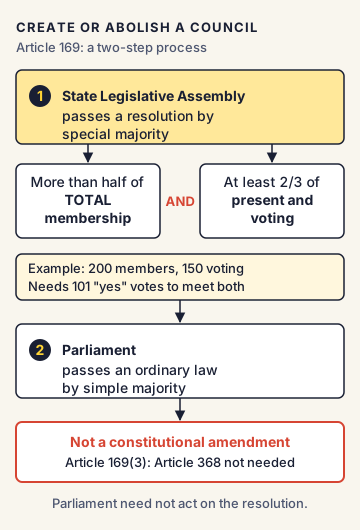
- The State Legislative Assembly passes a resolution by a special majority: a majority of its total membership, and also at least two-thirds of members present and voting.
- Parliament then passes an ordinary law (by simple majority) to create or abolish the Council.
Example: an Assembly has 200 members. On the day of the vote, 150 are present and voting. The resolution needs at least 101 votes (more than half of 200) and at least 100 votes (two-thirds of 150). So it needs 101 "yes" votes. Article 169(3) says such a law is not treated as an amendment of the Constitution under Article 368, even though it changes things like Article 168. Parliament is also not bound to act on a state's resolution.
Which states have a Council today?
Six states:
- Uttar Pradesh: 100 members
- Maharashtra: 78
- Bihar: 75
- Karnataka: 75
- Andhra Pradesh: 58
- Telangana: 40
Some states have asked for a Council but are still waiting. Bills for Rajasthan (introduced in 2013) and Assam (2013) are pending in Parliament. The Odisha Assembly (2018) and West Bengal Assembly (2021) have also passed resolutions.
How big can it be? (Article 171)
The Council's size is linked to the Assembly:
- Maximum: one-third of the total members of the Assembly. (The original 1950 text said one-fourth; the Seventh Amendment Act, 1956 changed it to one-third.)
- Minimum: 40 members. Telangana's Council is at this minimum.
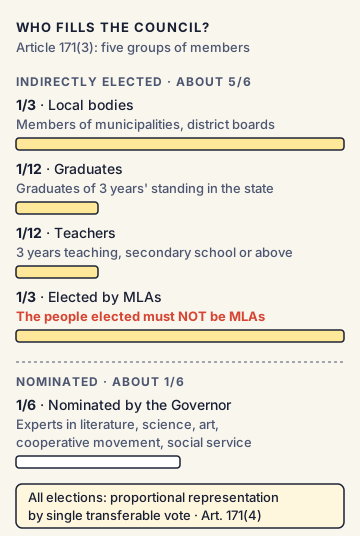
Who elects the members? (Article 171(3)) Members come from five groups:
- About one-third are elected by members of local bodies, such as municipalities and district boards.
- About one-twelfth are elected by graduates living in the state who have been graduates for at least three years.
- About one-twelfth are elected by teachers who have taught for at least three years in the state, in institutions not lower than a secondary school.
- About one-third are elected by the MLAs, from among people who are not MLAs.
- The rest (about one-sixth) are nominated by the Governor, from people with special knowledge or practical experience in literature, science, art, the cooperative movement and social service.
So about five-sixths are indirectly elected, and one-sixth are nominated. All elections are by proportional representation through the single transferable vote (Article 171(4)). Graduates and teachers register separately for their voter lists (Form 18 for graduates and Form 19 for teachers, under the Registration of Electors Rules, 1960).
Term and membership
The Council is a permanent house: it is never dissolved (Article 172(2)). Each member serves six years. About one-third of members retire every two years, and fresh elections fill those seats. This is just like the Rajya Sabha. To become an MLC, a person must be a citizen of India and at least 30 years old (Article 173(b)). The Council chooses its own Chairman and Deputy Chairman from among its members (Article 182).
What powers does it have?
The Council is much weaker than the Assembly:
- Ordinary bills (Article 197): The Council can delay a bill passed by the Assembly by up to three months the first time. If the Assembly passes it again, the Council can hold it for only one more month. After that, the bill is treated as passed by both houses. So the Council can delay a bill by at most four months, but can never block it.
- Money bills (Article 198): A money bill can start only in the Assembly. The Council must return it within 14 days, with or without suggestions. The Assembly may accept or reject those suggestions.
- No-confidence: The Council of Ministers is responsible only to the Assembly (Article 164(2)). The Council cannot remove the government.
- No joint sitting: Unlike Parliament, there is no joint sitting of the two state houses to solve a deadlock. The Assembly simply has the final say.
- MLCs do not vote in the election of the President or of Rajya Sabha members.
Commonly confused concepts
- Legislative Council vs Rajya Sabha: Both are permanent upper houses where one-third retire every two years. But the Rajya Sabha is required by the Constitution and has special powers (for example, Article 249 to let Parliament make laws on State List subjects, and Article 312 to create new All India Services). The Council is optional and has no such powers. The Rajya Sabha can delay an ordinary bill for up to six months and can force a joint sitting; the Council can delay a bill for at most four months and has no joint sitting.
- Article 169 vs Article 368: Creating or abolishing a Council needs only an ordinary law of Parliament (after a special-majority state resolution). It does not need a constitutional amendment under Article 368, even though the text of Article 168 effectively changes.
- Graduates' constituency vs ordinary constituency: In a graduates' or teachers' seat, only registered graduates or teachers vote. In an ordinary Assembly constituency, every adult citizen on the voter list votes.
- Minimum age: 25 years for an MLA, but 30 years for an MLC (same as for the Rajya Sabha).
Issues, criticism and the way forward
- Supporters say the Council adds expert voices, allows more careful debate on bills, and gives graduates, teachers and local bodies a direct say in law-making.
- Critics say it costs money but has little real power, since it can only delay bills. They argue it is sometimes used to bring in people who lost direct elections, or to make someone a minister without facing voters.
- The graduates and teachers seats were designed for a time when few people were educated. Some experts argue that, with many more graduates today, the logic needs fresh thinking. Others say the idea of including educated voices is still valuable.
- Political shifts: States have created and abolished Councils as governments changed, which suggests decisions are sometimes driven by short-term reasons. A Parliamentary Standing Committee, while examining the Rajasthan and Assam bills, suggested a national policy on whether states should have Councils, so that the matter is not decided case by case.
Concepts to Know
- Bicameral / unicameral: A bicameral legislature has two houses (like Parliament with Lok Sabha and Rajya Sabha). A unicameral legislature has only one house.
- Special majority (as in Article 169): A majority that needs two conditions at once: more than half of the total members of the house, and at least two-thirds of those present and voting.
- Money bill: A bill only about taxes, government borrowing, or spending from the state's funds. Only the Assembly has the real power over such bills.
- Nominated member: A member who is not elected but is chosen and appointed by the Governor because of their special knowledge or experience.
- Local bodies: Elected local governments such as municipalities, panchayats and district councils.
- Article 168: states with two houses; Article 169: creation and abolition; Article 171: composition; Article 172(2): permanent house; Article 173: qualifications; Article 182: Chairman
- Article 169 process: Assembly resolution by special majority, then an ordinary law of Parliament; not an amendment under Article 368
- Six states have Councils: UP (100), Maharashtra (78), Bihar (75), Karnataka (75), Andhra Pradesh (58), Telangana (40)
- Size: not more than one-third of Assembly strength, not less than 40 (one-third limit set by the Seventh Amendment, 1956)
- Composition: 1/3 local bodies, 1/12 graduates (3 years' standing), 1/12 teachers (3 years, secondary school or above), 1/3 MLAs, about 1/6 nominated by Governor
- Term: 6 years; one-third retire every 2 years; minimum age 30
- Ordinary bill delay: 3 months + 1 month (maximum 4 months); money bill: 14 days
- Abolished: West Bengal (1969), Punjab (1969/1970), Tamil Nadu (1986), Andhra Pradesh (1985, revived 2007), J&K (ended 2019)
- Pending: Rajasthan and Assam Council Bills (2013); resolutions by Odisha (2018) and West Bengal (2021)
● Tracked since October 31, 2026 · last seen November 03, 2026 · updates as the daily brief publishes