Second Administrative Reforms Commission (2nd ARC)
The Second Administrative Reforms Commission, or 2nd ARC, was a body set up by the Government of India in 2005 to suggest how to make public administration in the country better. Its job was to prepare a complete plan for reforming the government machinery at every level: Union, state, district and local. Between 2006 and 2009 it gave 15 reports on topics such as the Right to Information, ethics, police and public order, local government, civil services and e-governance.
Its reports are still among the most quoted documents on governance reform in India, and UPSC uses them often in GS2 and GS4 (Ethics).
Why was it needed?
Government in India grew very large after Independence, but many of its rules and ways of working came from the British period. Citizens often faced delays, corruption, too many layers of officers and a lack of accountability (no one answering for poor work). Think of an old house: over the years, rooms were added one after another without a plan, and now the wiring and plumbing do not work well together.
An administrative reforms commission is like hiring an expert to study the whole house and suggest a proper renovation plan, instead of fixing one tap at a time.
Where did it come from? The first ARC
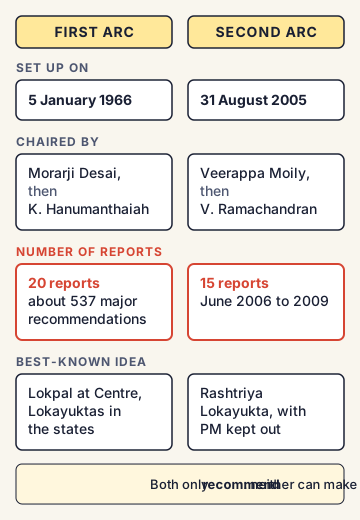
India had tried this once before. The First Administrative Reforms Commission was set up on 5 January 1966. It was first chaired by Morarji Desai. When he became Deputy Prime Minister, K. Hanumanthaiah took over as chairman. The first ARC gave 20 reports with about 537 major recommendations, on subjects like Centre-State relations, personnel administration, public sector undertakings and state administration.
Its best-known idea was an ombudsman (an independent officer who looks into citizens' complaints against the government) in the form of a Lokpal at the Centre and Lokayuktas in the states.
The second ARC: setting up and members
About forty years later, the government decided a fresh review was needed. The 2nd ARC was constituted on 31 August 2005 as a Commission of Inquiry. Its members were:
- Veerappa Moily: Chairperson
- V. Ramachandran: Member
- Dr. A.P. Mukherjee: Member
- Dr. A.H. Kalro: Member
- Jayaprakash Narayan: Member (resigned with effect from 1 September 2007)
- Vineeta Rai: Member-Secretary
Veerappa Moily resigned with effect from 1 April 2009, and V. Ramachandran became the chairman for the final phase.
What did it produce? The 15 reports
These titles are asked about directly in exams, so learn the order and the subjects:
- Right to Information: Master Key to Good Governance (June 2006)
- Unlocking Human Capital: Entitlements and Governance, a Case Study (on the rural employment guarantee scheme)
- Crisis Management: From Despair to Hope
- Ethics in Governance
- Public Order
- Local Governance
- Capacity Building for Conflict Resolution
- Combating Terrorism
- Social Capital: A Shared Destiny
- Refurbishing of Personnel Administration: Scaling New Heights
- Promoting e-Governance: The SMART Way Forward
- Citizen Centric Administration: The Heart of Governance
- Organisational Structure of Government of India
- Strengthening Financial Management Systems
- State and District Administration
Some well-known recommendations
A few ideas from these reports come up again and again in exams and in public debate:
- Official Secrets Act, 1923 (1st report): it suggested repealing this colonial-era secrecy law and putting the needed security provisions into a chapter of the National Security Act instead, so that secrecy does not block the Right to Information. The government did not accept this.
- Rashtriya Lokayukta (4th report, Ethics in Governance): it suggested a national ombudsman called the Rashtriya Lokayukta, to cover Union ministers, Chief Ministers and Members of Parliament, but not the Prime Minister, to protect the PM's constitutional position. The later Lokpal and Lokayuktas Act, 2013 chose differently: it does cover the Prime Minister, with special safeguards.
- Civil services entry age (10th report): it suggested lowering the upper age limit for the Civil Services Examination to 25 years for general candidates, 28 for OBC candidates and 29 for SC/ST candidates (from 30, 33 and 35 at that time). The government later said it was not taking this up.
- Lateral entry (10th report): it supported bringing in skilled people from outside the regular services for some senior posts. The Union government began lateral entry at the Joint Secretary level from 2018.
- Citizen-centric service (12th report): it backed Citizens' Charters (public promises by an office about what service it will give and how fast) and quality models like Sevottam.
- Local governance (6th report): it gave detailed suggestions to strengthen Panchayati Raj Institutions and urban local bodies, so that real power, money and staff reach the local level.
Legislative Councils and the 2nd ARC
In the debate on Legislative Councils, one reform idea linked to the 2nd ARC is to reshape Councils so that they mainly represent local governments (panchayats and municipalities) [Unverified: the exact report and paragraph could not be confirmed]. The thinking is simple. Today, only about one-third of a Council is elected by local bodies. If the Council became a house where local governments have the main voice, it would give panchayats and municipalities a real say in making state laws.
It would also give the Council a clear purpose, instead of being seen as a place to reward people who lost elections.
How do its reports get acted on?
A commission like the ARC only recommends. It cannot make laws or give orders. The government studies the reports and decides what to accept. For the 2nd ARC, a Group of Ministers was set up on 30 March 2007 to consider the reports, and it was reconstituted on 21 August 2009. A Core Group under the Cabinet Secretary also examined all 15 reports.
The Department of Administrative Reforms and Public Grievances (DARPG), under the Ministry of Personnel, Public Grievances and Pensions, is the nodal department that follows up on them.
India's position and examples
Many later reforms match ideas found in 2nd ARC reports, even when the final form was different. Examples often cited are the Lokpal and Lokayuktas Act, 2013, the Whistle Blowers Protection Act, 2014, the spread of Citizens' Charters and the Sevottam model, and lateral entry into senior civil service posts. At the same time, deeper reforms, such as a separate civil services law or major changes in police structure, have moved slowly or not at all.
Commonly confused concepts
- First ARC vs Second ARC: the first was set up in 1966 (Morarji Desai, then K. Hanumanthaiah; 20 reports). The second was set up in 2005 (Veerappa Moily, then V. Ramachandran; 15 reports).
- ARC vs Sarkaria / Punchhi Commissions: the ARCs looked at administration as a whole. The Sarkaria Commission (1983) and Punchhi Commission (2007) looked specifically at Centre-State relations.
- ARC vs Law Commission: the Law Commission reviews and suggests changes to laws. The ARC reviewed how the government machinery works.
- Rashtriya Lokayukta vs Lokpal: "Rashtriya Lokayukta" was the 2nd ARC's proposed name and design, which kept the PM out. The Lokpal is the body actually created by the 2013 Act, which includes the PM with safeguards.
- Recommendation vs law: an ARC report has no legal force by itself. It matters only when the government accepts it and acts on it.
Issues, criticism and the way forward
- Weak follow-through: many recommendations were only partly accepted or never put in place, especially those on civil services reform, police reform and political funding. Critics say this shows that reports alone cannot change a system without political will.
- No binding status: because commissions only advise, the same problems are studied again and again by new committees.
- Changed context: the reports came out between 2006 and 2009. Since then, digital governance, new criminal laws and new institutions have changed the picture, so some ideas need updating.
- Supporters' view: many experts still treat the 15 reports as the most complete blueprint for good governance in India, and suggest a time-bound review of which recommendations have been implemented, with reasons recorded for those rejected.
Concepts to Know
- Commission of Inquiry: a body set up by the government to study a matter of public importance and report back with findings and suggestions. It advises; it does not give orders.
- Ombudsman: an independent official who checks complaints from citizens against government officers, especially about corruption or misuse of power. Lokpal and Lokayukta are India's versions.
- Accountability: being answerable for your actions. An accountable officer has to explain and take responsibility for decisions and results.
- Lateral entry: appointing experienced people from outside the regular civil services (for example, from the private sector or universities) directly to senior government posts.
- Citizens' Charter: a public document in which a government office states what services it gives, the time it will take and how citizens can complain.
- Sevottam: a model for improving the quality of public services. It combines a citizens' charter, a working grievance system and the office's capacity to deliver services well.
- Nodal department: the main department responsible for coordinating work on a subject across the government.
- First ARC: set up 5 January 1966; chairs Morarji Desai, then K. Hanumanthaiah; 20 reports, about 537 major recommendations; suggested Lokpal and Lokayuktas
- 2nd ARC: constituted 31 August 2005 as a Commission of Inquiry; chair Veerappa Moily (resigned w.e.f. 1 April 2009), then V. Ramachandran; Member-Secretary Vineeta Rai
- 15 reports, from June 2006 (1st: Right to Information) to 2009
- 4th report (Ethics in Governance): Rashtriya Lokayukta, PM excluded; 10th report: civil services upper age 25/28/29; 1st report: repeal Official Secrets Act, 1923
- Group of Ministers on its reports: constituted 30 March 2007, reconstituted 21 August 2009; nodal department: DARPG
● Tracked since November 03, 2026 · last seen November 03, 2026 · updates as the daily brief publishes