State Forest Development Corporations (FDCs)
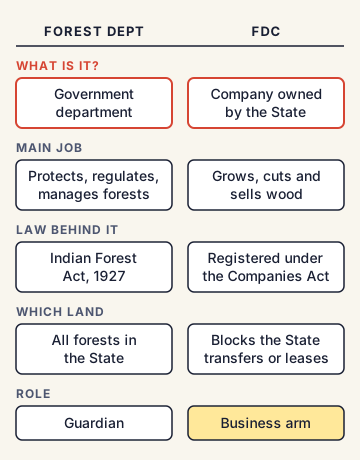
A State Forest Development Corporation (FDC) is a government-owned company set up by a State to run the commercial side of forestry. It raises plantations of valuable trees like teak, bamboo and eucalyptus, cuts and sells timber, poles, fuelwood and bamboo, and supplies wood to industries. You can think of the Forest Department as the "guardian" of the forest and the FDC as its "business arm".
Why were they created?
After Independence, India needed a lot of wood for houses, railways, furniture, paper and industry. Natural forests were growing slowly and giving low returns. Planners felt that forestry should move from simply protecting forests to producing wood on a large scale, like a crop. A company structure was chosen because it could borrow money from banks, act quickly and run like a business, which a government department could not easily do.
Where did they come from?
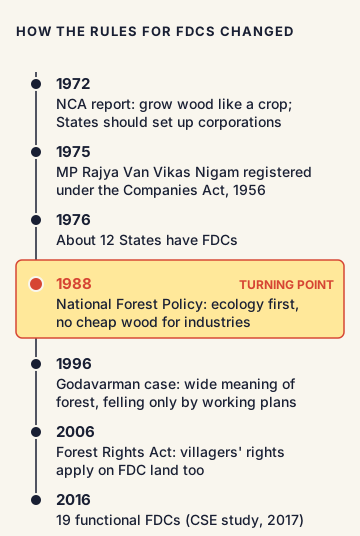
In August 1972, the National Commission on Agriculture (NCA) gave an Interim Report on Production Forestry: Man-made Forests. It recommended a shift from "conservation-oriented forestry" to a dynamic programme of production, with fast-growing and commercially valuable plantations, and wood-based industries to use their output. It also suggested that States set up corporations to do this work, using money from financial institutions. Following this report, many States set up FDCs from the mid-1970s:
- By 1976, around 12 States had set up such corporations, including Andhra Pradesh, Karnataka, Kerala, Madhya Pradesh and Maharashtra.
- The Madhya Pradesh Rajya Van Vikas Nigam Limited (MP State Forest Development Corporation) was registered under the Companies Act, 1956 on 24 July 1975. It describes itself as one of the largest public sector producers of timber, poles, fuelwood and bamboo in India.
- According to a 2017 study by the Centre for Science and Environment, there were 19 functional FDCs doing timber operations as of March 2016.
How does an FDC work?
- The State government transfers or leases blocks of forest land (often degraded forest or low-value natural forest) to the FDC.
- The FDC clears and prepares the land and plants a chosen species, often as a monoculture (a single species planted in neat rows).
- It protects and grows the plantation over many years. Teak, for example, takes several decades to mature.
- It harvests and sells the wood, and pays the State a share of revenue or a lease rent.
- FDC plantations, like all forest operations, must follow approved working plans (long-term management plans for each forest division).
How did the rules around them change?
- The National Forest Policy, 1988 changed India's direction. It made maintaining ecological balance the main goal of forest policy, and said that supplying forest produce to industries at cheap, concessional rates should stop. Industries were asked to grow their own raw material, for example by working with farmers. This reduced the original commercial purpose of FDCs.
- In the T.N. Godavarman Thirumulpad v. Union of India case, the Supreme Court in December 1996 ruled that "forest" must be understood in its dictionary meaning, whatever the ownership, and that tree felling in forests must follow approved working plans. This tightened controls on commercial felling.
- The Forest Rights Act, 2006 said that rights of forest dwellers apply on all kinds of forest land. So land handed to an FDC can still carry individual or community rights of nearby villages.
India's position and Indian examples
FDCs exist in many States, such as the Forest Development Corporation of Maharashtra Limited (FDCM), the Kerala Forest Development Corporation and the MP Rajya Van Vikas Nigam. Apart from timber, many now take up eco-tourism, bamboo work, plantations on mined land and wasteland, and nursery raising. They also carry out some compensatory afforestation and State plantation programmes.
Commonly confused concepts
- Forest Department vs FDC: The Forest Department is a government department that protects, regulates and manages forests under laws like the Indian Forest Act, 1927. The FDC is a company, owned by the State, doing commercial plantation and timber work on land given to it.
- Plantation vs natural forest: A plantation is planted by people, usually with one or few species and a set harvest cycle. A natural forest grows on its own, with many species of all ages and much richer biodiversity. Both may count as "forest cover" in satellite surveys, which critics say hides the loss of natural forests.
- Joint Forest Management (JFM) vs Community Forest Resource (CFR) rights: JFM (started by a 1990 Union government circular) is a partnership in which villagers help protect forests and share benefits, but the Forest Department stays in control. CFR under the FRA is a legal right that lets the Gram Sabha itself protect and manage its customary forest.
Issues, criticism and the way forward
- Clash with forest rights: Land handed to FDCs often overlaps with land that villages have used for farming, grazing and minor forest produce for generations. Evicting people for plantations before their FRA claims are settled has led to repeated conflicts.
- Loss of natural forests: Critics say FDCs have cleared mixed natural forests to plant teak or eucalyptus monocultures. These support fewer species and give local people fewer fruits, leaves and fodder.
- Weak financial results: The CSE study noted that the high returns expected by the NCA did not come, and many FDCs face losses.
- Transparency gaps: Old land records, working plans and encroachment registers are often not public, so it is hard to check who was on the land first.
- Way forward: settle all pending FRA claims before any plantation or eviction; consult the Gram Sabha on plantations in customary forests; prefer mixed native species over monocultures; and put working plans, land transfer orders and old satellite images online so that villagers can see and challenge them.
Concepts to Know
- Monoculture: Growing only one kind of plant over a large area. It is easy to manage and harvest, but it supports less wildlife and can spread pests and diseases quickly.
- Working plan: A detailed, approved plan (usually for 10 years) for managing a forest division: what to plant, protect and harvest, and where.
- Compensatory afforestation: Planting trees on other land to make up for forest land that was given for non-forest uses like mines, dams or roads.
- Encroachment: Occupying land without legal permission.
- Teak: A tall tree with strong, long-lasting wood used for furniture and construction. Central India, including Madhya Pradesh, has large natural teak forests.
- National Commission on Agriculture: Interim Report on Production Forestry (August 1972) led to the setting up of FDCs
- MP Rajya Van Vikas Nigam Limited: incorporated on 24 July 1975 under the Companies Act, 1956
- 19 functional FDCs doing timber operations as of March 2016 (CSE study, 2017)
- National Forest Policy, 1988: ecological balance as the main aim; end to concessional supply of forest produce to industries
- T.N. Godavarman Thirumulpad case (1996): wide meaning of "forest"; felling only under approved working plans
- Joint Forest Management started with a Union government circular in 1990
● Tracked since October 19, 2026 · last seen October 19, 2026 · updates as the daily brief publishes