Bhil Tribe
India's Largest Tribal Community
The Bhils are one of India's oldest and largest tribal communities. They live mainly in western and central India, in Madhya Pradesh, Gujarat, Rajasthan and Maharashtra. The Census 2011 counted about 1.7 crore Bhils (including their many sub-groups), which makes them the largest Scheduled Tribe group in India. They are known for their archery, their colourful festivals and paintings, and their long history of resisting outside control over their land and forests.
Where does the name come from?
The name "Bhil" is often traced to the Dravidian word billu or villu, meaning "bow". The Bhils have long been known as skilled archers. They even appear in Indian epics and folk stories; for example, Eklavya in the Mahabharata is traditionally described as a Bhil boy.
Where do they live?
The Bhil homeland is the hilly, forested belt of the Aravalli, Vindhya and Satpura ranges, and the valleys of the Narmada, Tapi and Mahi rivers. According to Census 2011, the largest numbers were in:
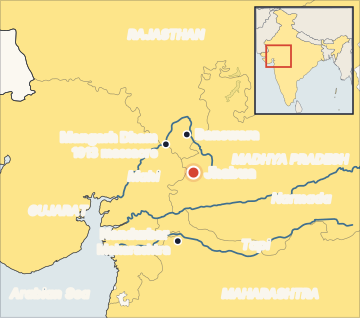
- Madhya Pradesh: about 60 lakh (mainly Jhabua, Alirajpur, Dhar, Barwani and Khargone districts)
- Gujarat: about 42 lakh
- Rajasthan: about 41 lakh (Banswara, Dungarpur, Udaipur)
- Maharashtra: about 26 lakh (Nandurbar, Dhule, Jalgaon)
Who are the sub-groups?
"Bhil" is a large family of related communities. Important sub-groups include the Bhilala, Barela, Patelia, Pawara (Pavra), Rathwa, Vasava and Tadvi Bhil. In Madhya Pradesh's Scheduled Tribes list, Bhil, Bhilala, Barela and Patelia appear together in one entry. Their language, Bhili, belongs to the Indo-Aryan language family (the same family as Hindi and Gujarati), with many local dialects.
How do they live?
Most Bhils are small farmers growing maize, jowar, pulses and cotton, often on hill slopes with little irrigation. Many also depend on forests for wood, fodder, mahua flowers and other minor forest produce. Large numbers migrate seasonally for wage labour to cities and farms in Gujarat and Rajasthan. Bhil villages are usually scattered, with houses spread across fields (called phalia) rather than close together.
What is their culture known for?
- Bhagoria: A festive market fair held in the week before Holi in the Jhabua and Alirajpur region, with music, dance and celebration.
- Pithora painting: A ritual wall painting of horses, gods and daily life, made by the Rathwa and Bhilala communities in Gujarat and Madhya Pradesh.
- Bhil painting: Dot-filled paintings of animals and nature. The Bhil artist Bhuri Bai received the Padma Shri in 2021.
- Ghoomar: Rajasthan's famous folk dance is believed to have roots in Bhil tradition.
What is their history of resistance?
The Bhils resisted many rulers who tried to control their land and forests:
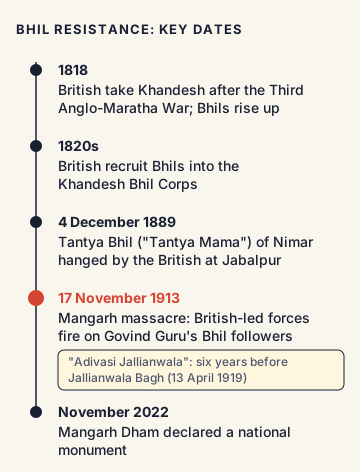
- Bhil uprisings in Khandesh (from 1818): After the British took Khandesh following the Third Anglo-Maratha War (1818), the Bhils rose against loss of forest and land rights. The British used force and also recruited Bhils into the Khandesh Bhil Corps in the 1820s.
- Tantya Bhil ("Tantya Mama"): A Bhil rebel of the Nimar region (present-day Madhya Pradesh), seen by local people as a "Robin Hood" who looted the rich to help the poor. He was hanged by the British in Jabalpur on 4 December 1889.
- Mangarh massacre (17 November 1913): Govind Guru, a social and religious reformer, led a Bhil movement for self-respect, against forced labour (begar) and heavy taxes. British-led forces fired on a large Bhil gathering on Mangarh hill on the Rajasthan-Gujarat border. Local tradition says about 1,500 people died, which is why it is often called the "Adivasi Jallianwala". Mangarh Dham was declared a national monument in November 2022.
What is their constitutional status?
Bhils are a Scheduled Tribe in several States, which gives them reserved seats in legislatures and reservation in jobs and education. Many Bhil areas in Madhya Pradesh, Gujarat, Rajasthan and Maharashtra are Fifth Schedule areas, where the PESA Act, 1996 gives Gram Sabhas special powers over land, forest produce and local resources. Bhil areas are also covered by the FRA, 2006.
Commonly confused concepts
- Bhil vs Gond: Both are among India's largest tribes. Bhils are concentrated in western India (MP's west, Gujarat, Rajasthan, Maharashtra). Gonds are concentrated in central India (eastern MP, Chhattisgarh, Maharashtra's Vidarbha, Telangana, Odisha). Gond art (Gondi painting) and Bhil art are different styles.
- Bhil vs Bhilala: The Bhilala are a Bhil sub-group of the Malwa-Nimar region, often described as a mixed Bhil-Rajput community. Both are listed under the same ST entry in Madhya Pradesh.
- Mangarh massacre (1913) vs Jallianwala Bagh (1919): Mangarh came six years earlier, in the Rajasthan-Gujarat tribal belt. Jallianwala Bagh happened in Amritsar, Punjab, on 13 April 1919.
- Scheduled Tribe vs PVTG: Bhils are a Scheduled Tribe, but they are not a Particularly Vulnerable Tribal Group (PVTG), which is a smaller list of the most disadvantaged tribal groups.
Issues, criticism and the way forward
- Land and forest insecurity: Many Bhil families farm forest land without formal title. Delays in deciding FRA claims leave them exposed to eviction.
- Displacement: Large projects like the Sardar Sarovar dam on the Narmada displaced many Bhil and Bhilala villages.
- Distress migration: Low farm income pushes many families into seasonal labour, which disrupts children's schooling and health care.
- Low human development: Literacy, nutrition and health indicators in Bhil-majority districts like Jhabua and Alirajpur remain below State averages.
- Way forward: fast and fair settlement of forest rights claims, real powers for Gram Sabhas under PESA, irrigation and better farm support in hill areas, local jobs to reduce migration, and protection of Bhili language and art.
Concepts to Know
- Scheduled Tribe (ST): A community listed as a tribe under Article 342 of the Constitution, by a Presidential order for each State. Listing gives special protections and benefits.
- Fifth Schedule: The part of the Constitution that deals with the administration of tribal-majority "Scheduled Areas" in States other than Assam, Meghalaya, Tripura and Mizoram.
- PESA Act, 1996: The Panchayats (Extension to Scheduled Areas) Act, which extends Panchayati Raj to Fifth Schedule areas and gives Gram Sabhas special powers over land, forest produce and local resources.
- Begar: Forced labour without pay, which tribal and peasant communities were made to do for rulers and officials in colonial times.
- Census 2011: about 1.7 crore Bhils, the largest Scheduled Tribe group in India
- Main States: Madhya Pradesh (about 60 lakh), Gujarat (about 42 lakh), Rajasthan (about 41 lakh), Maharashtra (about 26 lakh)
- Sub-groups include Bhilala, Barela, Patelia, Pawara, Rathwa, Vasava, Tadvi
- Language: Bhili (Indo-Aryan family)
- Tantya Bhil hanged at Jabalpur on 4 December 1889
- Mangarh massacre: 17 November 1913, led by Govind Guru; declared a national monument in November 2022
- Bhuri Bai, Bhil artist, received the Padma Shri in 2021
● Tracked since October 19, 2026 · last seen October 19, 2026 · updates as the daily brief publishes