Siang Upper Multipurpose Project (SUMP)
India's Storage Dam on the Siang
The Siang Upper Multipurpose Project, or SUMP, is a very large dam proposed on the Siang river in Upper Siang district of Arunachal Pradesh. The Siang is the name of the Brahmaputra river when it first enters India from Tibet. The project plans to produce about 11,000 to 11,200 MW of electricity and to store about 9 billion cubic metres of water behind a dam nearly 300 metres high.
It is called "multipurpose" because it is meant to do several jobs at once: make electricity, control floods and act as a water store for India.
Why is India planning such a big dam?
There are three main reasons. First, Arunachal Pradesh has some of the highest hydropower potential in India, because its rivers fall steeply from the Himalayas. Second, the Siang carries huge floods in the monsoon, which damage Arunachal Pradesh and Assam every year. A big reservoir can hold back part of a flood. Third, and most important today, China is building a giant hydropower project on the same river just upstream.
India wants its own large water store downstream so that it is not fully at the mercy of how China releases water.
Where does the river come from?
The river starts in Tibet, near Lake Mansarovar, where it is called the Yarlung Tsangpo. It flows east across Tibet for a long distance. Near the mountain Namcha Barwa it takes a sharp U-turn, called the Great Bend, and cuts through one of the deepest canyons in the world. It then enters India in Arunachal Pradesh near Gelling in Upper Siang district, where it is called the Siang (also called the Dihang).
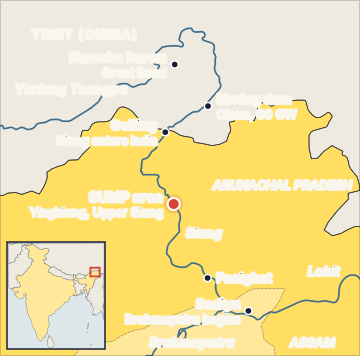
In Assam, near Sadiya, the Siang meets two other rivers, the Dibang and the Lohit. From there onwards, the combined river is called the Brahmaputra.
How did the project develop over time?
- 2000s: The Siang basin was seen as a major hydropower site. NHPC (India's largest hydropower company, owned by the Central government) began planning a project on the upper Siang around 2009.
- Two projects become one: Earlier, the plan was for two separate projects (Stage I and Stage II). Around 2017, NITI Aayog proposed replacing them with a single, bigger storage project. Officials said this would cut costs and give much more storage.
- China factor: After China approved its giant dam on the Yarlung Tsangpo in December 2024, SUMP began to be presented mainly as a strategic and water-security project, not only a power project.
- 2024 to 2026: NHPC tried to carry out pre-feasibility surveys and drilling at possible dam sites. Local groups blocked these surveys at several places, and Central Armed Police Forces were deployed to protect survey teams.
How is a project like this approved, step by step?
A dam of this size goes through several gates. At each gate it can be stopped or changed.
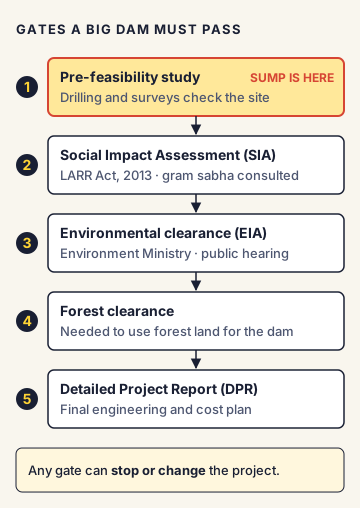
- Pre-feasibility study: Engineers check possible sites with drilling and surveys. This is the stage SUMP is at as of October 2026.
- Social Impact Assessment (SIA): If private land is to be taken, the Right to Fair Compensation and Transparency in Land Acquisition, Rehabilitation and Resettlement Act, 2013 requires a study of how the project will affect families, their homes and their livelihoods. The local gram sabha (village assembly) must be consulted.
- Environmental Impact Assessment (EIA): The project must get environmental clearance from the Union Environment Ministry. This includes a public hearing.
- Forest clearance: Most of the land around the Siang is forest, so separate permission is needed to use forest land for non-forest purposes.
- Detailed Project Report (DPR): The final engineering and cost plan, which is then put up for investment approval.
The key facts UPSC can ask about
- River: Siang (Dihang), the Indian name of the Yarlung Tsangpo
- Location: Upper Siang district, Arunachal Pradesh; candidate sites include Parong, Ugeng and Dite Dime, with villages such as Geku and Beging at the centre of protests
- Developer: NHPC Limited
- Capacity: about 11,000 to 11,200 MW, with expected yearly generation of about 47 billion units (kWh)
- Storage: about 9 to 9.2 billion cubic metres
- Dam height: about 280 to 300 metres
- Estimated cost: about ₹1.13 lakh crore
- Status (October 2026): pre-feasibility stage
Who opposes it, and why?
The Siang valley is home mainly to the Adi tribe, along with the Galo and other communities. The main protest group is the Siang Indigenous Farmers' Forum (SIFF), along with the Adi Banne Kebang, an Adi community body. Their main concerns are:
- Loss of land and homes: Many villages could be fully or partly submerged. Protest groups and officials give very different numbers for how many villages would be affected.
- Loss of culture: For the Adi, the river, forests and ancestral land are part of their identity, festivals and way of life.
- Earthquake risk: The eastern Himalayas are one of the most earthquake-prone areas in the world. The 1950 Assam-Tibet earthquake (magnitude about 8.6) struck this very region. A very tall dam in such a zone worries many people.
- Ecology: The valley has rich forests, wildlife, fish and fertile river land with orange (mandarin), kiwi and large cardamom orchards.
China's dam upstream (the reason behind the urgency)
In December 2024, China approved the Yarlung Tsangpo lower reaches hydropower project, often called the Medog dam after Medog County in Nyingchi, Tibet. Construction formally began on 19 July 2025. It is planned to have about 60,000 MW (60 GW) of capacity through five cascade power stations, with about 300 billion units of electricity a year.
This is about three times the Three Gorges Dam, the world's largest power station so far. The total investment was announced at about 1.2 trillion yuan. China says the project will not significantly harm downstream countries. India and Bangladesh have raised concerns about water flow, silt and flood safety.
What does India's dam actually protect against?
Supporters say SUMP's reservoir can work like a giant bucket placed under a tap. If China suddenly releases a large amount of water, or if a natural landslide dam breaks upstream, the reservoir can absorb the surge. If China holds water back in the dry season, India's stored water can keep the river flowing. Supporters also argue that a large Indian project strengthens India's "prior use" claim on the river's water under international water-sharing principles.
Commonly confused concepts
- Storage dam vs run-of-the-river project: A storage dam (like SUMP) holds back a huge volume of water in a big lake. A run-of-the-river project uses the natural flow and keeps only a small amount of water. China describes the Medog project mostly as run-of-the-river.
- Siang vs Subansiri Lower project: The Subansiri Lower Hydroelectric Project (2,000 MW, on the Subansiri river, a tributary of the Brahmaputra, on the Arunachal-Assam border) is a different NHPC project that has been under construction for years. SUMP is on the main Siang river.
- Upper Siang district vs Siang district: Both are districts of Arunachal Pradesh. The main SUMP sites are in Upper Siang district, but villages in Siang district are also affected.
- Pre-feasibility report vs DPR: A pre-feasibility report only checks if an idea is worth studying further. A DPR is the full, final engineering and cost plan.
Issues, criticism and the way forward
- Consent of local people: Arunachal Pradesh is a tribal state, and community land rights are strong there. Critics say surveys should not be pushed with armed police. The state government says the project needs studies first and that many residents support it. Experts suggest open sharing of maps, a fair compensation package and genuine community consent.
- Security vs livelihoods: The government's position is that national water security cannot be compromised. Local groups say they should not bear the whole cost of a national security project.
- Seismic and safety risks: Experts call for independent studies of earthquake risk, landslides and glacial lake outburst floods before deciding on dam height and design.
- Cumulative impact: Many dams are planned in the Brahmaputra basin. Experts recommend studying the combined effect on the whole river, not one project at a time.
- Diplomacy along with dams: Many experts say a dam alone cannot solve the China problem. India also needs regular data-sharing and a stronger water dialogue with China.
Concepts to Know
- Megawatt (MW): A unit for measuring how much electricity a power plant can produce at one time. 1,000 MW = 1 gigawatt (GW).
- Live storage: The part of the water in a reservoir that can actually be released and used. The water below the lowest outlet, which cannot be released, is called dead storage.
- Billion cubic metres (BCM): A unit of water volume. One BCM is one thousand million cubic metres of water. 9.2 BCM is a huge amount, enough to fill millions of large swimming pools.
- Pre-feasibility study: A first-level check, with surveys and drilling, to see whether a site is even suitable before spending money on full plans.
- NHPC: NHPC Limited, earlier the National Hydroelectric Power Corporation, a government-owned company under the Ministry of Power that builds and runs hydropower plants.
- Cascade project: A series of dams or power stations built one after another along the same river, each using the water after the one above it.
- Glacial lake outburst flood (GLOF): A sudden flood that happens when a lake formed by melting glaciers bursts its natural wall of ice or rock.
- SUMP: 11,000 to 11,200 MW; about 9 to 9.2 BCM storage; dam height about 280 to 300 m; cost about ₹1.13 lakh crore
- Location: Siang river, Upper Siang district, Arunachal Pradesh; developer NHPC
- The Siang enters India near Gelling; joins the Dibang and Lohit near Sadiya in Assam to form the Brahmaputra
- Main local opposition: Siang Indigenous Farmers' Forum (SIFF), mostly Adi community members
- China's Medog (Yarlung Tsangpo lower reaches) project: approved December 2024; construction began 19 July 2025; about 60 GW; about 300 billion kWh per year
- Approval chain after pre-feasibility: SIA, EIA (environmental clearance), forest clearance, DPR
● Tracked since October 08, 2026 · last seen October 08, 2026 · updates as the daily brief publishes