Seventh Schedule and Article 246
Distribution of Legislative Powers
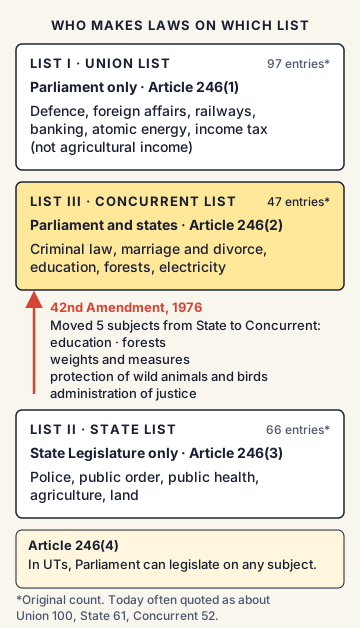
India has two levels of government that make laws: Parliament for the whole country and the State Legislatures for each state. To avoid confusion over who can make which law, the Constitution divides all subjects into three lists in the Seventh Schedule. Article 246 gives the rule: the Union makes laws on the Union List, the states on the State List, and both on the Concurrent List.
Why is this division needed?
Imagine a joint family where the father and the sons all want to make the household rules. If there is no agreement on who decides what, there will be fights every day. In a federal country, clear lists prevent the Centre and the states from stepping on each other's work. Subjects of national importance (defence, currency, foreign affairs) go to the Centre. Local subjects (police, public health, agriculture) go to the states. Subjects where both have an interest (education, forests, criminal law) are shared.
Where did it come from?
The idea came from the Government of India Act, 1935, which had a Federal List, a Provincial List and a Concurrent List. The Constitution makers kept this three-list system but made the Centre stronger, because India had just faced Partition and wanted a firm, united government.
The three lists
- List I, Union List: subjects only Parliament can make laws on, such as defence, foreign affairs, railways, banking, atomic energy, and taxes on income other than agricultural income (Entry 82). It originally had 97 entries.
- List II, State List: subjects only states can make laws on in normal times, such as police, public order, public health, agriculture, land, and some taxes. Entry 54 is about taxes on the sale of goods. It originally had 66 entries.
- List III, Concurrent List: subjects both can make laws on, such as criminal law, marriage and divorce, education, forests and electricity. It originally had 47 entries.
Because many entries have been added (like 2A or 17A) and some deleted over the years, exam books today often quote about 100, 61 and 52 entries. What matters more for exams are the key changes:
- The 42nd Amendment Act, 1976 moved five subjects from the State List to the Concurrent List: education, forests, weights and measures, protection of wild animals and birds, and administration of justice (constitution and organisation of courts other than the Supreme Court and High Courts).
- The 101st Amendment Act, 2016 (for GST) rewrote tax entries. Entry 54 of List II now covers only taxes on the sale of petroleum crude, high-speed diesel, petrol, natural gas, aviation turbine fuel and alcoholic liquor for human consumption. Entries such as 52 and 55 of List II and 92 and 92C of List I were deleted, and the new Article 246A gave both Parliament and states the power to make GST laws.
How does Article 246 work, clause by clause?
- Article 246(1): Parliament has the exclusive power to make laws on List I subjects.
- Article 246(2): Parliament and the State Legislatures both have power on List III subjects.
- Article 246(3): a State Legislature has the exclusive power on List II subjects for its own state.
- Article 246(4): Parliament can make laws on any subject, even a State List subject, for areas that are not part of any state (that is, Union Territories).
Who wins when there is a clash?
The Constitution gives a clear order:
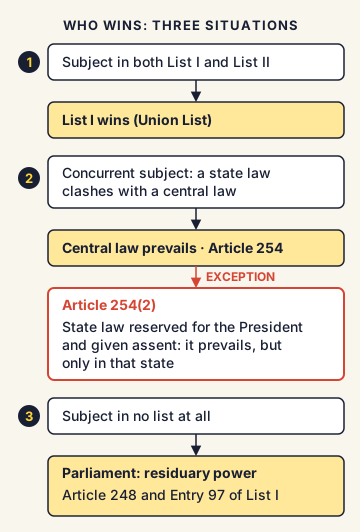
- Union List over the others: if a subject falls in both List I and List II, List I wins.
- Article 254 (repugnancy): if a state law on a Concurrent subject clashes with a central law, the central law prevails. But under Article 254(2), a state law can prevail in that state if it was reserved for the President and got the President's assent.
- Article 248 and Entry 97 of List I (residuary powers): any subject not in any list belongs to Parliament. This is why, for example, laws on many new subjects like cyber activities are made by the Centre.
When can Parliament make laws on State List subjects?
- Article 249: if the Rajya Sabha passes a resolution by two-thirds of members present and voting that it is necessary in the national interest. The resolution is valid for one year and can be renewed.
- Article 250: during a National Emergency.
- Article 252: if two or more states pass resolutions asking Parliament to make a law for them.
- Article 253: to carry out an international treaty or agreement.
- During President's Rule under Article 356, Parliament can make laws for that state.
How do courts decide which list a law belongs to?
Laws often touch more than one subject. Courts use these tests:
- Pith and substance: the court looks at the true nature of the law, not its side effects. If the main purpose is within the legislature's list, the law is valid even if it slightly touches another list. (State of Bombay v. F.N. Balsara, 1951, is a well-known example.)
- Colourable legislation: a legislature cannot do indirectly what it cannot do directly. If a law is a disguise to enter another's field, it is void.
- Harmonious construction: courts read entries together so that both can work, instead of making one useless.
- Taxing entries are separate: courts have held that the power to tax a subject comes only from the specific tax entries, not from general entries. This is exactly why the additional sales tax case turned on whether the levy fell under Entry 54 of List II (sale of goods) or Entry 82 of List I (income).
Important cases on the division of powers
- S. Kodar v. State of Kerala (1974): a five-judge Bench held that an additional sales tax worked out as a percentage of sales tax is a tax on sale of goods, not on income.
- Mineral Area Development Authority v. Steel Authority of India (2024): a nine-judge Bench, by 8:1, held that royalty is not a tax and that states have the power to tax mineral rights under the State List. It overruled India Cement v. State of Tamil Nadu (decided 1989), which had called royalty a tax. Justice B.V. Nagarathna dissented.
- Union of India v. Mohit Minerals (2022): the Court said the GST Council's recommendations are not binding, and that Parliament and states have equal, simultaneous power to make GST laws.
Commonly confused concepts
- Seventh Schedule vs Article 246: the Seventh Schedule is the list of subjects. Article 246 is the rule that says who can use which list.
- Concurrent List vs residuary power: Concurrent subjects are named and shared. Residuary subjects are not named anywhere and belong only to Parliament (Article 248). In Canada, too, residuary power lies with the Centre; in the USA and Australia, it lies with the states.
- Article 249 vs Article 252: Article 249 needs a Rajya Sabha resolution (two-thirds). Article 252 needs state legislature resolutions from two or more states.
- Entry 54 of List II vs Article 246A: Entry 54 now covers only petroleum products and alcohol. Almost all other goods and services are taxed under GST, using Article 246A.
Issues, criticism and the way forward
- Centralising tilt: the Union List is long, central law wins on Concurrent subjects, and residuary powers lie with Parliament. Many states argue this makes India "quasi-federal", with the Centre much stronger.
- Movement of subjects: the 42nd Amendment moved five subjects to the Concurrent List without the states' consent. Some states, for example, have asked for education to go back to the State List.
- Loss of fiscal freedom under GST: after the 101st Amendment, states gave up much of their own sales tax power. The present case shows how the old disputes over sales tax have faded, but states now depend more on GST collections and the GST Council.
- Official reviews: the Sarkaria Commission (set up 1983, report 1988) and the Punchhi Commission (set up 2007, report 2010) studied Centre-state relations. They suggested that the Centre should consult states before making laws on Concurrent subjects, and use powers over the State List sparingly.
- Way forward: experts suggest regular use of the Inter-State Council (Article 263), consultation on Concurrent List laws, and clear rules for sharing tax powers, so that "cooperative federalism" works in practice.
Concepts to Know
- Federalism: a system where power is shared between a central government and state governments, each with its own area of work set by the Constitution.
- Legislative competence: whether a legislature has the power, under the Constitution, to make a particular law. A law made without competence is void.
- Surcharge: an extra charge added on top of an existing tax, usually as a percentage of it. For example, a 10% surcharge on a ₹100 tax means paying ₹110.
- Turnover: the total value of sales a business makes in a year.
- Repugnancy: a clash between two laws, where both cannot be followed at the same time.
- Agricultural income: income from farming land, such as from selling crops. Only states can tax it (Entry 46 of List II), not the Centre.
- Article 246: division of law-making power; Seventh Schedule: three lists
- Original entries: Union 97, State 66, Concurrent 47 (often quoted today as about 100, 61, 52)
- 42nd Amendment (1976): education, forests, weights and measures, protection of wild animals and birds, administration of justice moved to the Concurrent List
- 101st Amendment (2016): Article 246A added; Entry 54 of List II limited to petroleum crude, diesel, petrol, natural gas, ATF and alcoholic liquor
- Entry 82, List I: taxes on income other than agricultural income; Entry 46, List II: taxes on agricultural income
- Article 248 and Entry 97, List I: residuary powers with Parliament
- Article 254: central law prevails on Concurrent subjects, except under 254(2) with President's assent
- Article 249: Rajya Sabha resolution by two-thirds of members present and voting; valid one year
- Source of the idea: Government of India Act, 1935
● Tracked since November 04, 2026 · last seen November 04, 2026 · updates as the daily brief publishes