Goods and Services Tax (GST)
Constitutional Framework and Structure
The Goods and Services Tax, or GST, is a single tax on the supply of goods and services across India. It replaced a long list of separate central and state taxes in one go on 1 July 2017. It is collected at every step where something is sold, but each seller pays tax only on the value they add. Because it is finally paid by the person who buys and uses the product, it is a consumption tax.
Why did India need GST?
Before 2017, the Centre and each state charged their own taxes on goods and services. The Centre charged central excise duty on manufacturing and service tax on services. States charged VAT on sales, entry tax, octroi, entertainment tax and more. A product moving from Tamil Nadu to Punjab could be taxed again and again, and tax was often charged on top of earlier tax.
This "tax on tax" is called the cascading effect. It made goods costlier and pushed businesses to set up warehouses in every state just to save tax. India was one country politically, but not one market for tax. GST was designed to create "One Nation, One Tax": one common market with similar rules everywhere.
Where did it come from?
The idea took about 17 years to become law:
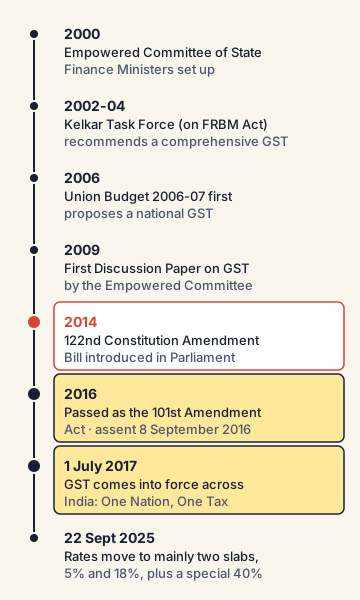
- 2000: The Centre set up an Empowered Committee of State Finance Ministers, first headed by Asim Dasgupta (then Finance Minister of West Bengal), to design a state-level reform.
- 2002 to 2004: The Kelkar Task Force on implementing the FRBM Act, 2003 recommended a comprehensive GST.
- 2006: The Union Budget for 2006-07 first proposed a national GST from 1 April 2010.
- 2009: The Empowered Committee released the First Discussion Paper on GST (10 November 2009).
- 2014: The 122nd Constitution Amendment Bill was introduced in Parliament.
- 2016: It was passed and became the Constitution (101st Amendment) Act, 2016, which received the President's assent on 8 September 2016.
- 1 July 2017: GST came into force across the country.
Why did the Constitution need to change?
Our Constitution splits taxing powers into separate lists. Before GST, the Centre alone could tax manufacturing and services, and states alone could tax the sale of goods. Neither could charge one combined tax on both goods and services. So the 101st Amendment had to give both the Centre and the states the power to tax the same transaction at the same time. This is called concurrent taxing power, and it is unusual in India's federal design.
The key articles added or changed by the 101st Amendment
- Article 246A: Gives Parliament and every State Legislature the power to make laws on GST. But only Parliament can make laws on GST for inter-state supplies (sales from one state to another).
- Article 269A: GST on inter-state supplies is levied and collected by the Centre and then shared between the Centre and the states, as Parliament decides on the GST Council's recommendation.
- Article 279A: Creates the GST Council, the joint body of the Centre and states that recommends rates, exemptions and model laws.
- Article 366(12A): Defines "goods and services tax" as a tax on supply of goods or services or both, except tax on alcoholic liquor for human consumption.
- Article 366(26A): Defines "services" as anything other than goods.
- Article 286: Stops states from taxing imports, exports and supplies taking place outside the state.
- Section 18 of the Amendment Act: Promised states compensation for any loss of revenue from GST for five years, by a law of Parliament. This became the GST (Compensation to States) Act, 2017.
How is GST split? The four types
GST is a dual GST: both the Centre and the state tax the same sale.
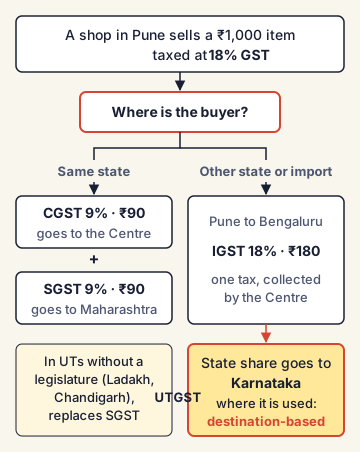
- CGST (Central GST): Charged by the Centre on sales within one state. Law: CGST Act, 2017.
- SGST (State GST): Charged by the state on the same sale within the state, usually at the same rate as CGST. Each state has its own SGST Act.
- UTGST (Union Territory GST): Used instead of SGST in Union Territories without a legislature, such as Ladakh or Chandigarh. Law: UTGST Act, 2017.
- IGST (Integrated GST): Charged by the Centre on sales between states and on imports. Law: IGST Act, 2017. The Centre collects it and the state where the goods are consumed gets its share.
A simple example: a shop in Pune sells a ₹1,000 item taxed at 18% to a customer in Pune. The bill shows CGST of 9% (₹90) and SGST of 9% (₹90). If the same shop sends the item to a buyer in Bengaluru, the bill shows IGST of 18% (₹180), and Karnataka gets the state share.
How does GST avoid tax on tax?
Through input tax credit (ITC). A business that paid GST on its raw materials can subtract that amount from the GST it collects on its own sales. So each seller pays tax only on the value it added. The final consumer bears the whole tax once.
Destination-based tax
GST goes to the state where goods or services are consumed, not where they are made. This is a big change from the old Central Sales Tax, which went to the producing state. It helps consuming states like Uttar Pradesh and Bihar, and it is why manufacturing states like Tamil Nadu and Maharashtra were promised compensation.
What is kept outside GST?
- Alcohol for human consumption: permanently out by the Constitution's own definition. States keep taxing it through state excise and VAT.
- Five petroleum products: crude oil, high-speed diesel, petrol (motor spirit), natural gas and aviation turbine fuel (ATF). They are legally within GST, but GST on them will start only from a date the GST Council recommends. Until then, the Centre charges excise duty and states charge VAT.
- Electricity is also outside GST.
The technology backbone
All GST work (registration, invoices, returns, payments) runs on a common online system run by the Goods and Services Tax Network (GSTN). Tools like the e-way bill (a digital document needed to move goods worth more than a set value) and e-invoicing (invoices reported to a government portal in real time) let the system match the seller's sales with the buyer's purchases.
How has GST changed over time?
- Rates: GST started with four main slabs: 5%, 12%, 18% and 28%, plus a compensation cess on luxury and harmful goods. In September 2025 the Council moved most goods to two slabs, 5% and 18%, with a special 40% rate for a short list of luxury and harmful items. The new rates came into force on 22 September 2025.
- Compensation: The promised five-year compensation ran until June 2022. The compensation cess was then kept going to repay loans taken during the COVID period. It was finally ended for all goods from 1 February 2026, when tobacco moved to central excise duty and pan masala to a new Health Security se National Security Cess.
- Disputes: The GST Appellate Tribunal (GSTAT) was set up to hear appeals, so that every dispute does not go straight to the High Courts.
Commonly confused concepts
- Direct tax vs indirect tax: Income tax is a direct tax: the person who earns pays it to the government. GST is an indirect tax: the shop collects it from you and pays it to the government.
- CGST vs IGST: CGST is the Centre's half on a sale within a state. IGST is the full tax on a sale between states or on imports.
- Article 246A vs Article 279A: 246A is the power to make GST laws. 279A creates the GST Council, which only recommends.
- Excluded vs deferred: Alcohol for drinking is excluded by the Constitution. Petrol and diesel are deferred: they can come under GST once the Council recommends a date.
- Origin-based vs destination-based: The old Central Sales Tax went to the state of origin (where goods are made). GST goes to the state of destination (where goods are used).
Issues, criticism and the way forward
- Loss of state taxing freedom: States gave up most of their own indirect taxes. Their revenue now depends heavily on decisions taken jointly in the GST Council, where the Centre holds one-third of the vote.
- Compensation dependence: Manufacturing states worried about lost revenue once compensation ended in 2022.
- Complex structure: Many slabs and frequent rate changes caused classification disputes (for example, whether a product is a "snack" or a "sweet"). The 2025 two-slab structure aims to reduce this.
- Compliance burden: Small businesses found monthly returns and invoice matching costly. Blocked input tax credit and long refund delays locked up working capital.
- Fake invoice fraud: Some people created fake companies to issue bills with no real goods, so that others could claim credit they were not entitled to.
- Petroleum still outside: Because fuel is outside GST, businesses cannot claim credit for tax paid on fuel, so some cascading remains.
- Way forward: Experts and the government point to simpler rates, automatic data-driven refunds, risk-based checks instead of manual checks, fewer small notices, and gradually bringing petroleum products inside GST.
Concepts to Know
- Indirect tax: A tax that one person pays to the government but another person finally bears. GST is collected by sellers but paid by buyers through prices.
- Cascading effect: When tax is charged on a price that already includes an earlier tax. The final price rises more than the tax rates suggest.
- Supply: The GST word for selling, transferring, renting or giving goods or services for business. GST is charged on "supply", not just on "sale".
- Concurrent taxing power: When both the Centre and the states can tax the same thing at the same time.
- Compensation cess: An extra charge on luxury and harmful goods (like tobacco, aerated drinks and big cars) used to pay states for their GST revenue loss.
- Working capital: The money a business needs for day-to-day running: buying raw materials, paying salaries and rent.
- GST in force from 1 July 2017; based on the Constitution (101st Amendment) Act, 2016 (assent 8 September 2016)
- Articles added: 246A (power to make GST laws), 269A (inter-state GST), 279A (GST Council); definitions in 366(12A) and 366(26A)
- Four laws: CGST Act, IGST Act, UTGST Act (all 2017) and a separate SGST Act in each state; plus the GST (Compensation to States) Act, 2017
- Excluded by the Constitution: alcoholic liquor for human consumption; deferred: crude oil, petrol, diesel, natural gas, ATF
- Original slabs: 5%, 12%, 18%, 28%; since 22 September 2025: mainly 5% and 18%, plus a special 40% rate
- Compensation to states: 5 years (to June 2022); compensation cess ended from 1 February 2026
- Origin of the idea: Empowered Committee (2000), Kelkar Task Force (2002-04), First Discussion Paper (2009), 122nd Amendment Bill (2014)
● Tracked since March 01, 2026 · last seen October 04, 2026 · updates as the daily brief publishes