Self Reliant India (SRI) Fund
Equity Capital for MSMEs
The Self Reliant India Fund, or SRI Fund, is a government scheme that gives growing small businesses equity: money in exchange for a share of ownership, instead of a loan. The government does not invest in the businesses itself. It puts money into private, professionally run investment funds, and those funds choose and invest in the businesses. The target is a total of ₹50,000 crore for Micro, Small and Medium Enterprises (MSMEs): ₹10,000 crore from the government and ₹40,000 crore from private investors.
Why does it exist?
Most small businesses in India grow only with loans. A loan has to be repaid in fixed instalments with interest, and the bank usually wants something as security (collateral). A business that wants to build a new factory line may not earn enough in the first few years to pay big EMIs. Equity solves this: the investor shares the risk and earns only if the business grows. But very few investors give equity to ordinary small businesses. Without growth capital, many good MSMEs stay small forever.
Why do investors avoid small businesses?
The scheme's own guidelines list the main reasons:
- Many MSMEs are run as sole proprietorships or partnerships, and these legal forms cannot easily take in outside shareholders.
- Each deal is small, so the cost of checking and managing it is high compared to the money invested.
- Investors cannot easily get reliable information about a small firm (this is called information asymmetry).
- Owners fear losing control of their business to an outside investor.
- Venture capital funds prefer technology startups that may grow very fast. A traditional factory or service business rarely gives such fast returns.
Where did it come from?
The SRI Fund was announced in May 2020 as part of the Aatmanirbhar Bharat (Self-Reliant India) economic package during the COVID-19 crisis. The announcement promised a ₹50,000 crore equity infusion for MSMEs through a "fund of funds". The Ministry of MSME approved the operating guidelines in August 2021. The main fund was registered with the Securities and Exchange Board of India (SEBI) as a Category II AIF on 1 September 2021.
In the Union Budget 2026-27, the government proposed a top-up of ₹2,000 crore to the SRI Fund to keep supporting micro enterprises.
How does the mother and daughter fund system work?
The SRI Fund is a fund of funds. Think of a big family where the mother gives pocket money only to children who have already saved some money themselves. The steps are:
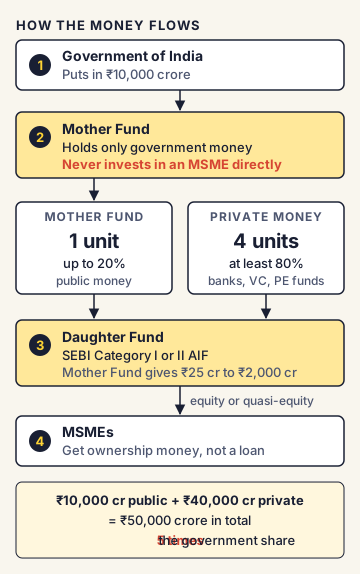
- The government puts its money only into the Mother Fund. No other investor is allowed in the Mother Fund.
- Private investment funds apply to be Daughter Funds. They must be registered with SEBI as Category I or Category II AIFs.
- A Daughter Fund raises money from outside investors: banks, rich individuals, venture capital and private equity firms, pension funds, public sector companies and others.
- For every 4 units a Daughter Fund raises, the Mother Fund gives 1 unit. So the Mother Fund supplies at most 20% and the Daughter Fund raises 80%.
- The Daughter Fund invests the full amount in MSMEs as equity or quasi-equity. The Mother Fund never invests in an MSME directly.
This is how ₹10,000 crore of public money is expected to become ₹50,000 crore of investment: 5 times the government's share. The guidelines add another multiplier: banks usually lend about ₹3 for every ₹1 of owner's equity, so new equity also helps a firm borrow more.
Who runs it?
The structure has several layers:
- NSIC Venture Capital Fund Limited (NVCFL): a company fully owned by the National Small Industries Corporation (NSIC), a public sector company under the Ministry of MSME. NVCFL anchors the Mother Fund. Its board is chaired by the Chairman and Managing Director of NSIC.
- Investment manager: SBICAP Ventures, part of the State Bank of India group, manages the Mother Fund's investments.
- Advisory Board: set up by the Government of India and chaired by the Secretary, Ministry of MSME. It lays down broad investment policy and monitors progress.
- Investment Committee: a group of professionals, chaired by an expert from finance or capital markets. It approves Daughter Funds and keeps an "arm's length" (a safe distance) from the government, so that decisions are commercial.
The key rules UPSC can ask about
- Eligible firms: any enterprise that is an MSME under the MSMED Act, 2006 (as amended), that is viable and has a clear growth plan. The previous 3 years' growth (CAGR) is considered.
- Not eligible: non-profit bodies, NBFCs (non-bank lenders), microfinance and micro credit bodies, Self-Help Groups and other financial middlemen.
- Focus: traditional manufacturing and service MSMEs, because private investors already favour IT and technology firms.
- Fund life: 15 years, longer than usual, because it is hard to exit (sell the stake) in small firms. The commitment period is up to 6 years from the last closing. Earnings are reinvested, so it is a revolving fund.
- Limits: no single Daughter Fund can get more than ₹2,000 crore (20% of the Mother Fund's initial ₹10,000 crore). The minimum sanction is ₹25 crore.
- No double funding: money a Daughter Fund gets from other government fund of funds (like the Fund of Funds for Startups) does not count towards its 80% share.
- Speed: a Daughter Fund must invest money received from the Mother Fund within 2 months (extendable by 1 month), or return it.
India's position and progress
As of March 2025, the SRI Fund had invested about ₹10,979 crore in 577 MSMEs. Karnataka had the most investee firms (151), followed by Maharashtra (144) and Delhi (69). The SRI Fund is one of several government tools for small business finance. Others include loans backed by government guarantees and faster payment platforms like TReDS (Trade Receivables Discounting System). In 2026, the government added a separate ₹10,000 crore SME Growth Fund for bigger, growth-stage small and medium firms.
Commonly confused concepts
- SRI Fund vs Fund of Funds for Startups (FFS): both are government fund of funds that invest through SEBI-registered AIFs. The FFS (approved in 2016, ₹10,000 crore, managed by SIDBI, under the startup programme) targets startups. The SRI Fund (₹10,000 crore from the government, managed through NSIC's company) targets established MSMEs, including traditional ones.
- SRI Fund vs SME Growth Fund: the SRI Fund works only through Daughter Funds and covers all MSMEs, with many investments in smaller firms. The SME Growth Fund (approved in October 2026) is meant for direct growth equity in small and medium firms, with a focus on manufacturing.
- Equity vs quasi-equity vs debt: equity is ownership (shares); the investor earns only if the firm does well. Debt is a loan that must be repaid with interest whatever happens. Quasi-equity sits in between, for example convertible debentures or preference shares, which behave like a loan but can turn into shares.
- Mother Fund vs Daughter Fund: the Mother Fund holds government money and invests only in Daughter Funds. Daughter Funds raise private money and invest in businesses.
Issues, criticism and the way forward
- Slow mobilisation: Daughter Funds must raise 80% from private sources. Raising money for traditional MSMEs is harder than for tech startups, so the ₹40,000 crore private share takes time.
- Uneven reach: investments are concentrated in a few states and cities with strong investor networks. Firms in remote areas and smaller towns find it harder to reach fund managers.
- Owner reluctance: many family-run MSMEs do not want outside shareholders or the extra disclosure that comes with them.
- Exit difficulty: investors make money only when they sell their stake. With few buyers for small-firm shares, exits are slow. Listing on SME stock exchange platforms is one route the guidelines encourage.
- Way forward: suggestions include better awareness in small towns, helping MSMEs turn into companies (corporatisation) so they can take equity, more fund managers focused on MSMEs, and new funds for gaps the SRI Fund does not cover, such as the SME Growth Fund for larger growth-stage firms.
Concepts to Know
- Equity: money given in return for part ownership of a business. The investor shares in profits and losses; there is no fixed repayment.
- Collateral: property or assets a borrower pledges to a lender. If the loan is not repaid, the lender can take it.
- Alternative Investment Fund (AIF): a privately pooled investment fund registered with SEBI under the SEBI (AIF) Regulations, 2012. Category I covers venture capital, SME, social and infrastructure funds; Category II covers private equity and debt funds; Category III covers funds that trade for short-term gains.
- Fund of funds: a fund that does not invest in companies directly, but invests in other funds which then invest in companies.
- Venture capital and private equity: investors who buy stakes in private businesses. Venture capital usually backs young, high-risk firms; private equity usually backs more established firms.
- CAGR (Compound Annual Growth Rate): the average yearly growth rate over a period, assuming growth builds on itself each year.
- Exit: when an investor sells its stake (to another investor, the owner, or the public through listing) and gets its money back with any gain.
- NSIC (National Small Industries Corporation): a public sector company under the Ministry of MSME that supports small industries with marketing, credit and technology help.
- Announced: May 2020, Aatmanirbhar Bharat package; operating guidelines approved August 2021
- Target corpus: ₹50,000 crore = ₹10,000 crore (Government of India) + ₹40,000 crore (private equity and venture capital via Daughter Funds)
- Mother Fund: SEBI Category II AIF, registered 1 September 2021; anchored by NSIC Venture Capital Fund Limited (100% owned by NSIC); investment manager SBICAP Ventures
- Funding ratio: Mother Fund up to 20%, Daughter Fund raises 80% (1 unit for every 4 raised); 5 times leverage
- Daughter Funds: SEBI Category I or II AIFs; exposure cap ₹2,000 crore each; minimum sanction ₹25 crore
- Fund life 15 years; commitment period up to 6 years from last closing; revolving fund
- Advisory Board chaired by Secretary, Ministry of MSME
- Progress (March 2025): about ₹10,979 crore invested in 577 MSMEs
- Union Budget 2026-27: ₹2,000 crore top-up for micro enterprises
● Tracked since February 01, 2026 · last seen October 06, 2026 · updates as the daily brief publishes