Integrated Transport and Logistics Authority (ITLA)
The Integrated Transport and Logistics Authority (ITLA) is a central government body that plans India's transport system as one connected network. Instead of roads, railways, ports and airports each planning separately, ITLA looks at all of them together. It prepares a long-term National Transport Master Plan, checks big transport projects, and keeps one shared pool of transport data. The Union Cabinet approved its creation on 6 October 2026.
Why does India need it?
In India, each mode of transport has its own ministry. Roads are with the Ministry of Road Transport and Highways, railways with the Ministry of Railways, ports with the Ministry of Ports, Shipping and Waterways, and airports with the Ministry of Civil Aviation. Each one plans its own projects. The result is often poor linking between them.
A new port may be built, but the rail line or highway to carry its cargo comes years later. A freight train may reach a city, but the last few kilometres to the factory have no good road. Goods then wait, change vehicles many times, and cost more to move.
Think of a wedding where the caterer, the tent person and the decorator never talk to each other. Each does a good job alone, but the guests still suffer. ITLA is meant to be the wedding planner who makes all of them work to one plan.
Where did the idea come from?
The idea of planning all transport together is old.
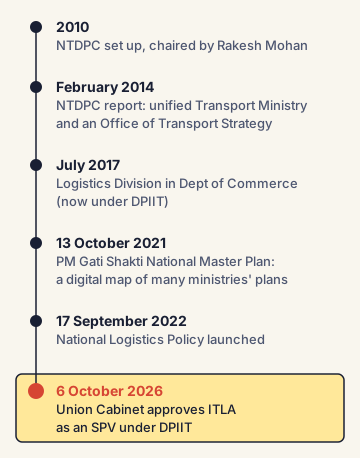
- In 2010, the government set up the National Transport Development Policy Committee (NTDPC), chaired by economist Rakesh Mohan. Its report, submitted in February 2014, said India needed a unified Ministry of Transport and an Office of Transport Strategy to plan all modes together.
- In July 2017, a Logistics Division was created in the Department of Commerce. It now works under DPIIT.
- On 13 October 2021, the government launched the PM Gati Shakti National Master Plan, a digital map that shows the infrastructure plans of many ministries on one screen.
- On 17 September 2022, the National Logistics Policy was launched to make moving goods cheaper and faster.
- These steps improved coordination, but transport planning needed deeper, full-time study than the existing Gati Shakti bodies could give. ITLA was created to fill this gap.
How will ITLA work?
ITLA will act as the top body for joint transport and logistics planning. Its main jobs are:
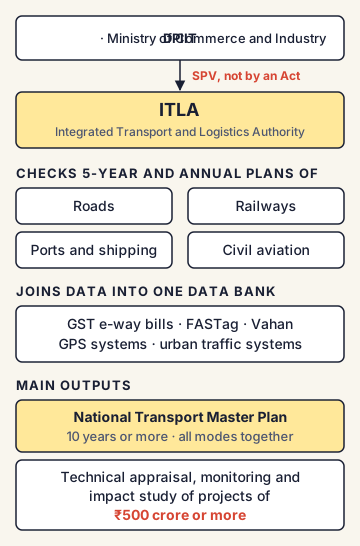
- Make the National Transport Master Plan: a plan for ten years or more, covering roads, railways, ports and shipping, civil aviation, inland waterways, coastal shipping, urban mobility and logistics.
- Check ministry plans: it will evaluate the short-term sector plans (about five years) and the annual plans of transport ministries, to see that they match the master plan.
- Appraise big projects: it will do a technical appraisal of transport and infrastructure projects of ₹500 crore or more.
- Monitor and solve problems: it will track the building of projects above ₹500 crore and give a common platform to solve issues that get stuck between ministries.
- Study impact after completion: it will check whether finished projects actually delivered the promised benefits. This is called post-implementation impact assessment.
- Build a transport data bank: it will join data from GSTN e-way bills, FASTag, Vahan, GPS systems and urban traffic systems into one unified transport data repository.
- Advise and train: it will advise on reviewing the National Logistics Policy and help build skills in the logistics sector.
Why is the data repository important?
Good plans need good data. Today, useful transport data sits in different places. E-way bills show what goods move from where to where. FASTag shows how many vehicles cross each toll plaza and when. Vahan shows how many trucks and buses are registered. When ITLA joins these, planners can see the real flow of goods across India. They can then spot where trucks get stuck, which routes need a rail line, and where a new warehouse would help.
How does its appraisal fit with existing checks?
Big government projects already go through a money check. Projects with an outlay above ₹500 crore are appraised by the Public Investment Board (PIB) or the Expenditure Finance Committee (EFC), both chaired by the Secretary (Expenditure), Ministry of Finance, under the Department of Expenditure's 2016 guidelines. That check asks: "Is this a good use of public money?" ITLA's technical appraisal is an extra layer. It asks: "Does this project fit well with the rest of the transport network?"
Why does it matter for the economy?
Logistics cost is the total cost of moving and storing goods: transport, warehousing, packing and paperwork. When it is high, Indian goods become costlier at home and less competitive abroad.
- An official DPIIT estimate, built on a method developed by the National Council of Applied Economic Research (NCAER), put India's logistics cost at 7.97% of GDP in 2023-24, down from 8.84% in 2022-23.
- Earlier, a figure of 13-14% of GDP was often quoted, but it was not based on a proper national method.
- In the World Bank's Logistics Performance Index (LPI) 2023, India ranked 38th out of 139 countries, up from 44th in 2018.
Commonly confused concepts
- ITLA vs PM Gati Shakti National Master Plan: Gati Shakti is a digital map platform where ministries put their projects in layers. ITLA is an organisation that makes the long-term transport plan, appraises projects and studies data. Gati Shakti is the tool; ITLA is an expert planner that can use such tools.
- ITLA vs Network Planning Group (NPG): The NPG is a group of planning heads from different infrastructure ministries that meets under PM Gati Shakti to examine projects. ITLA is a dedicated, full-time body with its own staff for deeper research and long-term planning.
- ITLA vs Public Investment Board (PIB): The PIB, under the Ministry of Finance, checks whether a big project is financially sound. ITLA checks whether a transport project fits the multimodal network.
- SPV vs statutory body: A statutory body is created by a law passed by Parliament (for example, the National Highways Authority of India under the NHAI Act, 1988). An SPV is created by a government decision as a separate unit for a set purpose. ITLA has been approved as an SPV, not created by a separate Act of Parliament.
- Multimodal vs intermodal transport: Multimodal means one journey uses two or more modes (for example, ship plus rail) under one contract. Intermodal usually means the cargo stays in the same container while it shifts between modes.
Issues, criticism and the way forward
- Power to enforce: As an SPV, ITLA does not have the force of a separate law. Its plans may work mainly as advice. Ministries could still go their own way unless the government makes its views binding.
- Another layer of checks: Adding a technical appraisal could slow project approvals if timelines are not fixed.
- States and cities: Much of transport, such as state highways, city buses and metro rail, involves state governments and cities. The master plan will work only if they are brought on board.
- Data privacy: Joining FASTag, Vahan and GPS data creates a very detailed picture of vehicle movement. Clear rules on data protection and anonymisation will be needed, in line with the Digital Personal Data Protection Act, 2023.
- Way forward: Experts suggest fixed time limits for appraisal, close links with PM Gati Shakti and state master plans, publishing the master plan for public comment, and regular public reports on project impact. The NTDPC's idea of one unified transport strategy office is partly met by ITLA.
Concepts to Know
- Logistics: All the activities needed to move goods from the producer to the buyer: transport, storage, packing, loading and paperwork.
- Special Purpose Vehicle (SPV): A separate unit or company set up to do one specific job. It keeps that job's work, staff and money apart from the parent organisation.
- Multimodal transport: Using more than one kind of transport in one journey, such as a truck to a railway station, a train to a port, and a ship abroad.
- Technical appraisal: A detailed expert check of a project's design, route, need and links before it is approved.
- E-way bill: An electronic document under GST that must be generated before moving goods worth more than ₹50,000. It records what is moving, from where and to where.
- FASTag: A sticker with a chip (RFID) on a vehicle's windscreen that lets the toll be paid automatically when the vehicle crosses a toll plaza.
- Vahan: The national online database of vehicle registrations run by the Ministry of Road Transport and Highways.
- DPIIT: The Department for Promotion of Industry and Internal Trade, under the Ministry of Commerce and Industry. It handles industrial policy, Startup India and logistics.
- Approved by the Union Cabinet on 6 October 2026, as an SPV under DPIIT (Ministry of Commerce and Industry)
- Prepares the National Transport Master Plan: horizon of 10 years or more; covers roads, railways, ports and shipping, civil aviation, inland waterways, coastal shipping, urban mobility and logistics
- Technical appraisal, monitoring and post-implementation impact assessment of projects of ₹500 crore and above
- Unified transport data repository: GSTN e-way bills, FASTag, Vahan, GPS-based systems, urban traffic management systems
- Evaluates five-year sector plans and annual plans of transport ministries
- NTDPC (chair: Rakesh Mohan; set up 2010; report February 2014) recommended a unified transport ministry and an Office of Transport Strategy
- Logistics cost: 7.97% of GDP in 2023-24 (DPIIT, NCAER method); India 38th of 139 in World Bank LPI 2023
● Tracked since October 06, 2026 · last seen October 06, 2026 · updates as the daily brief publishes