Seeds Act, 1966
The Seeds Act, 1966 is the main central law that controls the quality of seeds sold to farmers in India. It lets the government fix minimum standards for seeds, such as how many of them must sprout (germination) and how pure they must be. It also sets up a system to test and certify seeds, so that a farmer who buys a bag of seed gets what the label promises.
The Act is now nearly 60 years old, and the government plans to replace it with a new Seeds Bill.
Why does it exist?
A seed is the starting point of every crop. If a farmer sows bad seed, the whole season is lost, and the farmer only finds out after weeks of spending on water, fertiliser and labour. A farmer cannot check a seed's quality by looking at it. So the law makes sellers meet fixed standards and print the facts on a label. Think of it like a sealed medicine strip: you trust the label because a law makes the maker responsible for it.
Where did it come from?
In the mid-1960s, India faced food shortages and was starting the Green Revolution, which depended on new high-yielding seeds of wheat and rice. Good seed had to reach farmers on a large scale. The National Seeds Corporation was set up in 1963 to produce quality seed. Parliament then passed the Seeds Act in 1966, and the Seeds Rules, 1968 gave the details. Later, the Seeds (Control) Order, 1983 was issued under the Essential Commodities Act, 1955 to license seed dealers.
How does the Act work?
The Act does not control every seed. It controls only the "notified" kinds and varieties.
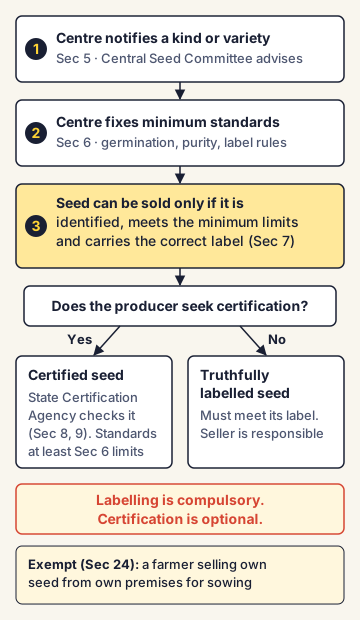
- Section 5: The Central Government, after consulting the Central Seed Committee, can notify a kind or variety of seed. Only notified seeds come under the main quality rules.
- Section 6: The Centre fixes minimum limits of germination and purity and the label rules for notified seeds.
- Section 7: Notified seed can be sold only if it is properly identified, meets the minimum limits and carries the correct label.
- Sections 8 and 9: States (or the Centre with a state) set up Seed Certification Agencies. A producer may apply to get seed certified. Certified seed must meet standards that are at least as high as the Section 6 limits. Certification is not compulsory under the Act; labelling is.
- Section 24: A farmer who grows seed and sells it directly from his or her own premises to another person for sowing is exempt from these rules.
The key bodies under the Act
- Central Seed Committee (Section 3): advises the Centre and states. It has a Chairman and 8 members nominated by the Centre (at least 2 must be seed growers), plus one member nominated by each state. Members serve 2 years.
- Central Seed Certification Board (Section 8A): advises governments on certification and coordinates certification agencies. It has a Chairman and 20 members.
- Central Seed Laboratory and State Seed Laboratories (Section 4): test seed samples.
- Seed Analysts and Seed Inspectors (Sections 12 and 13): appointed by states. Inspectors can take samples and act against violators.
- Appeals (Section 11): must be filed within 30 days.
What are the punishments?
Under Section 19, a first offence can attract a fine of only up to ₹500. A repeat offence can attract jail up to 6 months, a fine up to ₹1,000, or both. These amounts were fixed in 1966 and are now far too small to stop fake seed sellers. Some states, such as Maharashtra (2023) and Punjab (2025), have passed their own amendments with harsher penalties.
Why is the Act seen as outdated?
- It covers only notified varieties. Most private hybrid seeds, which now make up a large share of the market, are not notified, so their quality is checked only loosely through labels and the 1983 Control Order.
- Penalties are tiny.
- There is no compulsory registration of all varieties based on performance testing.
- It was written before biotech crops, online seed sales and large private seed companies existed.
- Earlier attempts to replace it, the Seeds Bill, 2004 and a later 2019 draft, never became law.
The Draft Seeds Bill, 2025
Released by the Department of Agriculture and Farmers Welfare in November 2025 for public comments (till 11 December 2025), it proposes:
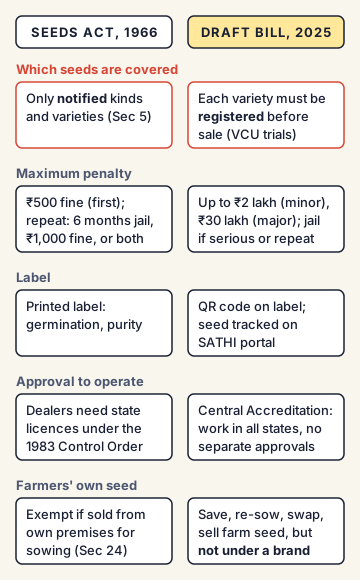
- Compulsory registration of seed varieties before sale, based on Value for Cultivation and Use (VCU) trials (tests at many locations to check yield and performance). Varieties notified under the 1966 Act will be "deemed registered".
- Registration of seed producers, processing units, dealers, distributors and nurseries with state governments.
- A Central Accreditation System, so that companies accredited by the Centre can operate across states without separate approvals in each state.
- QR codes on labels and tracking of seed through the SATHI portal (Seed Authentication, Traceability and Holistic Inventory).
- Graded penalties: small penalties for trivial offences, up to ₹2 lakh for minor offences and up to ₹30 lakh for major offences, with jail in serious or repeat cases.
- Farmers' freedom: farmers can save, use, re-sow, exchange and sell farm-saved seed, but not under a brand name.
- Power for the Centre to regulate seed prices in emergencies such as shortages or profiteering.
Commonly confused concepts
- Seeds Act, 1966 vs Protection of Plant Varieties and Farmers' Rights (PPV&FR) Act, 2001: The Seeds Act is about seed quality (germination, purity, labels). The PPV&FR Act is about ownership rights over new plant varieties: it gives breeders intellectual property rights and protects farmers' rights to save and sell seed. It is run by the PPV&FR Authority, set up in 2005.
- Seeds Act, 1966 vs Seeds (Control) Order, 1983: The Act is a law passed by Parliament on quality. The Control Order is an order made by the government under the Essential Commodities Act, 1955, mainly to license seed dealers.
- Certified seed vs truthfully labelled seed: Certified seed is checked by a certification agency at every stage. Truthfully labelled seed is only required to meet the standards printed on its label, which the seller is responsible for.
- Notification vs registration: Notification under the 1966 Act brings a variety under quality rules. Registration under the new Bill would make approval compulsory before any variety can be sold.
Issues, criticism and the way forward
- Industry view: Companies want faster approvals, a single national licence instead of separate state licences, and clear timelines.
- Farmer groups' concerns: Some farmer organisations fear that compulsory registration and accreditation could increase the power of large seed companies, and that farmers who suffer losses from bad seed will still not get fair compensation.
- Federal angle: Agriculture is a State subject (Entry 14, State List), while the Centre regulates seed quality and trade through central laws, using its powers over trade, commerce and supply of certain goods (Entry 33, Concurrent List) and over the Essential Commodities Act. A Central Accreditation System could reduce the role of states.
- Way forward suggested by experts: strong penalties for spurious seed, a clear compensation system for farmers, time-bound approvals and protection of farmers' traditional rights to save and share seed.
Concepts to Know
- Germination: The sprouting of a seed into a young plant. A germination rate of 80% means 80 out of 100 seeds sprout.
- Purity (of seed): How much of a seed lot is actually the right seed, without stones, weed seeds or seeds of other varieties.
- Variety: A particular type of a crop with its own features, for example a specific rice variety that matures in 120 days.
- Hybrid seed: Seed produced by crossing two different parent plants. It gives higher yield, but farmers usually must buy fresh seed every season.
- Notification: An official order published in the Gazette of India that brings a rule into force.
- Spurious seed: Fake seed sold as something it is not.
- Seeds Act, 1966; Seeds Rules, 1968; Seeds (Control) Order, 1983 (under Section 3 of the Essential Commodities Act, 1955)
- Applies mainly to notified kinds and varieties (Section 5)
- Central Seed Committee (Section 3); Central Seed Certification Board (Section 8A)
- Section 19 penalty: first offence fine up to ₹500; repeat offence jail up to 6 months and/or fine up to ₹1,000
- Draft Seeds Bill, 2025: VCU-based registration, Central Accreditation System, QR codes and SATHI portal, penalties up to ₹30 lakh
- PPV&FR Act, 2001 deals with plant variety rights, not seed quality
● Tracked since April 24, 2026 · last seen November 02, 2026 · updates as the daily brief publishes