Fertiliser Control Order (FCO), 1985
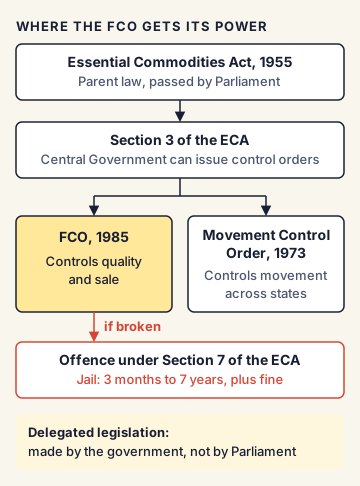
The Fertiliser Control Order (FCO), 1985 is the main set of rules that controls the quality, sale and distribution of fertilisers in India. Its full name is the Fertiliser (Inorganic, Organic or Mixed) (Control) Order, 1985. It is not a law passed by Parliament. It is an order made by the Central Government under Section 3 of the Essential Commodities Act, 1955. Under the FCO, a fertiliser can be made, imported or sold only if it meets the standards listed in the Order.
Why does it exist?
Fertilisers are costly, and farmers cannot test them at home. A bag of fake or low-quality fertiliser can ruin a crop. Also, the government gives huge subsidies on fertilisers, so it needs to make sure the subsidised product is genuine and reaches farmers. The FCO protects farmers from cheating and helps the government control supply.
Where did it come from?
Fertilisers were declared an essential commodity under the Essential Commodities Act, 1955. The government issued fertiliser control orders from the 1950s onwards. The present, comprehensive FCO was issued in 1985. It has been amended many times since:
- Biofertilisers and organic fertilisers were later brought under it.
- In February 2021, biostimulants (products that help plants grow better without being nutrients themselves) were added. Their approved list is in Schedule VI.
- Standards for nano fertilisers, such as nano urea and nano DAP, have also been added.
How does the FCO work?
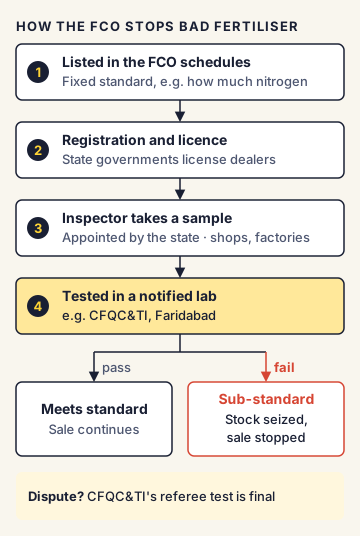
- Specifications: Every fertiliser must meet the standard given in the Order's schedules (for example, how much nitrogen it must contain). A product not listed cannot be sold.
- Registration and authorisation: Manufacturers, importers and dealers need a registration certificate or authorisation. State governments license dealers.
- Fertiliser Inspectors: appointed by states. They can enter shops and factories, take samples, seize stock and stop sales.
- Testing: Samples are tested in notified laboratories. The Central Fertiliser Quality Control and Training Institute (CFQC&TI), Faridabad, and its regional labs at Mumbai, Kalyani and Chennai are recognised labs under the FCO. In a dispute, CFQC&TI's referee test is final.
- Labelling and packing: Bags must show the product name, nutrient content, weight, price and maker's details.
What are the punishments?
Breaking the FCO is an offence under Section 7 of the Essential Commodities Act, 1955. For orders like the FCO, it can mean jail of at least 3 months, up to 7 years, plus a fine. The licence can also be cancelled.
India's position and examples
India is one of the world's largest users of fertilisers and imports a large share of its DAP, potash and urea needs. Urea has a price fixed by the government (₹242 for a 45 kg bag, excluding neem-coating charges and taxes). Other fertilisers like DAP and potash get a fixed subsidy per kilogram of nutrient under the Nutrient Based Subsidy (NBS) scheme.
The FCO works alongside these subsidy systems: the subsidy makes fertiliser cheap, and the FCO makes sure it is genuine. A related order, the Fertiliser (Movement Control) Order, 1973, controls the movement of fertilisers between states.
Commonly confused concepts
- FCO, 1985 vs Essential Commodities Act, 1955: The ECA is the parent law passed by Parliament. The FCO is a delegated order made under Section 3 of the ECA. Penalties for breaking the FCO come from Section 7 of the ECA.
- FCO vs Fertiliser (Movement Control) Order, 1973: The FCO controls quality and sale. The Movement Control Order controls movement and distribution of fertilisers across states.
- FCO vs Nutrient Based Subsidy: The FCO is about quality rules. NBS is about subsidy money.
- Fertiliser vs biostimulant: A fertiliser supplies nutrients (nitrogen, phosphorus, potassium). A biostimulant helps the plant use nutrients or handle stress better, but is not a nutrient itself.
- FCO vs Seeds Act, 1966: Both protect farmers from bad inputs. The Seeds Act is a law passed by Parliament for seeds. The FCO is an order under the ECA for fertilisers.
Issues, criticism and the way forward
- Slow approvals: Industry says adding a new product to the FCO schedules takes a long time, which delays new and better fertilisers.
- "Inspector raj": Wide powers of inspectors can lead to harassment of small dealers.
- Biostimulant shake-up: When provisional registrations ended in June 2025, thousands of biostimulant products lost permission to be sold, because only a small number had been added to Schedule VI.
- Fake fertilisers: Spurious and sub-standard products still reach farmers in many states.
- New law? In 2022, the Department of Fertilizers released a draft Integrated Plant Nutrition Management Bill, 2022, which proposed a central authority and would have taken in provisions of the FCO. It has not become law. Experts suggest a clear, modern law with time-bound approvals, risk-based checks and strong penalties for fakes.
Concepts to Know
- Essential Commodities Act, 1955: A central law that lets the government control the production, supply, distribution and price of goods it declares essential, such as food items, drugs, fertilisers and seeds.
- Delegated legislation: Rules or orders made by the government using power given by a law passed by Parliament. The FCO is an example.
- Subsidy: Money the government pays so that a product can be sold to people at a lower price than its real cost.
- Nano urea: Urea in the form of extremely tiny particles in a liquid, sprayed on leaves, meant to reduce the use of normal urea.
- DAP (Di-Ammonium Phosphate): A common fertiliser that supplies nitrogen and phosphorus.
- Full name: Fertiliser (Inorganic, Organic or Mixed) (Control) Order, 1985
- Made under Section 3 of the Essential Commodities Act, 1955; offences punishable under Section 7 of the ECA (3 months to 7 years jail plus fine)
- Biostimulants added in February 2021 (Schedule VI); provisional registrations ended June 2025
- CFQC&TI, Faridabad, with regional labs at Mumbai, Kalyani and Chennai
- State governments license dealers and appoint Fertiliser Inspectors
- Related: Fertiliser (Movement Control) Order, 1973; draft Integrated Plant Nutrition Management Bill, 2022
● Tracked since February 25, 2026 · last seen November 02, 2026 · updates as the daily brief publishes