Second Optional Protocol to the ICCPR
Abolishing the Death Penalty
Updated 18 Nov 2026: Added the 2024 and November 2026 Third Committee votes on the moratorium resolution, and India's argument based on ICCPR Article 6.
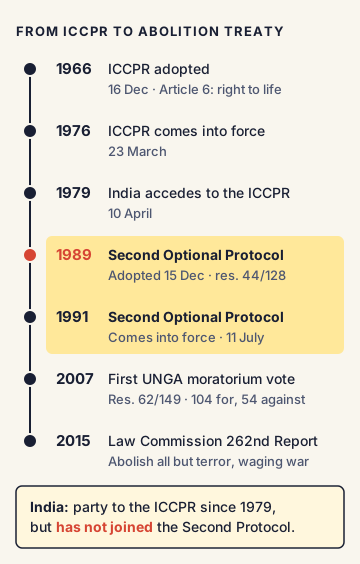
The Second Optional Protocol to the International Covenant on Civil and Political Rights (ICCPR) is the only worldwide treaty whose main purpose is to end the death penalty. A country that joins it promises that it will not execute anyone, and that it will take steps to remove the death penalty from its laws. It is "optional" because a country can be a member of the main ICCPR without joining this extra protocol. India is a party to the ICCPR but has not joined this protocol.
Why does it exist?
The death penalty (also called capital punishment) is the most serious punishment a state can give: taking a person's life. Over the 20th century, many people began to argue that it is cruel, that it cannot be undone if the court makes a mistake, and that there is no clear proof it stops crime better than life imprisonment.
The main ICCPR only limited the death penalty; it did not ban it. Countries that wanted to go further needed a separate, binding promise. The Second Optional Protocol gives them that.
The parent treaty: what does the ICCPR say?
The ICCPR is one of the two great human rights treaties of the UN. It was adopted on 16 December 1966 and came into force on 23 March 1976. Article 6 protects the right to life. On the death penalty, it says:
- Article 6(2): Countries that have not abolished it may give a death sentence only for the "most serious crimes", and only under a law that existed when the crime was committed. The sentence can be carried out only after a final judgment by a competent court.
- Article 6(4): Every person sentenced to death has the right to ask for pardon or a lighter sentence (commutation).
- Article 6(5): No death sentence for crimes committed by persons below 18 years of age, and no execution of pregnant women.
- Article 6(6): Nothing in the article can be used to delay or prevent abolition.
The UN Human Rights Committee, a body of 18 independent experts that watches over the ICCPR, explained in its General Comment No. 36 (2018) that "most serious crimes" should mean only crimes of extreme gravity involving intentional killing.
Where did the Second Optional Protocol come from?
The UN General Assembly adopted it on 15 December 1989 through resolution 44/128. It came into force on 11 July 1991. (The "First" Optional Protocol, from 1966, is different: it lets individuals send complaints to the Human Rights Committee.)
What does the Protocol say?
Its key parts are short and strict:
- Article 1: No one within the jurisdiction (legal control) of a member country shall be executed, and each member must take all necessary steps to abolish the death penalty.
- Article 2: No reservations (opt-outs) are allowed, except one: at the time of joining, a country may keep the death penalty for the most serious crimes of a military nature committed during wartime.
- Reporting: Members report on the measures they take to the Human Rights Committee, as part of their regular ICCPR reports.
- Cannot be suspended: Even in a public emergency, a member cannot set aside these duties.
As of June 2024, 91 of the 173 parties to the ICCPR had joined the Second Optional Protocol.
The UN General Assembly moratorium resolutions
Alongside the treaty, the General Assembly has a separate, softer tool: resolutions asking for a moratorium (a pause in executions). Italy first tried to pass one in 1994, but it lost by eight votes. The first such resolution, 62/149, was adopted on 18 December 2007, by 104 votes in favour, 54 against and 29 abstentions. Since 2008, a new version has come up roughly every two years. Support has grown slowly:
- 2007: 104 in favour, 54 against
- 2014: 117 in favour, 37 against
- 2022: 125 in favour, 37 against, 22 abstentions
- 2024 (Third Committee vote, 18 November 2024): 131 in favour, 36 against, 21 abstentions. The full Assembly then adopted it on 17 December 2024 as resolution 79/179.
- 2026 (Third Committee vote, 13 November 2026): 133 in favour, 33 against, 16 abstentions. As of November 2026, the text still has to go to the full Assembly.
The text is first voted on in the General Assembly's Third Committee (which handles social, humanitarian and human rights issues), and then in the full Assembly. Countries that support the death penalty usually propose an amendment stressing each country's sovereign right to decide its own punishments, and this idea now appears in the resolution itself.
How does it work in practice?
The two tools are very different:
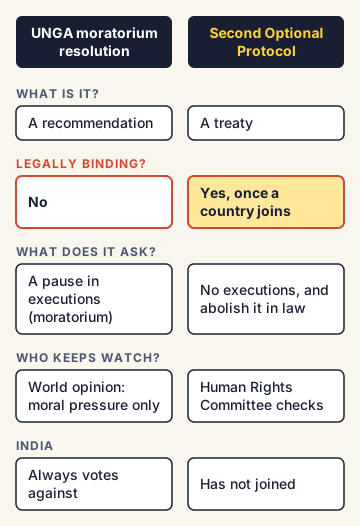
- A General Assembly resolution is a recommendation. It is not legally binding. It shows the opinion of the world and puts moral and diplomatic pressure on countries.
- The Second Optional Protocol is a treaty. Once a country joins it, the duty is legally binding, and the Human Rights Committee checks its record.
So a country may vote for a moratorium resolution without joining the Protocol. But a country that has joined the Protocol has already given up executions for good (except the wartime option).
Where does the world stand?
According to Amnesty International's count at the end of 2025:
- 113 countries have abolished the death penalty for all crimes.
- 145 countries have abolished it in law or in practice.
- 54 countries still keep and use it (retentionist countries).
Yet executions rose sharply. Amnesty recorded 2,707 executions in 2025, up from 1,518 in 2024. This is the highest number it has recorded since 1981, and it does not include China, which keeps its figures secret and is believed to execute thousands. Iran alone carried out about 2,159 of the recorded executions, and drug-related crimes made up a large share of cases.
India's position
India keeps the death penalty and has always voted against the moratorium resolutions, including in the Third Committee vote of November 2026. Its stated reasons have been:
- The resolution goes against India's statutory law (laws made by Parliament).
- Every country has the sovereign right to decide its own legal system and punishments.
- In India, the death penalty is used only in the "rarest of rare" cases, with strong legal safeguards.
- ICCPR Article 6 itself allows the death penalty, with limits. So, in India's view, there is no international consensus (general agreement among countries) against it.
Those safeguards are real and many:
- A death sentence given by a Sessions Court must be confirmed by the High Court before it can be carried out.
- The convict can appeal to the Supreme Court.
- The convict can ask for mercy from the President (Article 72) or the Governor (Article 161).
- In Bachan Singh v. State of Punjab (1980), the Supreme Court said death should be given only in the "rarest of rare" cases.
- In Mithu v. State of Punjab (1983), the Supreme Court struck down Section 303 of the Indian Penal Code, which made death the only punishment for a life convict who committed murder. Since then, India has had no general mandatory death sentence for murder.
- The Juvenile Justice (Care and Protection of Children) Act, 2015 bars a death sentence for anyone who was below 18 when the crime was committed.
India joined (acceded to) the ICCPR on 10 April 1979. In 2015, the Law Commission of India, in its 262nd Report, recommended abolishing the death penalty for all crimes except terrorism-related offences and waging war against the country. The government has not accepted this. India's most recent executions took place in March 2020.
Commonly confused concepts
- Moratorium vs abolition: A moratorium is a pause in executions; the law still allows death. Abolition removes the death penalty from the law.
- "Abolitionist in practice": A country that still has the death penalty in law but has not executed anyone for at least 10 years and seems to have a policy of not doing so.
- UNGA resolution vs treaty: A resolution is a non-binding recommendation. A treaty like the Second Optional Protocol binds the countries that join it.
- First vs Second Optional Protocol: The First (1966) allows individual complaints to the Human Rights Committee. The Second (1989) is about abolishing the death penalty.
- Human Rights Committee vs Human Rights Council: The Committee is a group of 18 experts that watches over the ICCPR. The Council is a body of 47 member countries under the General Assembly.
- Commutation vs pardon: Commutation changes the sentence to a lighter one (for example, death to life imprisonment). Pardon cancels the punishment completely.
Issues, criticism and the way forward
- Does it stop crime? Supporters say the fear of death deters (stops) terrible crimes and gives justice to victims' families. Critics point out that studies have not shown clear proof that the death penalty stops crime better than life imprisonment.
- Mistakes cannot be undone. If an innocent person is executed, there is no way to correct it. Critics note that courts sometimes disagree among themselves on who deserves death.
- Fairness. Studies in India and abroad have found that most people on death row are poor and could not afford strong lawyers, which raises questions of equal justice.
- Sovereignty vs universal rights. Retentionist countries say criminal law is a national matter. Abolitionist countries say the right to life is a universal human right.
- Way forward suggested by experts: better legal aid at trial, strict use of the rarest-of-rare test, faster handling of mercy petitions (long delays can themselves be grounds to reduce a sentence), and, as the Law Commission suggested, limiting the death penalty to terrorism and waging war.
Concepts to Know
- Covenant: Another word for a binding international treaty.
- Optional Protocol: An extra treaty attached to a main treaty. Countries choose separately whether to join it.
- Accession: Joining a treaty that a country did not sign at the start. It has the same legal effect as ratification.
- Reservation: A statement by which a country, when joining a treaty, says it will not follow a certain part of it.
- Retentionist country: A country that keeps the death penalty in its law and uses it.
- Recorded vote: A vote in the UN where each country's choice (yes, no or abstain) is officially written down.
- ICCPR: adopted 16 December 1966; in force 23 March 1976; Article 6 = right to life
- Article 6(5): no death sentence for crimes by persons under 18; no execution of pregnant women
- Second Optional Protocol: adopted 15 December 1989 (UNGA resolution 44/128); in force 11 July 1991
- Only allowed reservation: death penalty in wartime for the most serious military crimes (Article 2)
- 91 of 173 ICCPR parties had joined the Second Optional Protocol as of June 2024; India has not
- First UNGA moratorium resolution: 62/149, 18 December 2007 (104–54–29)
- Third Committee votes: 2024, 131–36–21 (adopted as resolution 79/179); 13 November 2026, 133–33–16, with India voting against
- End of 2025: 113 countries abolitionist for all crimes; 145 in law or practice; 54 retentionist
- 2,707 executions recorded in 2025 (excluding China), highest since 1981
- India acceded to the ICCPR on 10 April 1979; Law Commission 262nd Report (2015) recommended abolition except for terrorism and waging war
- 18 Nov 2026Added the 2024 and November 2026 Third Committee votes on the moratorium resolution, and India's argument based on ICCPR Article 6.
● Tracked since November 15, 2026 · last seen November 17, 2026 · updates as the daily brief publishes