Sample Return Missions
Bringing Pieces of Space Back to Earth
A sample return mission is a space mission that travels to another world, such as the Moon, an asteroid, a comet or a planet's moon, collects some of its material and brings it back to Earth. The material may be soil, rock, dust or even particles of the solar wind. Scientists then study it in powerful laboratories on Earth. This is the most direct way to learn what other worlds are made of and how the solar system formed.
Why bring samples back at all?
A spacecraft can carry only small, light instruments. It also must work with limited power and time. Laboratories on Earth are far bigger and more exact. They can measure the age of a rock to within a few million years, find tiny amounts of water or carbon, and look at single grains under huge magnification.
Samples can also be stored for decades. New machines invented in the future can then study them again. For example, Moon rocks brought back by Apollo in the 1970s are still giving new results today.
How does a sample return mission work?
Every such mission has to do five hard things:
- Reach the target: Travel millions of kilometres and enter orbit or fly alongside the body.
- Touch down or touch the surface: Land, or briefly touch the surface. On small bodies with weak gravity, the spacecraft may just "tap" the surface for a few seconds.
- Collect the material: By scooping, drilling, firing a small bullet to throw up dust, or blowing gas to push soil into a container.
- Leave and fly home: Launch again from the target and travel back to Earth.
- Re-enter safely: A small capsule enters Earth's atmosphere at very high speed, protected by a heat shield, then opens a parachute and lands in a remote area, often a desert.
Where did it come from? The history so far
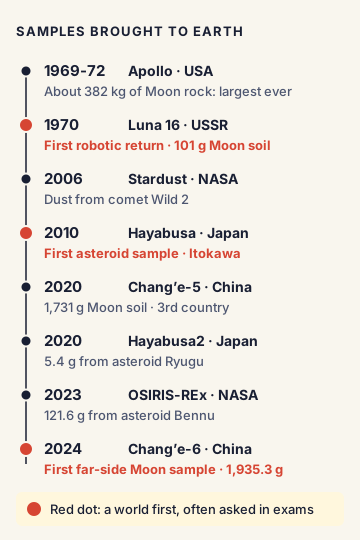
- Apollo (USA), 1969 to 1972: Astronauts on six Apollo missions brought back about 382 kg of Moon rock and soil. This is still the largest collection of samples from another world.
- Luna 16 (Soviet Union), 1970: The first robotic (without humans) sample return. It brought back about 101 grams of Moon soil in September 1970. Later, Luna 20 and Luna 24 also returned Moon samples.
- Genesis (NASA), 2004: Collected particles of the solar wind (the stream of charged particles from the Sun). Its capsule crashed on landing because its parachute did not open, but scientists still saved useful material.
- Stardust (NASA), 2006: Collected dust from the comet Wild 2 and returned it in January 2006.
- Hayabusa (Japan), 2010: The first mission to bring back material from an asteroid, Itokawa. Despite many breakdowns, the capsule landed in the Woomera desert of Australia on 13 June 2010 with tiny grains.
- Chang'e-5 (China), 2020: Brought back about 1,731 grams of Moon soil in December 2020. China became the third country, after the USA and the Soviet Union, to return Moon samples.
- Hayabusa2 (Japan), 2020: Brought back about 5.4 grams from the asteroid Ryugu in December 2020. It even fired a small "bullet" into the asteroid to make an artificial crater and reach fresh material below.
- OSIRIS-REx (NASA), 2023: Brought back about 121.6 grams from the asteroid Bennu in September 2023, the largest asteroid sample so far.
- Chang'e-6 (China), 2024: Brought back 1,935.3 grams from the far side of the Moon (the side we never see from Earth), from the South Pole-Aitken basin. This was the first sample ever taken from the far side.
What is happening now and next?
- Tianwen-2 (China): Launched in May 2025 to collect samples from a small near-Earth asteroid called Kamo'oalewa, then go on to study a comet.
- MMX (Japan): Launching in October 2026 to bring back at least 10 grams from Phobos, a moon of Mars, by 2031.
- Mars Sample Return (NASA and ESA): NASA's Perseverance rover has been collecting and sealing rock samples on Mars since 2021. The original plan to bring them back became very costly and was dropped in the US 2026 budget process. Other cheaper ways to fetch them are being discussed.
- Chandrayaan-4 (India): India's first sample return mission. The Union Cabinet approved it on 18 September 2024 at a cost of ₹2,104.06 crore. It aims to land on the Moon, collect soil, and bring it back to Earth.
Chandrayaan-4: India's plan in detail
The mission will be made of five parts (modules) and launched in two separate rocket launches. Two groups of modules will be joined together in orbit around Earth or the Moon. This joining is called docking. India practised docking in space with the SpaDeX mission. After landing, an ascender module will lift the samples back up from the Moon's surface.
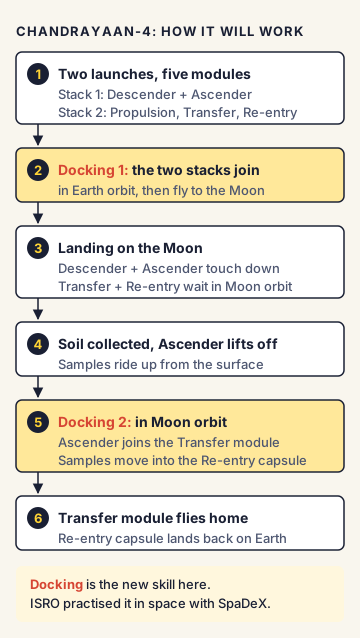
It will dock with a transfer module, which will carry a re-entry capsule back to Earth. The government expects the mission to be completed within 36 months of approval. Chandrayaan-4 is a key step towards India's goal of landing an Indian astronaut on the Moon by 2040.
India's position
India has not yet returned any sample from space. But ISRO has shown the needed building blocks: soft landing on the Moon (Chandrayaan-3, 23 August 2023, near the south pole), bringing back a module from space safely (the Space Capsule Recovery Experiment in 2007), and docking in orbit (SpaDeX). Chandrayaan-4 will put these together. India and Japan are also jointly building the Chandrayaan-5/LUPEX mission to study the Moon's south pole region.
Commonly confused concepts
- Sample return vs in-situ analysis: In-situ ("on the spot") analysis means instruments study the material on the target itself, as rovers on Mars do. Sample return brings the material to Earth. Sample return gives far more detail but is much harder and costlier.
- Meteorites vs returned samples: Meteorites are pieces of space rock that fall to Earth naturally. Some even come from Mars. But scientists do not know exactly where on the parent body they came from, and they get damaged by heat and Earth's environment. Returned samples come from a known place and are kept clean.
- Near side vs far side of the Moon: The Moon always shows the same face to Earth. The far side is not "dark" (it gets sunlight), it is just never visible from Earth. Chang'e-6 took the first far-side samples.
- Hayabusa vs Hayabusa2: Hayabusa went to asteroid Itokawa (returned 2010). Hayabusa2 went to asteroid Ryugu (returned 2020).
Issues, criticism and the way forward
- High cost and risk: Return missions must carry fuel and engines for the journey home, so they are heavier and costlier. NASA's Mars Sample Return plan grew from early estimates of a few billion dollars to around 11 billion dollars, which led to its original plan being dropped.
- Contamination: Samples must be kept free of Earth's air, water and germs, or results will be wrong. Special clean storage rooms (curation facilities) are needed.
- Planetary protection: Material from places that might have had life, like Mars, must be handled as if it could be dangerous, until proven safe. This is guided by the Committee on Space Research (COSPAR).
- Sharing: Countries often share samples with partners. For example, Japan and the USA exchanged parts of their Ryugu and Bennu samples. Fair and open sharing helps science move faster.
- Way forward: Cheaper designs, international partnerships and robotic missions are making sample return more common. For India, Chandrayaan-4 will build the skills needed for future human Moon landings and the Bharatiya Antariksh Station.
Concepts to Know
- Asteroid: A small rocky or metal body that goes around the Sun. Most are in a belt between Mars and Jupiter. Many are leftovers from when the planets formed, so they are like time capsules.
- Comet: A small body of ice, dust and rock. When it comes near the Sun, the ice turns to gas and forms a glowing tail.
- Heat shield: A protective layer on a capsule that absorbs or throws away the intense heat created when it rushes into Earth's air at very high speed.
- Docking: Joining two spacecraft together in space, so that they can pass objects or people between them.
- Curation facility: A special super-clean laboratory where returned space samples are stored, catalogued and carefully handed out for study.
- Apollo (USA, 1969 to 1972): about 382 kg of Moon samples
- Luna 16 (USSR, 1970): first robotic sample return, about 101 g of Moon soil
- Hayabusa (Japan): first asteroid sample, Itokawa, returned 13 June 2010 (Woomera, Australia)
- Hayabusa2 (Japan): about 5.4 g from asteroid Ryugu, December 2020
- OSIRIS-REx (USA): about 121.6 g from asteroid Bennu, September 2023
- Chang'e-5 (China): about 1,731 g, December 2020; Chang'e-6 (China): 1,935.3 g, first far-side samples, June 2024
- Tianwen-2 (China): launched May 2025 to asteroid Kamo'oalewa
- Chandrayaan-4 (India): approved 18 September 2024, ₹2,104.06 crore, five modules, two launches
- MMX (Japan): Phobos, at least 10 g, return 2031
● Tracked since October 18, 2026 · last seen October 18, 2026 · updates as the daily brief publishes