Martian Moons eXploration (MMX) Mission
Japan's Journey to Phobos
The Martian Moons eXploration mission, or MMX, is a Japanese robotic spacecraft that will fly to Mars, land on its larger moon Phobos, scoop up some of its soil and bring it back to Earth. It is led by JAXA, Japan's national space agency. It is a "sample return" mission: its main job is not just to take photos, but to carry real pieces of another world back home so scientists can study them in laboratories. If successful, it will be the first time any country brings back material from Mars or its moons.
Why go to the moons of Mars?
Mars has two small, dark, potato-shaped moons, Phobos and Deimos. Nobody knows for sure how they were born. There are two main ideas:
- Captured asteroid idea: They were once asteroids (small rocky bodies that go around the Sun). They came too close to Mars and got trapped by its gravity.
- Giant impact idea: A large object smashed into Mars long ago. The crash threw a cloud of rock into space around Mars. Over time, some of this rock came together to form the moons.
Photos and measurements from far away have not settled this debate. The answer is hidden in the chemistry of the rocks. If Phobos soil looks like asteroid material, the first idea wins. If it looks like Martian rock, the second idea wins. That is why a sample is needed.
Why does the answer matter?
How the moons formed tells us how planets like Mars and Earth were built. It also tells us how water and carbon-rich material, the raw ingredients of life, were carried around the early solar system. There is another bonus. When rocks hit Mars over billions of years, some Martian dust and pieces were thrown up and fell on Phobos, which is very close to Mars. So Phobos soil may also contain tiny bits of Mars itself. This gives scientists a "free" sample of Mars too.
Where did it come from?
JAXA announced the MMX idea on 9 June 2015. The Japanese government and JAXA approved it for full development on 19 February 2020. At that time, the launch was planned for 2024. In late 2023, the launch was moved to 2026. The main reason was to allow enough time for ground checks after the early test flights of Japan's new H3 rocket (the first H3 flight in March 2023 failed; the second, in February 2024, succeeded).
The spacecraft reached the Tanegashima launch site on 31 March 2026. MMX builds on Japan's earlier asteroid missions, Hayabusa and Hayabusa2, which made JAXA one of the world's most experienced agencies in bringing back samples.
How will the mission work, step by step?
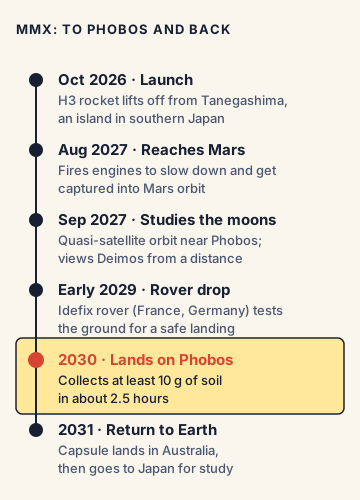
- Launch (October 2026): An H3 rocket lifts MMX from Tanegashima, an island in southern Japan.
- Cruise (about one year): The spacecraft travels to Mars.
- Reaching Mars (August 2027): MMX fires its engines to slow down and get captured into orbit around Mars.
- Studying the moons (from September 2027): MMX moves into a special path close to Phobos, called a quasi-satellite orbit. It maps Phobos in detail and also studies Deimos from a distance.
- Rover drop (early 2029): The small Idefix rover is released onto Phobos. It tests the surface so the main spacecraft can land safely later.
- Landing and sampling (2030): The main spacecraft lands on Phobos and collects soil.
- Return (2031): A return module flies back to Earth and drops a capsule with at least 10 grams of Phobos soil. The capsule lands in Australia and is taken to Japan for study. Samples will be shared with partner countries.
What is a quasi-satellite orbit?
Normally a spacecraft goes around a moon, held by that moon's gravity. But Phobos is too small. Its gravity is too weak to hold a spacecraft in a normal orbit. So MMX will actually go around Mars, on a path that keeps it always near Phobos, looping around it as seen from Phobos. It is like a person walking beside a friend on a circular running track, while also circling around the friend. This is called a quasi-satellite ("almost satellite") orbit.
How will it collect the soil?
MMX carries two samplers:
- Coring sampler (C-SMP): A robotic arm shoots a tube into the ground to pick up soil from more than 2 cm deep. Deeper soil is less damaged by space radiation, so it keeps its original chemistry better.
- Pneumatic sampler (P-SMP): Fitted near a landing leg. It blows a puff of gas to push loose surface soil into a container. NASA provided this sampler.
The target is at least 10 grams in total. The robotic arm then moves both containers into the return capsule. The whole sampling job on the surface is planned to take only about 2.5 hours.
The key parts and facts
- Three modules: A propulsion module (engines and fuel to reach Mars), an exploration module (the main body with instruments and the landing system) and a return module (to fly home). Launch mass is about 4 tonnes.
- Main science instruments: Cameras named TENGOO (zoom camera) and OROCHI (wide camera), a LIDAR (laser that measures height and distance), MIRS (an infrared spectrometer from France that identifies minerals), MEGANE (a gamma-ray and neutron spectrometer from NASA that reads the chemical make-up of the surface), CMDM (dust counter) and MSA (an instrument that studies charged particles around Mars).
- Idefix rover: About 25 kg, built by CNES (France) and DLR (Germany). Because Phobos's gravity is so weak, it would weigh only about 15 grams there. It is a test of driving on wheels in very low gravity.
- Partners: NASA (MEGANE and the pneumatic sampler), CNES and DLR (Idefix and the MIRS instrument; CNES also helps plan the path), ESA (deep-space radio hardware and ground stations). Japan's broadcaster NHK supplied an 8K (very high-definition) camera.
What do we know about Phobos and Deimos?
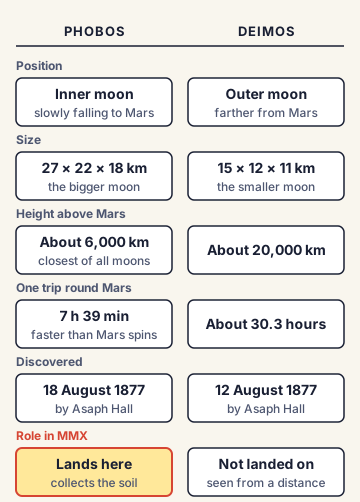
- Both moons were discovered in August 1877 by the American astronomer Asaph Hall. Deimos was found on 12 August and Phobos on 18 August.
- The names come from Greek mythology: Phobos means "fear" and Deimos means "dread". They were the sons of Ares, the Greek god of war (Mars is the Roman god of war).
- Phobos: About 27 × 22 × 18 km in size. It orbits only about 6,000 km above the Martian surface, closer than any other known moon to its planet. It goes around Mars once every 7 hours 39 minutes, faster than Mars spins (about 24.6 hours). Its biggest crater, Stickney, is about 9 to 10 km wide, nearly half the moon's width.
- Phobos is falling: It moves about 1.8 metres closer to Mars every 100 years. Within about 100 million years, it will either crash into Mars or break apart into a ring.
- Deimos: Smaller, about 15 × 12 × 11 km, orbiting about 23,460 km above Mars, once every 30.3 hours.
India's position
India's Mars Orbiter Mission (Mangalyaan), launched by ISRO in November 2013, reached Mars on 24 September 2014. India became the first country to reach Mars orbit in its first attempt and the first Asian country to reach Mars orbit. Mangalyaan also photographed Phobos, including its far side. ISRO has plans for a Mars landing mission in the future, and its first sample return mission, Chandrayaan-4, will bring soil back from the Moon. Japan and India are also partners on the Chandrayaan-5/LUPEX lunar mission, so JAXA's sample-handling skills matter to India.
Commonly confused concepts
- MMX vs Mars Sample Return (MSR): MMX lands on Phobos, a moon of Mars, and is led by Japan. MSR was a NASA-ESA plan to bring back the rock samples that NASA's Perseverance rover has been collecting on the surface of Mars itself. The original MSR plan was dropped in the US 2026 budget process because of its huge cost; the samples remain on Mars.
- MMX vs Hayabusa2: Hayabusa2 brought back samples from an asteroid called Ryugu (2020). MMX goes to a moon of a planet, much farther and harder to reach.
- Phobos vs Deimos: Phobos is the bigger, inner moon that is slowly falling towards Mars. Deimos is the smaller, outer moon. MMX lands only on Phobos.
- JAXA vs ISAS: ISAS (Institute of Space and Astronautical Science) is the science arm inside JAXA that runs missions like Hayabusa and MMX. JAXA itself was formed on 1 October 2003 by merging ISAS, NAL (National Aerospace Laboratory) and NASDA (National Space Development Agency of Japan).
Issues, criticism and the way forward
- Delays and cost: The mission slipped by two years because Japan's new H3 rocket had a failed first flight. Long missions also depend on many years of steady funding.
- Very hard landing: Landing on a body with almost no gravity is tricky. A spacecraft can bounce off. This is why Idefix first tests the ground.
- Distance and time: Radio signals take several minutes to travel between Earth and Mars, so the spacecraft must make many decisions by itself.
- Planetary protection: Scientists must make sure no Earth germs contaminate Phobos, and that the returned samples are handled carefully. Phobos is considered low risk for carrying life, so this is easier than for samples from Mars itself.
- Way forward: If MMX succeeds, it will give the world its first material from the Mars system. This will help plan future crewed trips to Mars, since Phobos has been suggested as a possible base or stepping stone.
Concepts to Know
- Sample return mission: A space mission that collects material from another world and brings it back to Earth for study in laboratories.
- Regolith: The loose layer of dust, soil and broken rock covering the surface of moons, asteroids and planets like Mars.
- Spectrometer: An instrument that splits light or other radiation into its parts. Each chemical element or mineral leaves its own pattern, so the instrument can tell what a surface is made of without touching it.
- Gravity of a small body: The pull of gravity depends on mass. Phobos is tiny, so its pull is about a thousand times weaker than Earth's. Things there weigh almost nothing.
- Orbit insertion: The moment a spacecraft fires its engines to slow down so that a planet's gravity can capture it into an orbit.
- H3 rocket: Japan's new main launch rocket, which replaced the older H-IIA. It is designed to be cheaper and more flexible.
- MMX = Martian Moons eXploration; led by JAXA (Japan); announced 9 June 2015; approved 19 February 2020
- Launch: H3 rocket, Tanegashima Space Center; planned 20 October 2026 (04:41 JST)
- Mars arrival August 2027; Idefix rover release early 2029; Phobos landing and sampling 2030; capsule return to Earth 2031 (lands in Australia)
- Sample target: at least 10 grams; two samplers (coring C-SMP and pneumatic P-SMP)
- Partners: NASA, CNES, DLR, ESA; Idefix rover by CNES and DLR (about 25 kg)
- Phobos and Deimos discovered by Asaph Hall in August 1877
- Phobos orbits about 6,000 km above Mars in 7 h 39 min; moving inward about 1.8 m per century; Stickney crater about 10 km wide
● Tracked since October 18, 2026 · last seen October 18, 2026 · updates as the daily brief publishes