Right to Water as a Fundamental Right
India's Constitution does not mention a "right to water" in so many words. But the Supreme Court and High Courts have read it into Article 21, the right to life and personal liberty. The courts reason that life without clean, safe drinking water is not a life with dignity. So access to safe drinking water is today treated as part of the fundamental right to life, and the state has a duty to work towards providing it.
Why does it exist?
Water is the most basic need after air. Dirty water spreads diseases like cholera, typhoid and diarrhoea, which hit children and the poor the hardest. In many villages, women and girls spend hours every day carrying water from far away, which affects their health, schooling and work. If drinking water were treated only as a service the government may give when it likes, the poorest would always be left at the end of the line. Treating it as a right makes the state accountable and lets people go to court when it fails.
Where did it come from?
The right grew through court judgments, step by step:
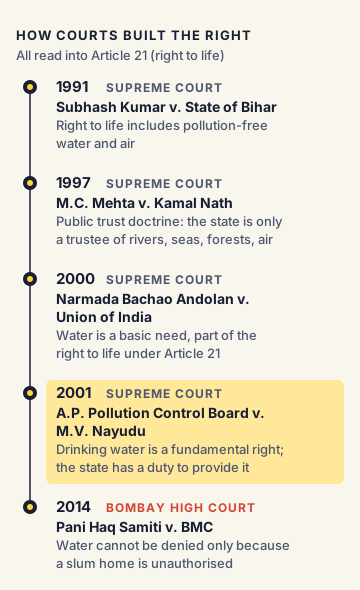
- Subhash Kumar v. State of Bihar (1991): The Supreme Court said the right to life under Article 21 includes the right to enjoy pollution-free water and air. The case was about sludge from steel plant washeries polluting the Bokaro river.
- M.C. Mehta v. Kamal Nath (1997): The Supreme Court adopted the public trust doctrine: natural resources like rivers, seas, forests and air are held by the state as a trustee for the people. The state cannot hand them over for private use in a way that harms public use.
- Narmada Bachao Andolan v. Union of India (2000): The Court said water is a basic need for survival and part of the right to life and human rights under Article 21.
- A.P. Pollution Control Board v. M.V. Nayudu (2001): The Court said access to drinking water is a fundamental right and the state has a duty to provide it.
- Pani Haq Samiti v. Brihanmumbai Municipal Corporation (2014): The Bombay High Court held that the city could not deny water supply to residents of slums only because their homes were unauthorised. Access to water was separated from the legal status of the house.
How does it work in practice?
A court judgment alone does not lay pipes. The right works through three channels:
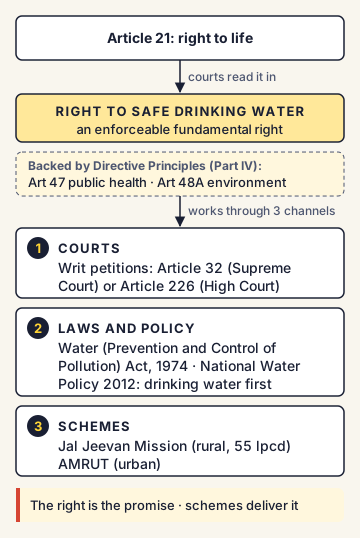
- Courts: People can file writ petitions (Article 32 in the Supreme Court or Article 226 in a High Court) when the state fails, for example by polluting a water source or cutting off supply without reason.
- Laws and policy: Water pollution laws, like the Water (Prevention and Control of Pollution) Act, 1974, and national policies set the rules. The National Water Policy, 2012 treats safe water for drinking and sanitation as a "pre-emptive need", which means it must be met first, before water is given to other uses like industry or irrigation.
- Schemes: Programmes like the Jal Jeevan Mission (rural) and AMRUT (urban) turn the right into actual taps and pipelines. A useful comparison: the right is the promise, and the schemes are the delivery system.
Key constitutional links
- Article 21: right to life, which courts have read to include safe drinking water.
- Article 47 (Directive Principle): the state's duty to raise the level of nutrition and standard of living, and to improve public health.
- Article 48A (Directive Principle): the state shall protect and improve the environment.
- Article 51A(g) (Fundamental Duty): every citizen must protect and improve the natural environment, including lakes and rivers.
- Article 39(b) (Directive Principle): ownership and control of material resources of the community should be distributed to serve the common good.
- Entry 17, State List: water supply, irrigation, canals, drainage, water storage and water power are state subjects, subject to Entry 56 of the Union List, which lets Parliament regulate inter-state rivers and river valleys in the public interest.
- Article 262: Parliament can make law to settle disputes over inter-state rivers.
Global framework
On 28 July 2010, the UN General Assembly adopted Resolution 64/292, which recognised the right to safe and clean drinking water and sanitation as a human right; 122 countries voted in favour, none against, and 41 abstained. In September 2010, the UN Human Rights Council adopted Resolution 15/9, affirming these rights. In 2015, the UN treated water and sanitation as two separate rights (General Assembly Resolution 70/169).
Earlier, in 2002, the UN Committee on Economic, Social and Cultural Rights had explained in General Comment No. 15 that the right means water that is sufficient, safe, acceptable, physically accessible and affordable. Sustainable Development Goal 6 aims for clean water and sanitation for all by 2030.
India's position
India supports the idea through court-recognised rights and large schemes rather than a separate law that guarantees a fixed quantity of water to each person. In May 2019, the Ministry of Water Resources and the Ministry of Drinking Water and Sanitation were merged to form the Ministry of Jal Shakti. The JJM sets a rural benchmark of 55 litres per person per day of BIS 10500 quality water. In cities, the planning norm used for homes with sewerage is 135 litres per person per day.
Commonly confused concepts
- Right to water vs right to a clean environment: Both come from Article 21. The right to a clean environment is broader (air, land, forests). The right to water focuses on access to enough safe water for personal and domestic use.
- Fundamental Right vs Directive Principle: Fundamental Rights (Part III) can be enforced in court. Directive Principles (Part IV), like Articles 47 and 48A, cannot be directly enforced, but courts use them to explain the meaning of rights like Article 21.
- Entry 17 (State List) vs Entry 56 (Union List): Entry 17 makes water mainly a state subject. Entry 56 lets the Union step in only for inter-state rivers and river valleys, and only to the extent Parliament declares it expedient in the public interest.
- Human right (UN) vs fundamental right (India): The UN resolution recognises water as a human right at the international level. In India, it is enforceable because courts have read it into Article 21.
Issues, criticism and the way forward
- Taps without water: Studies and reviews have found that many new tap connections do not supply water regularly, or supply less than 55 lpcd. This is why JJM 2.0 shifts focus from counting connections to measuring actual service.
- Source sustainability: Most rural drinking water comes from groundwater, which is falling fast in many states. Without recharge and careful use, schemes may run dry.
- Water quality: Arsenic, fluoride, nitrate and bacterial contamination affect water in several regions. Regular testing and treatment are needed.
- Operation and maintenance: Villages often lack the money and skills to run and repair systems after the contractor leaves. Gram Panchayats and village water committees need training and funds.
- Equity vs pricing: Some experts argue that water must be priced to cover costs and avoid waste. Others argue that a basic minimum amount of water should be free or very cheap for the poor. Many suggest a mix: a free or low-cost basic quantity, and higher charges above it.
- Way forward: Experts suggest clear service standards that citizens can check, protection and recharge of water sources, regular quality testing, strong village-level management, and legal clarity on the minimum quantity of water every person is entitled to.
Concepts to Know
- Article 21: The fundamental right that no person shall be deprived of life or personal liberty except according to procedure established by law. Courts have read many rights into it, such as the right to health, shelter and clean environment.
- Directive Principles of State Policy (DPSP): Guidelines in Part IV of the Constitution that the government should follow while making laws and policies. They cannot be enforced in court directly.
- Public trust doctrine: The idea that certain natural resources belong to the public, and the government only holds them as a trustee, like a guardian, for everyone's benefit.
- lpcd (litres per capita per day): The amount of water supplied to each person every day, used to measure how good a water supply is.
- BIS 10500: The Bureau of Indian Standards' standard that sets limits for what safe drinking water may contain.
- Groundwater: Water stored under the ground in soil and rock layers, drawn up through wells, handpumps and borewells.
- Right to water read into Article 21 through court judgments; not written separately in the Constitution
- Subhash Kumar v. State of Bihar (1991): pollution-free water part of right to life
- M.C. Mehta v. Kamal Nath (1997): public trust doctrine
- Narmada Bachao Andolan (2000) and A.P. Pollution Control Board v. M.V. Nayudu (2001): drinking water a fundamental right
- Pani Haq Samiti v. BMC (Bombay HC, 2014): water supply cannot be denied only because a slum is unauthorised
- Related provisions: Articles 39(b), 47, 48A, 51A(g), 262; Entry 17 (State List), Entry 56 (Union List)
- UNGA Resolution 64/292: 28 July 2010; 122 for, 0 against, 41 abstentions
- UN Human Rights Council Resolution 15/9: September 2010; UNGA Resolution 70/169 (2015): water and sanitation as separate rights
- CESCR General Comment No. 15 (2002); SDG 6 (clean water and sanitation)
- National Water Policy, 2012: drinking water and sanitation a pre-emptive need
- Ministry of Jal Shakti formed: May 2019
- JJM norm: 55 lpcd, BIS 10500; urban norm with sewerage: 135 lpcd
● Tracked since October 05, 2026 · last seen October 05, 2026 · updates as the daily brief publishes