Right to Internet Access as a Fundamental Right
The right to internet access means a person has a protected right to get online and use the internet. India's Constitution does not mention the internet anywhere. But the Supreme Court has read this right into Article 21 (right to life and personal liberty) and Article 19(1)(a) (freedom of speech and expression). This means the government cannot cut off or limit a person's internet use without a valid law and a fair, balanced reason.
Why does it matter?
Today the internet is the door to almost everything: school classes, bank accounts, ration and pension schemes, job forms, news, and talking to family. A student in a remote village may have no library, but a phone can bring the whole world's lessons to them. When the internet is cut, a person loses not one right but many at once: the right to learn, to work, to speak and to get government services. That is why courts now treat access itself as something that must be protected.
Is it written in the Constitution?
No. Courts build it from rights that are written:
- Article 19(1)(a): freedom of speech and expression, which includes the right to receive and share information. The internet is a main way to do both.
- Article 19(1)(g): freedom to carry on any trade or business, which today often happens online.
- Article 21: right to life and personal liberty, which the Supreme Court has long read to mean a life with dignity, not mere survival.
- Article 21A: right to free and compulsory education for children aged 6 to 14, for which online learning now matters a great deal.
Where did it come from? The road through the courts
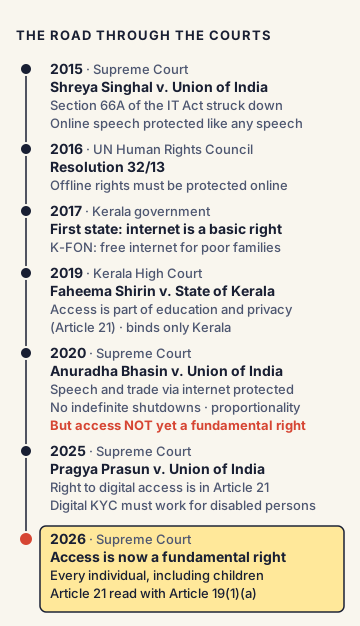
- Shreya Singhal v. Union of India (2015): The Supreme Court struck down Section 66A of the Information Technology Act, 2000, which punished "offensive" online messages. It held the section was vague and too broad, and violated Article 19(1)(a). This made clear that speech on the internet gets the same protection as speech anywhere else.
- Faheema Shirin R.K. v. State of Kerala (2019): On 19 September 2019, the Kerala High Court struck down a college hostel rule that banned girl students from using mobile phones at night. It held that the right to access the internet is part of the right to education and the right to privacy under Article 21. It relied on a 2012 United Nations Human Rights Council resolution. This was the first clear court ruling of its kind in India, but it binds only Kerala.
- Anuradha Bhasin v. Union of India (10 January 2020): This case came from the long internet shutdown in Jammu and Kashmir after August 2019. The Supreme Court held that freedom of speech and freedom of trade through the internet are protected by Articles 19(1)(a) and 19(1)(g). It said indefinite internet shutdowns are not allowed, every shutdown must pass the test of proportionality, shutdown orders must be published so they can be challenged, and a review committee must check them regularly. It did not, however, declare internet access itself a fundamental right.
- Foundation for Media Professionals v. UT of Jammu and Kashmir (11 May 2020): During COVID-19, when only slow 2G internet was allowed in J&K, the court asked a special committee of senior officials to review whether faster 4G could be restored.
- Pragya Prasun v. Union of India (30 April 2025): An acid attack survivor could not complete digital KYC (the online identity check banks use) because it needed her to blink at a camera. A bench of Justices J.B. Pardiwala and R. Mahadevan held that the right to digital access is part of Article 21, and ordered that KYC be made accessible for persons with disabilities.
- The 2026 ruling: Building on Pragya Prasun, the Supreme Court declared that the right to access and use the internet is a fundamental right of every individual, including children, under Article 21 read with Article 19(1)(a).
How can the government limit it?
No fundamental right is unlimited. The internet right can be restricted, but only in a fair way:
- Grounds: Under Article 19(2), speech can be limited only on eight grounds, such as the sovereignty and integrity of India, security of the State, public order, decency or morality, and incitement to an offence.
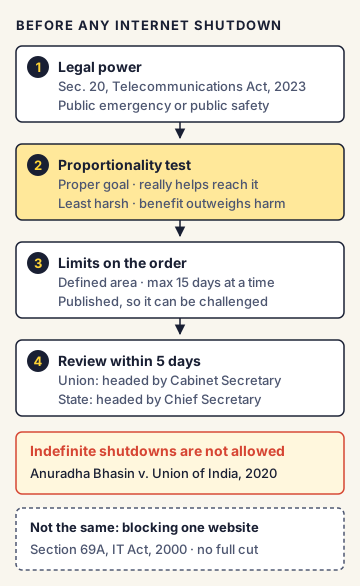
- Proportionality test: A restriction must have a proper goal, must actually help reach that goal, must be the least harsh option available, and must balance the harm done to the right against the benefit gained. Cutting the whole internet of a district to stop one rumour usually fails this test.
- Internet shutdowns: These are now made under Section 20 of the Telecommunications Act, 2023, which allows suspension of telecom services in a public emergency or in the interest of public safety. The rules for this, the Temporary Suspension of Telecommunication Services Rules, 2024, replaced the 2017 rules made under the old Indian Telegraph Act, 1885.
- Under the 2024 Rules: an order can cover only a defined area, cannot last more than 15 days at a time, and must be checked by a review committee (headed by the Cabinet Secretary at the Union level and the Chief Secretary in a state) within 5 days.
- Blocking websites: The government can block specific online content under Section 69A of the IT Act, 2000, which the court upheld in Shreya Singhal because it has safeguards.
What about children?
The 2026 ruling is the first to say clearly that children, too, hold this right. The court's reasoning:
- The internet is a "marketplace of ideas". For many children in remote areas it is the only source of learning, and for children with special needs it can be a source of companionship.
- A blanket ban could push children towards unsafe, unregulated platforms. It could also make children afraid to tell trusted adults about online abuse, for fear they would be punished.
- Age checks for every user mean collecting sensitive data again and again, which creates a risk of misuse and surveillance.
- So the answer is safer design, not exclusion: child modes, private-by-default accounts, limits on strangers, and parental guidance.
India's data protection law already treats anyone below 18 as a child. Under the Digital Personal Data Protection Act, 2023, platforms need verifiable parental consent before processing a child's personal data, and the DPDP Rules notified in November 2025 set out how this consent is to be checked.
The global picture
- United Nations: On 1 July 2016, the UN Human Rights Council adopted resolution 32/13, without a vote, on the promotion and protection of human rights on the internet. It says the same rights people have offline must be protected online. Such resolutions guide countries but are not binding law.
- Kerala: In 2017, Kerala became the first Indian state to declare internet access a basic right and announced the K-FON (Kerala Fibre Optic Network) project to give free internet to poor families. K-FON was launched on 5 June 2023.
- Australia: In November 2024, Australia passed a law setting 16 as the minimum age for social media accounts. It is the best-known example of the age-ban approach that India's Supreme Court has now chosen not to follow.
India's position and practice
India is a world leader in cheap mobile data and digital public services such as Aadhaar, UPI and DigiLocker. At the same time, India uses internet shutdowns often. The digital rights group Access Now counted 84 shutdowns in India in 2024, down from 116 in 2023. That was the second-highest number in the world after Myanmar, and the highest among democracies. Manipur saw the most (21). The new ruling adds weight to the demand that every shutdown be narrow, short and justified.
Commonly confused concepts
- Right to internet access vs freedom of speech on the internet: Freedom of speech on the internet (Shreya Singhal, Anuradha Bhasin) protects what you say and do online. The right to access protects being able to get online at all. Anuradha Bhasin recognised the first; the 2026 ruling recognised the second.
- Article 19 vs Article 21: Article 19 rights belong only to citizens. Article 21 protects every person, including foreigners. Placing the internet right under Article 21 makes it available to everyone in India.
- Fundamental right vs free internet: A fundamental right to access does not mean the government must give every person a free connection or device. It mainly means the government cannot take access away unfairly, and must not shut people out (for example, through inaccessible KYC).
- Fundamental right vs human right vs legal right: A fundamental right is in (or read into) Part III of the Constitution and can be enforced directly in the Supreme Court under Article 32. A human right (like the UN resolution) is a global standard. A legal right comes from an ordinary law and can be changed by Parliament.
- Blocking vs shutdown: Blocking (Section 69A, IT Act) removes particular websites or posts. A shutdown (Section 20, Telecommunications Act) cuts the whole internet or mobile service in an area.
Issues, criticism and the way forward
- The digital divide: Many people, especially women, rural families and the elderly, still lack a phone, data or digital skills. A right means little if people cannot afford to use it. Programmes like BharatNet (to take broadband to villages) aim to close this gap.
- Child safety vs access: Child rights groups worry that open access exposes children to abuse, addiction and harmful content. The court's view is that platforms, not children, must carry the burden of making the internet safe. How well the Union government designs and enforces "child mode" rules will decide whether this balance works.
- Shutdowns as a first response: Critics say shutdowns are often used for exams or local tension where narrower tools would do. The way forward is strict proportionality, published orders and real review.
- Privacy: Any age-verification system must not turn into large-scale tracking of users, given the right to privacy recognised in K.S. Puttaswamy v. Union of India (2017).
- Platform responsibility: Courts and the government are pushing platforms to detect and remove abuse material quickly, report it to the police and design safer products.
Concepts to Know
- Fundamental Rights: The basic rights in Part III of the Constitution (Articles 12 to 35). If they are violated, a person can go straight to the Supreme Court under Article 32 or a High Court under Article 226.
- Read into (a right): When a court explains that an unwritten right is already part of a written one. For example, privacy, clean air and now internet access have been read into Article 21.
- Internet shutdown: A government order that cuts internet or mobile data in an area for some time, usually to stop rumours or violence.
- Proportionality: A test courts use to check if a restriction on a right is fair. The restriction must be for a proper purpose, actually useful, the least harsh option, and not cause more harm than good.
- Intermediary: A company that carries other people's content, such as a social media app, search engine or messaging service.
- KYC (Know Your Customer): The identity check that banks and other services do before opening an account.
- Constitutional base: Article 21 read with Article 19(1)(a); also linked to Articles 19(1)(g) and 21A
- Shreya Singhal v. Union of India (2015): Section 66A of the IT Act struck down
- Faheema Shirin R.K. v. State of Kerala (19 September 2019, Kerala High Court): internet access part of right to education and privacy
- Anuradha Bhasin v. Union of India (10 January 2020): no indefinite shutdowns; proportionality; orders must be published
- Pragya Prasun v. Union of India (30 April 2025): right to digital access part of Article 21
- 2026 ruling (Justices J.B. Pardiwala and K. Vinod Chandran): internet access a fundamental right of every individual, including children
- Shutdowns: Section 20, Telecommunications Act, 2023; Suspension Rules, 2024; maximum 15 days per order; review within 5 days
- UN Human Rights Council resolution 32/13: 1 July 2016, adopted without a vote
- India: 84 internet shutdowns in 2024 (Access Now)
● Tracked since October 17, 2026 · last seen October 17, 2026 · updates as the daily brief publishes