Reservation of Seats for SCs and STs in Panchayats and Municipalities (Articles 243D and 243T)
The Constitution says that in every panchayat (rural local body) and every municipality (urban local body), some seats must be reserved for Scheduled Castes (SCs) and Scheduled Tribes (STs). In a reserved seat, only an SC (or ST) person can stand as a candidate, but every voter in that area votes. The number of reserved seats depends on the SC and ST share of the local population.
Unlike in Parliament, these reserved seats rotate: the seat that is reserved changes from one constituency to another over time.
Why does it exist?
For centuries, SCs and STs were kept out of village and town power structures. Even after independence, local bodies were often run by a few dominant families or castes. If elections were left fully open, many villages would never elect an SC or ST member. Reservation makes sure these communities have a voice where everyday decisions are made: who gets a road, a well, a ration card or a housing scheme. It is called political reservation, because it is about seats in elected bodies, not jobs or college admissions.
Where did it come from?
Before 1992, panchayats and municipalities were made under ordinary state laws. Reservation, if any, depended on each state. The 73rd Constitutional Amendment Act, 1992 added Part IX (Panchayats, Articles 243 to 243O), and the 74th Constitutional Amendment Act, 1992 added Part IXA (Municipalities, Articles 243P to 243ZG). They came into force in 1993. For the first time, reservation for SCs, STs and women in local bodies became compulsory for every state. Article 243D covers panchayats and Article 243T covers municipalities. The two are almost word for word the same.
What does Article 243D say, clause by clause?
- Clause (1): Seats are reserved for SCs and STs in every panchayat. Their number must be, as nearly as possible, in the same proportion to total seats as the SC (or ST) population of that area is to its total population. These seats may be allotted by rotation to different constituencies in the panchayat.
- Clause (2): At least one-third of the seats reserved for SCs and STs must be reserved for SC and ST women.
- Clause (3): At least one-third of all directly elected seats (counting the SC and ST women's seats) must be reserved for women, also by rotation.
- Clause (4): The posts of chairpersons (for example, sarpanch or zilla parishad president) are reserved for SCs, STs and women in the way the state law says. The SC and ST share of these posts in the state must match their share of the state's population. At least one-third must go to women. These posts rotate among different panchayats at each level.
- Clause (5): The SC and ST reservation (seats and chairpersons, but not women's reservation) ends when the period in Article 334 ends.
- Clause (6): A state may (it is not forced to) reserve seats and chairperson posts for backward classes (OBCs).
Article 243T repeats the same six-part design for municipalities: proportional SC/ST seats with rotation (243T(1)), one-third for SC/ST women (243T(2)), one-third for all women (243T(3)), chairpersons as state law provides (243T(4)), the Article 334 time limit (243T(5)) and the optional backward class quota (243T(6)).
How does rotation work? A simple example
Think of a school where the class monitor post goes to a different row each term, so no single row keeps it forever. Rotation works in a similar way. Suppose a zilla parishad has 50 seats and SCs are 14% of its population. Then about 7 seats must be reserved for SCs. Usually, the state law picks the 7 constituencies with the highest share of SC population, going in descending order.
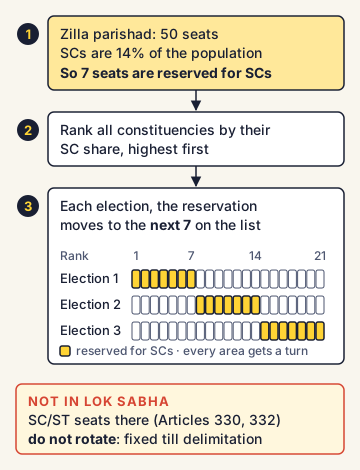
At the next election (or after the period the state law fixes), the reservation moves to the next set of constituencies in that list. So over a few elections, different areas get a reserved seat.
Who decides the details?
The Constitution only says seats "may" rotate. It does not fix how often, in what order, or from which starting point. Those details are left to state laws and rules. In Maharashtra, for example, the Maharashtra Zilla Parishads and Panchayat Samitis Act, 1961 and the rules under it decide this. The actual allotment of seats is usually done by the State Election Commission (Article 243K for panchayats and Article 243ZA for municipalities) or the state government, as the state law says.
How long will it last?
Article 243D(5) and 243T(5) link local body SC/ST reservation to Article 334. Article 334 fixes the end date for SC/ST reservation in the Lok Sabha and state assemblies. The 104th Constitutional Amendment Act, 2019 extended it to 80 years from the start of the Constitution, that is, until 25 January 2030. So local body SC/ST reservation also runs till then, unless Parliament extends it again. Women's reservation in local bodies has no such end date.
Special rules for tribal areas
Under Article 243M, Part IX does not apply on its own to the Fifth Schedule (Scheduled) Areas and to some tribal areas. Parliament extended it to Fifth Schedule Areas through the Panchayats (Extension to the Scheduled Areas) Act, 1996 (PESA). Under Section 4(g) of PESA, at least half the seats in these panchayats must be reserved for STs, and all chairperson posts at every level must go to STs. The Supreme Court upheld the chairperson rule in 2010.
Important court cases
- K. Krishna Murthy v. Union of India (2010): A five-judge bench upheld Articles 243D(6) and 243T(6) (backward class quota) and the reservation of chairperson posts. It said political backwardness is different from social or educational backwardness, so local body reservation must be justified separately.
- Vikas Kishanrao Gawali v. State of Maharashtra (2021): The Court laid down the triple test for OBC reservation in local bodies (a dedicated commission, a fixed proportion based on its findings, and a 50% ceiling). Total reservation for SCs, STs and OBCs together in a local body cannot cross 50%.
- Article 243O: Courts cannot question the validity of a state law on delimitation or allotment of seats made under Article 243K. Disputes over a panchayat election can only be raised through an election petition. This is why courts are cautious about stepping into seat allotment.
Commonly confused concepts
- Local bodies vs Parliament and assemblies: Reserved seats in panchayats and municipalities rotate (Articles 243D and 243T). Reserved seats in the Lok Sabha and assemblies (Articles 330 and 332) do not rotate; they stay fixed until the next delimitation.
- SC/ST reservation vs OBC reservation in local bodies: SC/ST reservation is compulsory and based on population. OBC reservation is optional (clause 6) and must pass the triple test.
- SC/ST reservation vs women's reservation: SC/ST reservation ends with the Article 334 date (2030 for now). Women's reservation (one-third) has no end date.
- Seats vs chairperson posts: Seat reservation follows the population of the local area. Chairperson reservation for SCs and STs follows their population in the whole state.
- Political reservation vs job reservation: Job reservation (Articles 16(4) and 16(4A)) has no end date. Political reservation for SCs and STs is time-bound.
Issues, criticism and the way forward
- Rotation cuts both ways. It spreads representation across areas. But a member who does good work in a reserved seat often cannot contest again from the same place once it rotates out. This weakens long-term local leadership and accountability.
- Frequent resets cause uncertainty. When a state restarts the rotation cycle after delimitation, some areas may get reserved again soon, while others may wait longer. Candidates and voters often challenge these changes in court.
- Proxy rule. In some places, a reserved seat or post is held on paper by an SC, ST or woman member while someone else takes the real decisions. This defeats the purpose.
- Data problems. Reservation depends on population figures. India's last census was in 2011, so seat shares may not match today's population.
- Way forward: Experts suggest fixing a clear rotation period in law (for example, two terms per seat), publishing the rotation order in advance, training elected SC/ST and women members, and acting firmly against proxy representation.
Concepts to Know
- Scheduled Castes (SCs) and Scheduled Tribes (STs): Communities listed by the President under Articles 341 and 342 for special protection, because they faced untouchability (SCs) or isolation and backwardness (STs).
- Constituency (ward or electoral division): The area whose voters elect one member. A zilla parishad is divided into electoral divisions; a municipality into wards.
- Delimitation: Drawing or redrawing the boundaries of constituencies, usually after a census, so each one has a roughly equal population.
- Rotation: Moving the reserved status from one constituency to another over time, so that different areas get a turn.
- Vested right: A right that is already fixed and fully belongs to a person, so it cannot be taken away. The Court said nobody has such a right to a particular seat being reserved.
- Zilla parishad and panchayat samiti: The district-level and block-level (intermediate) panchayats. The gram panchayat is the village level.
- State Election Commission: The constitutional body in each state that conducts panchayat and municipal elections (Articles 243K and 243ZA).
- Article 243D: reservation in panchayats; Article 243T: reservation in municipalities
- Added by the 73rd and 74th Constitutional Amendment Acts, 1992 (in force 1993)
- SC/ST seats: in proportion to their population in the area; may be allotted by rotation
- At least one-third of SC/ST seats for SC/ST women; at least one-third of all seats for women
- Chairperson posts for SCs/STs: in proportion to their population in the state
- SC/ST reservation tied to Article 334: until 25 January 2030 (104th Amendment, 2019)
- OBC reservation in local bodies: optional (243D(6), 243T(6)); triple test (Vikas Kishanrao Gawali, 2021); total reservation cap 50%
- PESA, 1996, Section 4(g): at least half the seats and all chairperson posts for STs in Fifth Schedule Areas
- Article 243O: courts cannot question laws on delimitation or seat allotment made under Article 243K
● Tracked since November 16, 2026 · last seen November 16, 2026 · updates as the daily brief publishes