Representation of the People Act, 1950
The Law Behind Voter Lists and Seats
Updated 14 Oct 2026: Added Section 23(3): the voter list is frozen from the last date for nominations until the election is over.
The Representation of the People Act, 1950 (RPA 1950) is the law passed by Parliament that decides who can be a voter, how voter lists are made and corrected, and how many seats each State gets in Parliament and the State legislatures. Think of it as the rulebook for "getting ready" for elections. The actual conduct of elections, like nominations, voting, counting and disqualification of candidates, is covered by a separate law, the RPA 1951.
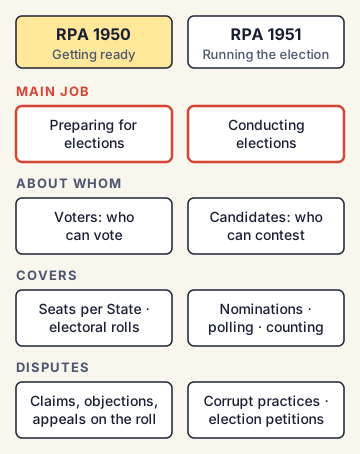
So if you want to know why your name is on (or missing from) the voter list, the answer lies in the RPA 1950.
Why does this law exist?
The Constitution gives every adult citizen the right to vote (Article 326), and gives the Election Commission control over voter lists (Article 324). But the Constitution does not say how a list should be prepared, who should prepare it, or what happens if a name is wrongly left out. Article 327 lets Parliament make laws on all matters relating to elections, including the preparation of electoral rolls and the delimitation of constituencies.
The RPA 1950 is the main law made under this power. Without it, there would be no clear rules, no officials responsible, and no way to complain or appeal.
Where did it come from?
India's first general election was held in 1951-52. Before that, the country needed two things: a fixed number of seats for each State, and voter lists for about 17 crore adults, most of whom had never voted. Parliament passed the RPA 1950 (Act No. 43 of 1950) for this preparation, and the RPA 1951 for running the elections. The 1950 Act has been amended many times since:
- 1988-89: after the 61st Constitutional Amendment Act, 1988 lowered the voting age from 21 to 18 years, the Act was changed to match.
- 1988: Section 13CC was added. It says all officers who prepare voter lists and conduct elections are deemed to be on deputation to the Election Commission while doing that work. This puts them under the ECI's control.
- 2010: Section 20A was added, allowing overseas electors: Indian citizens living abroad for work or study, who have not taken another country's citizenship, can register at the address in their passport.
- 2021: the Election Laws (Amendment) Act, 2021 gave four qualifying dates a year instead of one, allowed voluntary linking of Aadhaar with the voter list, and replaced the word "wife" with "spouse" for service voters.
How is the Act organised?
The main parts students should know:
- Part II (Sections 3 onwards and the First Schedule): allocation of seats. The Lok Sabha has 543 elected seats spread across States and UTs, with 84 reserved for Scheduled Castes and 47 for Scheduled Tribes.
- Part IIA (Sections 13A to 13CC): the officers who make voter lists.
- Part III (Sections 14 to 25): electoral rolls for Lok Sabha and Assembly constituencies.
- Section 27: electoral rolls for Legislative Council constituencies (local authorities, graduates and teachers), in States that have a Council under Article 171.
- Sections 31 and 32: punishments.
Who does the work?
The Act creates a chain of officers, like a pyramid with the Election Commission at the top:
- Chief Electoral Officer (CEO), Section 13A: one for each State. The ECI designates a State government officer for this post, in consultation with that government.
- District Election Officer (DEO), Section 13AA: supervises voter-list work in a district, under the CEO.
- Electoral Registration Officer (ERO), Section 13B: the key officer. The ERO actually prepares and corrects the roll for a constituency and decides on claims and objections.
- Assistant Electoral Registration Officers (AEROs), Section 13C: help the ERO.
- Booth Level Officers (BLOs): local government employees (often teachers or anganwadi workers) who visit homes and collect forms for each polling booth area. They work under the ERO.
Who can be a voter? Sections 16 to 20
A person is entitled to be registered if both conditions below are met:
- Age: at least 18 years on the qualifying date (Section 19). Since the 2021 amendment, there are four qualifying dates a year: 1 January, 1 April, 1 July and 1 October. So a young person turning 18 does not have to wait a whole year to enrol.
- Residence: the person is "ordinarily resident" in the constituency (Section 19). Under Section 20, owning a house there is not enough by itself. But being away for a while, say for a job or studies, does not take away your ordinary residence.
A person cannot be registered (Section 16) if he or she:
- is not a citizen of India;
- is of unsound mind and has been declared so by a competent court; or
- is disqualified from voting under a law on corrupt practices or election offences.
Two more rules stop double voting. Section 17: no one can be registered in more than one constituency. Section 18: no one can be registered more than once in the same constituency.
How is the roll prepared and revised? Section 21
Every constituency must have a roll (Section 15). Section 21 sets three situations:
- Section 21(1)-(2): the roll is prepared with reference to the qualifying date. It is revised before each general election and each by-election, and in any year if the ECI so directs. In practice, the ECI orders a summary revision every year.
- Section 21(3): the ECI may, at any time and for reasons recorded in writing, order a special revision of the roll for any constituency or part of it, in any manner it thinks fit. Until the special revision is complete, the existing roll stays in force. This is the clause behind the Special Intensive Revision.
How are names added, changed or removed? Sections 22 to 24
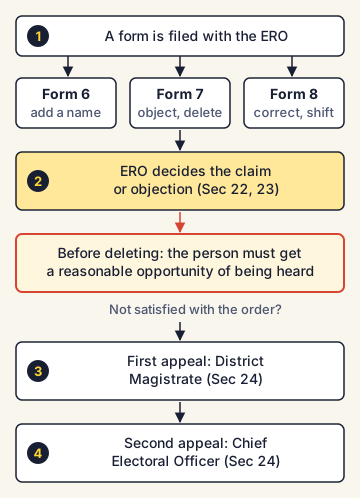
- Section 22 (correction by the ERO): the ERO can correct a wrong entry, move an entry to the right part of the roll, or delete the name of a person who has died, shifted, or is not entitled to be on the roll. Before doing so, the ERO must give the person "a reasonable opportunity of being heard", in other words, a chance to explain. This is the principle of natural justice.
- Section 23 (inclusion of names): a person whose name is not on the roll can apply to the ERO to be added. Since 2021, the ERO may ask for an Aadhaar number to verify identity, but no one can be refused registration or deleted only because they cannot give Aadhaar; other documents can be used.
- Section 23(3) (the roll is frozen during an election): once the last date for filing nominations for an election in a constituency has passed, no name can be added, corrected, moved or deleted under Sections 22 or 23 until that election is over. Think of it as locking the team list once the match has started. The Supreme Court has treated this rule as mandatory: votes cast by people added after that date can be held void (Baidyanath Panjiar v. Sitaram Mahto, 1969). This is why you should check your name well before an election is announced.
- Section 24 (appeals): if the ERO's order under Section 22 or 23 is wrong, a person can appeal to the District Magistrate (or an officer of equal rank), and then to the Chief Electoral Officer.
Who makes the detailed rules?
Under Section 28, the Central Government, after consulting the Election Commission, makes rules for the Act. These rules are issued by notification in the Official Gazette (the government's official record of laws and orders). Under Section 28(3), every rule must also be laid before both Houses of Parliament for a total of 30 days, and Parliament can change it or cancel it.
The main rules are the Registration of Electors Rules, 1960. Rule 13 of these rules prescribes the forms: Form 6 for new registration, Form 7 for objecting to or deleting a name, and Form 8 for corrections and shifting. Because the forms are part of rules made by the Central Government, a question often raised is whether they can be changed by ECI instructions alone without amending the rules.
What are the penalties? Sections 31 and 32
- Section 31: anyone who makes a false statement or declaration in writing about the roll (for example, a false claim or a false objection) can get up to one year in jail, or a fine, or both.
- Section 32: an ERO or other official who, without reasonable cause, breaks his official duty in preparing or correcting the roll can get three months to two years in jail, plus a fine.
What have the courts said?
- Lal Babu Hussein v. Electoral Registration Officer (1995): the Supreme Court said a person already on the roll is presumed to be eligible. If someone's citizenship is doubted, the person must be told the reasons and the material, and given a fair chance to defend himself before deletion. The burden is not simply placed on the voter.
- The SIR judgment (27 May 2026): the Supreme Court read Section 21(3) with Article 324 and held that the ECI can conduct a special intensive revision. It added that the ECI can check citizenship only for the purpose of the voter list, and cannot make a final finding that a person is not a citizen. The Court also noted that being on the roll once is not a lifelong guarantee.
Commonly confused concepts
- RPA 1950 vs RPA 1951: RPA 1950 covers seats, voter qualifications and electoral rolls (preparation for elections). RPA 1951 covers conduct of elections: qualifications and disqualifications of candidates, nominations, polling, counting, corrupt practices and election petitions.
- Qualification to vote vs qualification to contest: Voting needs age 18 and ordinary residence (RPA 1950). Contesting needs different ages (25 for Lok Sabha and Assembly, 30 for Rajya Sabha and Legislative Council) under the Constitution and RPA 1951.
- Summary revision vs intensive revision vs special revision: A summary revision updates the existing roll using claims and objections. An intensive revision rebuilds the roll through house-to-house enumeration. A special revision under Section 21(3) is ordered by the ECI at any time for recorded reasons, and can be either type.
- Section 16 vs Section 22: Section 16 lists who cannot be registered at all. Section 22 is about correcting or deleting an entry that is already on the roll.
- CEO vs CEC: The Chief Electoral Officer is a State-level officer. The Chief Election Commissioner heads the Election Commission of India at the national level.
Issues, criticism and the way forward
- Burden of proof: Critics argue that asking every voter to re-prove eligibility in an intensive revision shifts the burden from the State to the citizen, which seems to go against the spirit of Lal Babu Hussein. The ECI's position is that intensive revision is needed because of migration, urbanisation, unreported deaths and duplicate entries.
- Due process in deletions: Section 22 requires a hearing before a name is deleted. Mass deletions in a short time raise questions about whether each person really got that chance.
- Easy objections, hard restoration: Filing a Form 7 objection is easy, but getting back on the roll can take time and documents. Section 31 punishes false objections, but critics point out it is rarely used.
- Rules vs instructions: Forms are prescribed in rules made by the Central Government under Section 28. Changes made only through ECI instructions can be challenged as lacking legal backing.
- Way forward: Suggestions include continuous, transparent roll updates instead of sudden mass revisions; publishing lists of deleted names with reasons; strict use of Sections 31 and 32 against false objections and careless officials; and making re-enrolment quick and simple.
Concepts to Know
- Electoral roll: The official list of voters for a constituency, divided into parts for each polling booth.
- Qualifying date: The date on which a person's age is counted for enrolment. If you are 18 on that date, you can enrol.
- Ordinarily resident: Living in a place in a normal, settled way. It is about where you actually live, not just where you own property.
- Natural justice: Basic fairness rules: no one should be punished or lose a right without being told the reason and given a chance to reply.
- Delimitation: Drawing the boundaries of constituencies and fixing the number of seats, so that each seat has roughly similar population.
- Deputation: When an official from one department works for another body for some time, under that body's control.
- Nomination: The formal papers a candidate files to enter an election. The Election Commission fixes a last date for filing them in each election.
- RPA 1950: Act No. 43 of 1950; made under Article 327; covers seats, voter qualifications and electoral rolls
- Section 13A: CEO; 13AA: DEO; 13B: ERO; 13C: AERO; 13CC (1988): election staff deemed on deputation to the ECI
- Section 16: disqualified if not a citizen, declared of unsound mind by a court, or disqualified for corrupt practices or election offences
- Sections 17 and 18: no registration in more than one constituency, or more than once in a constituency
- Section 19: 18 years on the qualifying date and ordinarily resident; Section 20: meaning of ordinarily resident; Section 20A (2010): overseas electors
- Section 21(3): ECI may order a special revision at any time for reasons recorded
- Section 22: deletion only after a reasonable opportunity of being heard; Section 23: inclusion, voluntary Aadhaar (2021); Section 24: appeal to DM, then CEO
- Section 23(3): no addition, correction or deletion after the last date for nominations until the election is over (mandatory: Baidyanath Panjiar, 1969)
- Section 28: Central Government makes rules after consulting the ECI, by Gazette notification; rules are laid before both Houses of Parliament (Registration of Electors Rules, 1960; Rule 13 prescribes Forms 6, 7 and 8)
- Section 31: false declaration, up to 1 year or fine or both; Section 32: breach of official duty, 3 months to 2 years plus fine
- Election Laws (Amendment) Act, 2021: four qualifying dates (1 January, 1 April, 1 July, 1 October)
- Lok Sabha: 543 elected seats; 84 SC and 47 ST reserved (First Schedule)
- Lal Babu Hussein v. ERO (1995): person on the roll presumed eligible; fair hearing before deletion
- 14 Oct 2026Added Section 23(3): the voter list is frozen from the last date for nominations until the election is over.
- 12 Oct 2026Added that voter registration rules are notified in the Gazette and laid before Parliament, and that Rule 13 prescribes Forms 6, 7 and 8.
● Tracked since February 18, 2026 · last seen October 15, 2026 · updates as the daily brief publishes