Duration of Parliament and State Legislatures (Articles 83 and 172)
The Constitution fixes how long the Lok Sabha and each state's Legislative Assembly can last. Under Article 83(2) (Lok Sabha) and Article 172(1) (state Assemblies), the House continues for five years from the date of its first meeting, unless it is dissolved earlier. When five years end, the House is automatically dissolved. The Rajya Sabha and state Legislative Councils are permanent houses and are never dissolved.
Why does it exist?
In a democracy, power must go back to the people at regular intervals. A fixed maximum term makes sure that no government can stay in power forever without asking voters again. It also tells the Election Commission when to plan the next election. You can think of it like a rental agreement with a fixed end date: the tenant may leave early, but cannot stay beyond the end date without a fresh agreement.
Where did it come from?
The Constituent Assembly chose a five-year term for the lower houses, following the parliamentary model. The term has been changed once, during the Emergency:
- The 42nd Amendment Act, 1976 raised the term of the Lok Sabha and state Assemblies from five to six years.
- The 44th Amendment Act, 1978 brought it back to five years.
- During the Emergency, Parliament also passed the House of the People (Extension of Duration) Act, 1976, which extended the life of the Fifth Lok Sabha beyond its normal term. That Lok Sabha was finally dissolved in January 1977.
What do Articles 83 and 172 say, clause by clause?
- Article 83(1): the Rajya Sabha is not subject to dissolution. About one-third of its members retire every second year.
- Article 83(2): the Lok Sabha continues for five years from the date appointed for its first meeting, and no longer. When the five years end, it stands dissolved.
- Article 172(1): the same five-year rule for every state Legislative Assembly.
- Article 172(2): the state Legislative Council is not subject to dissolution; about one-third of members retire every second year.
- The Emergency proviso (in both Articles): while a Proclamation of Emergency is in operation, Parliament can extend the term by law, by not more than one year at a time. The extension cannot go beyond six months after the Emergency ends.
How can a House end early?
The five years is a maximum, not a guarantee.
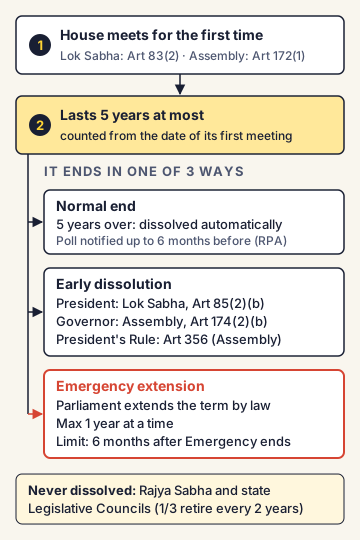
- The President can dissolve the Lok Sabha under Article 85(2)(b), on the advice of the Council of Ministers.
- The Governor can dissolve a state Assembly under Article 174(2)(b).
- Under Article 356 (President's Rule), a state Assembly can be suspended or dissolved.
When must the next election be held?
The Constitution sets the term. The Representation of the People Act, 1951 sets when the election can be called.
- Section 14 (Lok Sabha) and Section 15 (state Assemblies) say the President or Governor, on the ECI's recommendation, issues the notification calling the general election.
- If the House is ending at the normal end of its term, this notification cannot be issued earlier than six months before the term expires. This is why the ECI can plan polls up to six months in advance.
- If the House is dissolved early, there is no such window; the ECI must hold elections as early as possible.
- In Special Reference No. 1 of 2002 (the Gujarat case), the Supreme Court held that the six-month gap between sessions in Article 174 applies to a working Assembly, not to a dissolved one. Fixing the election schedule is the ECI's job under Article 324, and the effort should be to hold elections, not delay them.
How does it work in practice? A simple example
Suppose a state Assembly first met on 20 March 2022. Its five years end on 19 March 2027. The ECI can have the election notified any time from about September 2026. It usually holds polls a few weeks before the end date, so that the new House is ready when the old one ends.
Other related term rules
- Members of the Rajya Sabha serve six years (Section 155, RPA 1951). Members of a Legislative Council also serve six years.
- Panchayats (Article 243E) and municipalities (Article 243U) also have five-year terms. Elections must be completed before the term ends, or within six months of an early dissolution.
India's position and examples
- India's first general elections were held in 1951-52, and for some years Lok Sabha and state polls happened together. This cycle broke from the late 1960s, as several Assemblies and later the Lok Sabha were dissolved early.
- The Law Commission (170th Report, 1999) and a High-Level Committee chaired by Ram Nath Kovind (report in 2024) recommended bringing back simultaneous elections.
- The Constitution (129th Amendment) Bill, 2024 proposes a new Article 82A. The President would notify an "appointed date" on the first sitting of the Lok Sabha after a general election. All Assemblies elected after that date would end with the Lok Sabha's full term. It would also amend Articles 83, 172 and 327. As of July 2026, a Joint Parliamentary Committee examining it had its term extended to the Winter Session 2026.
Commonly confused concepts
- Dissolution vs prorogation vs adjournment: Dissolution ends the life of the House, and a fresh election is needed. Prorogation (by the President or Governor) ends a session, but the House continues. Adjournment (by the Speaker or Chairman) pauses a sitting for hours or days.
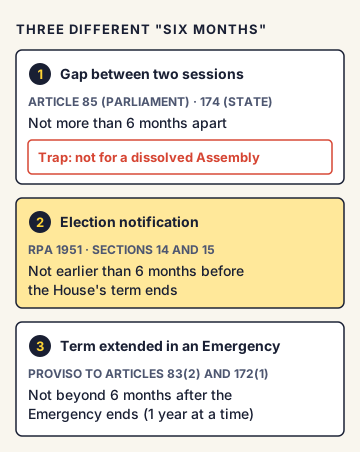
- Three different "six months": (1) Article 85/174: the gap between two sessions cannot be more than six months. (2) RPA 1951, Sections 14 and 15: the election notification can come up to six months before the term ends. (3) Emergency proviso: an extended term cannot go beyond six months after the Emergency ends.
- Lok Sabha vs Rajya Sabha: The Lok Sabha has a five-year term and can be dissolved. The Rajya Sabha is permanent; its members have six-year terms, with one-third retiring every two years.
- Term of the House vs term of a member: A Lok Sabha member's seat ends when the House is dissolved. A Rajya Sabha member's seat ends after the member's own six years.
Issues, criticism and the way forward
- Frequent elections: Supporters of simultaneous polls say elections in some state every few months raise costs and keep the Model Code of Conduct in force often, which slows down government work.
- Federalism concerns: Critics argue that cutting short or extending an elected Assembly's term to match the Lok Sabha may weaken the people's mandate in states and the idea of a government answerable to its House.
- Emergency extensions: The 1976 experience showed how a term could be stretched. The 44th Amendment restored five years, but the Emergency proviso still allows extension one year at a time.
- Way forward: Experts suggest wide consultation with states, clear rules for a hung House or early dissolution, and strong ECI capacity if simultaneous polls are adopted.
Concepts to Know
- Dissolution: The end of the life of an elected House. All members lose their seats and a fresh election is held.
- Proclamation of Emergency: A declaration by the President under Article 352 when India's security is threatened by war, external aggression or armed rebellion.
- Notification (of an election): The official order that formally starts the election process, after which nominations can be filed.
- Simultaneous elections ("One Nation, One Election"): Holding Lok Sabha and all state Assembly elections at the same time.
- Presidential reference (Article 143): The President asking the Supreme Court for its opinion on a legal question.
- Article 83(2): Lok Sabha term 5 years from the date appointed for its first meeting; Article 172(1): same for state Assemblies
- Article 83(1) and 172(2): Rajya Sabha and Legislative Councils are permanent; one-third retire every second year
- Emergency: term can be extended by a law of Parliament, max one year at a time, not beyond six months after the Emergency ends
- 42nd Amendment (1976): 5 to 6 years; 44th Amendment (1978): back to 5 years
- Early dissolution: Article 85(2)(b) (President, Lok Sabha), Article 174(2)(b) (Governor, Assembly)
- RPA 1951: Section 14 (Lok Sabha) and Section 15 (Assemblies) election notification, not earlier than six months before the term ends
- Special Reference No. 1 of 2002: Article 174's six-month rule does not apply to a dissolved Assembly; scheduling elections is the ECI's job under Article 324
- Panchayats and municipalities: 5 years (Articles 243E and 243U); election within six months of early dissolution
- Constitution (129th Amendment) Bill, 2024: proposes Article 82A for simultaneous elections
● Tracked since October 15, 2026 · last seen October 15, 2026 · updates as the daily brief publishes