Rafale Marine (Rafale M)
The Navy's Carrier-Based Fighter
The Rafale Marine, or Rafale M, is the navy version of the Rafale fighter jet, made by the French company Dassault Aviation. It is built to take off from and land on aircraft carriers. India has ordered 26 of these jets to fly from INS Vikrant. They are India's main new carrier fighters until India builds its own.
Why did the Navy need a new jet?
A carrier is only as strong as the jets it carries. The Navy's MiG-29K fleet had problems with serviceability, meaning too many jets were often under repair and not ready to fly. India's own LCA Navy prototype turned out too heavy and short of power for regular carrier use. With Vikrant joining in 2022, the Navy needed a ready, proven carrier jet quickly, as a bridge until an Indian design is ready.
Where did the deal come from?
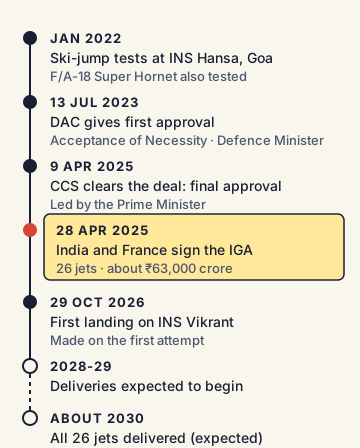
- In January 2022, the Rafale M was tested at the Shore Based Test Facility at INS Hansa, Goa. This facility has a ski-jump ramp on land that copies a carrier deck. The US-made F/A-18 Super Hornet was tested too.
- On 13 July 2023, the Defence Acquisition Council (DAC), led by the Defence Minister, gave initial approval to buy 26 Rafale M.
- On 9 April 2025, the Cabinet Committee on Security (CCS), led by the Prime Minister, cleared the deal.
- On 28 April 2025, India and France signed an Inter-Governmental Agreement for the jets.
What is in the deal?
- 26 aircraft: 22 single-seat Rafale M and 4 twin-seat trainer aircraft.
- Value of about ₹63,000 crore (some reports say about ₹64,000 crore).
- Training, simulators, spare parts, weapons and five years of performance-based support (support paid for by how well the jets perform). [Unverified]
- A facility in India to make parts of the Rafale's fuselage (main body), and repair facilities in India for engines, sensors and weapons.
- Plans to fit India's own Astra air-to-air missile on the jets.
- Deliveries expected from about 2028-29, to be completed by about 2030. Navy aircrew will train in both France and India.
How is the Rafale M different from the Air Force Rafale?
The Indian Air Force already flies 36 Rafale jets, bought in a 2016 deal. The Rafale M is the same basic jet, changed for life at sea:
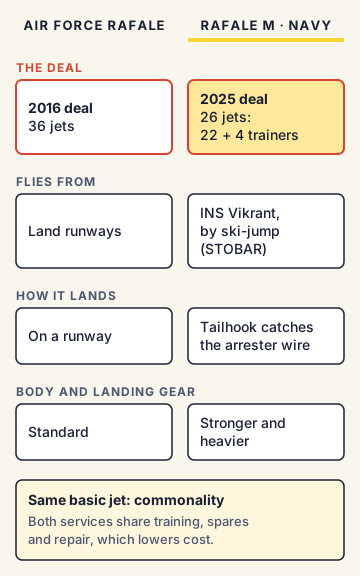
- A stronger landing gear, because carrier landings are hard, controlled "crashes" onto the deck.
- A tailhook, to catch the arrester wire on landing.
- A heavier, stronger airframe to bear the stress of carrier take-offs and landings.
- Better protection against salt-water corrosion (rusting and damage from sea air). [Unverified]
Because both services fly Rafales, they can share training, spares and repair facilities. This is called commonality, and it lowers cost.
What does it do at sea?
It is a multi-role fighter. It can fight enemy aircraft, strike enemy ships and land targets, and collect intelligence, all from one airframe. In France, it flies from the carrier Charles de Gaulle, which uses catapults (CATOBAR). On Vikrant it must instead use a ski-jump (STOBAR). This is why the 2022 ski-jump tests and the 2026 deck trials matter so much.
Commonly confused concepts
- Rafale M deal (2025, Navy, 26 jets) vs Rafale deal (2016, Air Force, 36 jets): Two separate government-to-government purchases from France. The Navy jets are the carrier version.
- Rafale M vs MiG-29K: The MiG-29K is Russian and already in service. The Rafale M is French, newly ordered, and will operate alongside it.
- Rafale M vs TEDBF: The Twin Engine Deck Based Fighter (TEDBF) is India's own planned carrier jet, still in design. The Rafale M is an imported, ready-made jet meant to fill the gap until then.
- Rafale M vs MRFA: The Multi-Role Fighter Aircraft (MRFA) programme is a separate Air Force plan to buy 114 fighters.
- DAC vs CCS: The DAC (under the Defence Minister) gives the first approval, called Acceptance of Necessity. The CCS (under the Prime Minister) gives the final approval for big deals.
Issues, criticism and the way forward
- Import dependence: A ₹63,000-crore foreign buy runs against the aim of self-reliance in defence. The government's position is that the Navy's need is urgent and an Indian jet is years away.
- Long wait: Jets ordered in 2025 arrive only from 2028-29. Until then, Vikrant depends on the ageing MiG-29K fleet.
- Ski-jump limits: From a ski-jump, a heavy jet cannot take off with as much fuel and weapons as from a catapult. So the Rafale M may carry less from Vikrant than from a French carrier.
- Way forward: Use the fuselage plant and repair facilities to build skills in India, fit Indian weapons like the Astra, and speed up the TEDBF so the next generation of carrier jets is made at home.
Concepts to Know
- Multi-role fighter: A fighter jet that can do several jobs, like air combat, ground attack and ship attack, often in the same mission.
- Tailhook: A strong hook under a carrier jet's tail. It catches a steel cable on the deck to stop the jet in a short distance.
- Inter-Governmental Agreement (IGA): A deal signed directly between two governments, not between a government and a private company. It is meant to make the purchase faster and more transparent.
- Defence Acquisition Council (DAC): India's top body for approving defence purchases, chaired by the Defence Minister.
- Cabinet Committee on Security (CCS): A small group of senior ministers, led by the Prime Minister, which gives final approval to big defence deals.
- Maker: Dassault Aviation, France
- Order: 26 aircraft (22 single-seat Rafale M + 4 twin-seat trainers) for INS Vikrant
- DAC initial approval: 13 July 2023; CCS clearance: 9 April 2025; Inter-Governmental Agreement signed: 28 April 2025
- Deal value: about ₹63,000 crore
- Deliveries: expected from about 2028-29, completion by about 2030
- Shore-based ski-jump trials: INS Hansa, Goa, January 2022 (F/A-18 Super Hornet also tested)
- First landing on INS Vikrant: 29 October 2026 (on the first attempt)
- Air Force Rafale deal: 36 jets, signed 2016
● Tracked since October 30, 2026 · last seen October 30, 2026 · updates as the daily brief publishes