INS Vikrant (IAC-1)
India's First Indigenous Aircraft Carrier
INS Vikrant is the first aircraft carrier designed and built in India. An aircraft carrier is a very large warship that works like a floating airbase: fighter jets and helicopters take off from its deck, land back on it, and are stored and repaired inside it. Vikrant was built at Cochin Shipyard Limited in Kochi, Kerala, and joined the Indian Navy on 2 September 2022. Its project name was Indigenous Aircraft Carrier-1 (IAC-1).
Why does a navy need an aircraft carrier?
A warship's own guns and missiles can reach only so far. Fighter jets can reach hundreds of kilometres further. Near India's coast, jets can fly from land bases. But far out in the Indian Ocean, there are no Indian airbases. A carrier takes the airbase along with the fleet. This lets the Navy protect its ships from enemy aircraft, attack enemy ships, and show strength far from home. Showing strength far from home in this way is called power projection.
Where did it come from?
India has operated carriers since 1961.
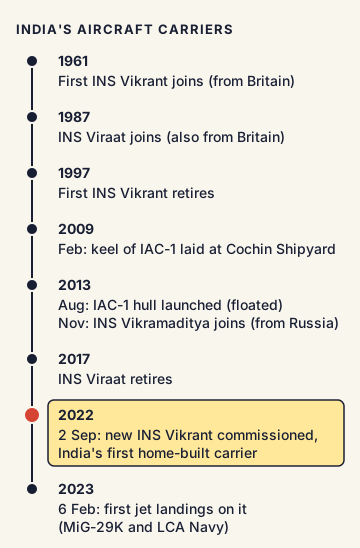
- The first INS Vikrant, bought from Britain, served from 1961 to 1997. It played a key role in the 1971 war, in the Bay of Bengal.
- INS Viraat, also from Britain, served from 1987 to 2017.
- INS Vikramaditya, a converted Russian ship, joined in November 2013 and is still in service.
- The new INS Vikrant is India's fourth carrier. It carries forward the name of the first one.
Its keel was laid in February 2009. Laying the keel means starting to build the ship's backbone. The hull was launched (floated) in August 2013, and sea trials began in August 2021. The Navy's own Warship Design Bureau designed the ship.
The key numbers
- Length about 262 metres, which is roughly the length of two and a half football fields.
- Full displacement of nearly 45,000 tonnes. Displacement is the weight of water a ship pushes aside, a standard way to measure a ship's size.
- Top speed about 28 knots (about 52 km per hour), with a range of about 7,500 nautical miles.
- It can operate about 30 aircraft, a mix of fighter jets and helicopters.
- Built at a cost of about ₹20,000 crore. The government says over 76% of its content is Indian.
How does it launch and recover jets?
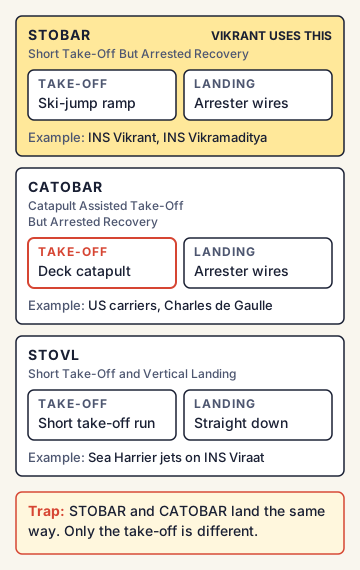
Vikrant uses a system called STOBAR, which stands for Short Take-Off But Arrested Recovery.
- Take-off: The front of the deck curves upwards like a ski-jump ramp. A jet runs at full power along a short deck and the ramp throws it upward into the air.
- Landing: The jet lowers a strong hook under its tail, called a tailhook. The hook catches one of the steel cables stretched across the deck, called arrester wires. The wire stops a jet landing at over 200 km per hour within about 100 metres. [Unverified]
A simple way to picture it: take-off is like a cyclist using a ramp to get airborne, and landing is like a running person being caught by a rope stretched across their path.
Which aircraft fly from it?
The MiG-29K, a Russian-made fighter, and the naval prototype of the Light Combat Aircraft (LCA Navy) made the first landings on Vikrant on 6 February 2023. The first night landing by a MiG-29K came on 24 May 2023. The Navy acquired 45 MiG-29K and MiG-29KUB jets between 2004 and 2010, but some were lost in accidents. The Rafale M is being bought to fly from Vikrant along with the MiG-29K. Helicopters on board include the Kamov Ka-31 (an early-warning helicopter) and the MH-60R.
India's position
With Vikrant, India joined a small group of countries that can design and build an aircraft carrier themselves. The Navy wants at least two carriers at all times, ideally three. The idea is that one can guard the Arabian Sea, one the Bay of Bengal, and a third can be under repair. A carrier also never sails alone. It moves with destroyers, frigates, a submarine and supply ships that protect it. This whole group is called a Carrier Battle Group or carrier strike group.
Commonly confused concepts
- STOBAR vs CATOBAR vs STOVL: In STOBAR (Vikrant, Vikramaditya), jets take off using a ski-jump and land with arrester wires. In CATOBAR (Catapult Assisted Take-Off But Arrested Recovery), a catapult on the deck throws the jet forward at high speed, as on US carriers and France's Charles de Gaulle. This allows heavier jets with more fuel and weapons. In STOVL (Short Take-Off and Vertical Landing), special jets like the Sea Harrier land straight down. INS Viraat used Sea Harriers.
- INS Vikrant (1961) vs INS Vikrant (2022): The first was a British-built ship bought by India. The second was designed and built in India. Same name, different ships.
- INS Vikrant vs INS Vikramaditya: Vikramaditya was built in the Soviet Union as the Admiral Gorshkov and rebuilt in Russia for India. Vikrant was built in India. Both use STOBAR.
- IAC-1 vs IAC-2: IAC-1 is INS Vikrant. IAC-2 is a proposed second indigenous carrier. It has not been ordered as of October 2026. [Unverified]
Issues, criticism and the way forward
- Fighter gap: For years, Vikrant had too few suitable jets. The MiG-29K fleet faced serviceability problems, and the LCA Navy was too heavy for carrier use. The Rafale M is meant to close this gap.
- The indigenous content debate: The 76% figure counts much of the ship's steel and structure. Critics point out that a large share of its weapons ("fight" systems) and engines ("move" systems) are still imported.
- Cost and vulnerability: Carriers are very costly. Some experts argue that modern anti-ship missiles and submarines make large carriers easy targets, and money could go to submarines instead. The Navy's view is that a carrier is the only way to get air cover far out at sea.
- Way forward: Build a home-made deck jet, the Twin Engine Deck Based Fighter (TEDBF), being designed by the Aeronautical Development Agency; decide on a third carrier; and raise indigenous content in engines and weapons.
Concepts to Know
- Aircraft carrier: A large warship with a flat deck from which aircraft can take off and land. It works like a moving airbase at sea.
- Displacement: The weight of the water a floating ship pushes aside. It equals the ship's own weight, so it is used to measure ship size.
- Knot: A unit of speed at sea. One knot is one nautical mile per hour, about 1.85 km per hour.
- Keel: The long beam along the bottom of a ship, like its backbone. "Laying the keel" marks the formal start of building.
- Commissioning: The ceremony when a ship formally joins the Navy and starts service.
- Power projection: A country's ability to send and use military force far from its own borders.
- Project name: Indigenous Aircraft Carrier-1 (IAC-1); designed by the Navy's Warship Design Bureau; built by Cochin Shipyard Limited, Kochi
- Keel laid: February 2009; launched: August 2013; sea trials from August 2021; commissioned: 2 September 2022
- About 262 m long; nearly 45,000 tonnes full displacement; top speed about 28 knots; about 30 aircraft
- Cost about ₹20,000 crore; over 76% indigenous content (official figure)
- Launch and recovery system: STOBAR (ski-jump take-off, arrester-wire landing)
- First fighter landings (MiG-29K and LCA Navy): 6 February 2023; first night landing (MiG-29K): 24 May 2023
- India's carriers so far: Vikrant (1961–1997), Viraat (1987–2017), Vikramaditya (2013–), Vikrant (2022–)
● Tracked since October 30, 2026 · last seen October 30, 2026 · updates as the daily brief publishes