Radicalisation and Deradicalisation in India
Radicalisation is the step-by-step process through which a person starts accepting extreme ideas, and then comes to believe that violence is a right way to achieve a religious, political or social goal. Deradicalisation is the opposite process: helping such a person give up those extreme beliefs and return to normal life. A third idea, counter-radicalisation, means stopping people from becoming radical in the first place. Together, these ideas form the "soft" side of fighting terrorism, alongside the "hard" side of police, laws and courts.
Why does it matter?
Terror groups cannot work without new recruits. Most recruits are not born violent; they are pulled in slowly, often when they are young, angry or lonely. If the state only arrests people after an attack, it is always one step behind. Stopping radicalisation early is like treating an illness before it spreads, rather than only operating after it becomes serious. This is why India's counter-terror thinking now places weight on prevention.
How does a person become radicalised?
There is no single path, but experts usually describe two kinds of forces:
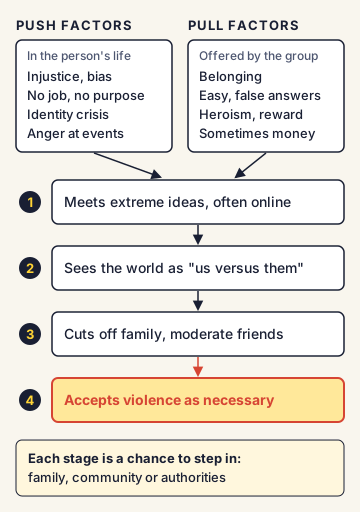
- Push factors: problems in a person's own life or society that make them open to extreme ideas. Examples include a feeling of injustice or discrimination, unemployment, lack of purpose, identity crisis, and anger over events at home or abroad.
- Pull factors: what the extremist group offers. Examples include a sense of belonging and brotherhood, a clear (but false) explanation for every problem, promises of heroism or a religious reward, and sometimes money.
The process usually moves in stages. A person first meets the ideas (often online), then starts to see the world as "us versus them", then cuts off from family and moderate friends, and finally accepts violence as necessary. Each stage is a chance for family, community or authorities to step in.
What role does the internet play?
Earlier, a person had to meet a recruiter face to face. Today, speeches, videos and chat groups reach a young person's phone directly. Social media algorithms can then show more and more similar content, creating an echo chamber, where a person hears only one side again and again. Extremist groups like ISIS used the internet heavily to recruit people from many countries, including a small number from India.
Under Section 69A of the Information Technology Act, 2000, the Central Government can order websites and social media platforms to block content that threatens India's sovereignty, security or public order. The Supreme Court upheld this power in Shreya Singhal v. Union of India (2015).
What does the law say?
India has no law that defines "radicalisation" itself. Holding a belief is not a crime. The law steps in when beliefs turn into actions:
- Article 19(1)(a) gives freedom of speech, but Article 19(2) allows reasonable limits on grounds like the sovereignty and integrity of India, security of the State, public order and incitement to an offence.
- Article 25 gives freedom of religion, but "subject to public order, morality and health".
- The Bharatiya Nyaya Sanhita, 2023 (BNS) punishes promoting enmity between groups on grounds of religion, race, place of birth, language and so on (Section 196, earlier IPC 153A), and deliberate, malicious acts meant to outrage religious feelings (Section 299, earlier IPC 295A).
- The UAPA, 1967 lets the government ban organisations that spread hatred or support terror, and punishes terror-related acts, recruitment and funding.
Who handles it in India?
Several bodies share the work:
- The Ministry of Home Affairs set up a Counter Terrorism and Counter Radicalisation (CTCR) Division in November 2017, to focus on de-radicalisation strategy and on tracking the online reach of terror groups.
- The National Investigation Agency (NIA), created under the NIA Act, 2008 after the 26/11 Mumbai attacks, investigates terror cases, including online recruitment.
- State police and their Anti-Terrorism Squads (ATS) work at the ground level, often with the Intelligence Bureau (IB).
- In February 2026, the MHA released PRAHAAR, India's first comprehensive National Counter-Terrorism Policy and Strategy. One of its seven pillars is reducing the conditions that help terrorism grow, including radicalisation.
What has India actually done?
Some examples help:
- Operation Pigeon (Kerala, from 2016): After some young people from Kerala left to join ISIS, the Kerala Police, along with the IB and NIA, watched social media for signs of radicalisation. Instead of arresting everyone, they called in vulnerable youth and counselled them with their parents and community elders. Reports say over 300 youth were brought back to normal life.
- PRAHAAR's graded response: The policy suggests a step-by-step approach: rehabilitation and counselling for young people who are only at an early stage, and legal action against hardcore elements. It also involves community leaders, religious heads and NGOs to counter extremist messages, and calls for separating extremist ideologues from other prisoners so that jails do not become recruiting centres.
- Banning organisations: Bans under UAPA on groups accused of spreading hatred or supporting terror are part of the "hard" response. The idea is to cut off their funds, offices and reach.
What does the world do?
The UN Global Counter-Terrorism Strategy (2006) asks countries to address the conditions that help terrorism spread. In January 2016, the UN Secretary-General presented a Plan of Action to Prevent Violent Extremism, with more than 70 recommendations and a focus on dialogue, good governance, community engagement and empowering youth. Many countries, such as the United Kingdom through its Prevent programme, run similar early-warning and counselling schemes.
Commonly confused concepts
- Radicalisation vs extremism vs terrorism: Radicalisation is the process. Extremism is the set of beliefs at the end of that process, rejecting democracy, tolerance and other people's rights. Terrorism is the act of using violence or threats against ordinary people to spread fear for a political or ideological goal. A person can hold extreme views without ever becoming a terrorist.
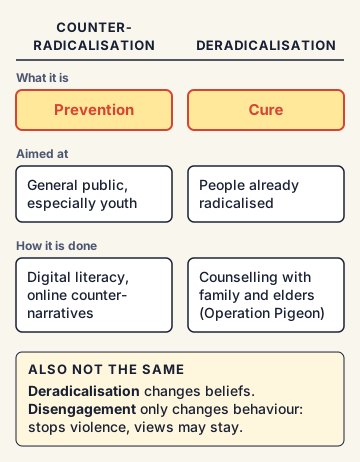
- Counter-radicalisation vs deradicalisation: Counter-radicalisation is prevention, aimed at the general public, especially youth. Deradicalisation is cure, aimed at people who are already radicalised.
- Deradicalisation vs disengagement: Deradicalisation changes a person's beliefs. Disengagement only changes their behaviour: they stop taking part in violence, even if their views have not fully changed. Many experts think disengagement is the more realistic first goal.
- "Radical" vs "violent": In everyday English, "radical" can simply mean wanting big change, which is legal in a democracy. The security concern is with violent radicalisation.
Issues, criticism and the way forward
- No clear definition: Because "radicalisation" is not defined in law, critics worry that it can be applied unevenly, or used against people for their opinions rather than their actions. Even PRAHAAR's analysts note that measuring radicalisation is subjective.
- Rights vs security: Strong tools like UAPA bans and online blocking help security, but rights groups argue they can also affect free speech and the right to form associations (Article 19(1)(c)). The government's position is that these tools are needed against real threats and that the Tribunal and courts act as safeguards.
- Stigma and alienation: If whole communities feel targeted, it can create more anger, which is itself a push factor. Experts stress that programmes should be fair and focused on individuals, not communities.
- Weak data and follow-up: India has few formal, published deradicalisation programmes, and little data on whether people stay reformed.
- Way forward: Experts suggest a whole-of-society approach: involving families, teachers, religious leaders and civil society; digital literacy so young people can recognise propaganda; counter-narratives online; jobs and skills for vulnerable youth; prison reform; and clear legal standards so that action is based on conduct, not belief.
Concepts to Know
- Ideology: A set of ideas and beliefs about how society or the world should be.
- Echo chamber: An online or social space where a person only hears views that match their own, so those views keep getting stronger.
- Counter-narrative: A message that answers extremist propaganda with facts, real stories or a different religious or moral view.
- Unlawful association: An organisation the Central Government declares illegal under Section 3 of UAPA, making membership and support of it a crime.
- Whole-of-society approach: Solving a problem not only through the government but also through families, schools, religious bodies, companies and citizens.
- Communal harmony: Peaceful living together of people of different religions.
- India has no legal definition of "radicalisation"; action is taken on speech or acts under BNS, UAPA and the IT Act.
- BNS Section 196 (earlier IPC 153A): promoting enmity between groups. BNS Section 299 (earlier IPC 295A): deliberate, malicious acts to outrage religious feelings.
- IT Act, 2000, Section 69A: power to block online content; upheld in Shreya Singhal v. Union of India (2015).
- MHA's CTCR Division: created November 2017.
- NIA: set up under the NIA Act, 2008, after the 26/11 attacks.
- PRAHAAR: India's first National Counter-Terrorism Policy and Strategy, released by MHA in February 2026; seven pillars, including reducing conditions that help terrorism (radicalisation).
- Operation Pigeon: Kerala, from 2016; counselling of vulnerable youth with families and elders.
- UN Global Counter-Terrorism Strategy: 2006. UN Plan of Action to Prevent Violent Extremism: presented January 2016, 70+ recommendations.
● Tracked since November 13, 2026 · last seen November 13, 2026 · updates as the daily brief publishes