Extradition Act, 1962
India's Law on Handing Over Fugitives
The Extradition Act, 1962 is the Indian law that sets out how India hands over a wanted person to another country, and how India asks other countries to send wanted persons back. A treaty is a promise between two countries; this Act is the machinery inside India that makes that promise work. It tells us who receives a request, which court checks it, and when India must say no.
Why does it exist?
A treaty alone cannot tell an Indian police officer or magistrate what to do. India needs its own law that says: who can arrest the person, which court examines the case, what rights the person has, and who takes the final decision. Without such a law, any hand-over could be challenged as illegal detention, because Article 21 of the Constitution says no person can lose personal liberty except according to a procedure established by law.
Where did it come from?
Before independence, extradition in India ran on British laws: the Extradition Act, 1870 (for "foreign states"), the Fugitive Offenders Act, 1881 (for British dominions) and the Indian Extradition Act, 1903. After independence, Parliament passed the Extradition Act, 1962 (Act 34 of 1962), which came into force on 5 January 1963. It was amended in a big way by Act 66 of 1993, with effect from 18 December 1993.
The 1993 amendment removed the separate, softer treatment of Commonwealth countries, added "composite offences", let India treat looser "arrangements" as extradition treaties, and added provisions such as provisional arrest and the death penalty rule.
Key definitions (Section 2)
- Extradition treaty (2(d)): A treaty, agreement or arrangement made by India with a foreign State on extradition, including pre-1947 treaties that still bind India.
- Extradition offence (2(c)): For a treaty country, an offence listed in the treaty. For a non-treaty country, an offence punishable with at least one year of imprisonment under Indian law or the foreign country's law.
- Composite offence (2(a)): An act done wholly or partly in one country whose effects, taken as a whole, make it an extradition offence in the other.
- Fugitive criminal (2(f)): A person accused or convicted of an extradition offence in a foreign State, including someone in India who conspires or helps in such an offence abroad.
How does a foreign request work, step by step?
- Request (Section 4): A foreign country sends a request to the Central Government through its diplomat in Delhi or through diplomatic channels. In practice, the CPV (Consular, Passport and Visa) Division of the MEA handles extradition requests.
- Order for inquiry (Section 5): If the Central Government thinks fit, it asks a magistrate to inquire into the case.
- Arrest warrant (Section 6): The magistrate issues a warrant to arrest the person.
- Magisterial inquiry (Section 7): The magistrate hears evidence from both sides, including evidence that the offence is political or is not an extradition offence. If there is no prima facie case, the person is discharged. If there is one, the person is kept in custody and the magistrate reports to the Central Government.
- Final decision (Section 8): The Central Government decides whether to issue a warrant to hand the person over.
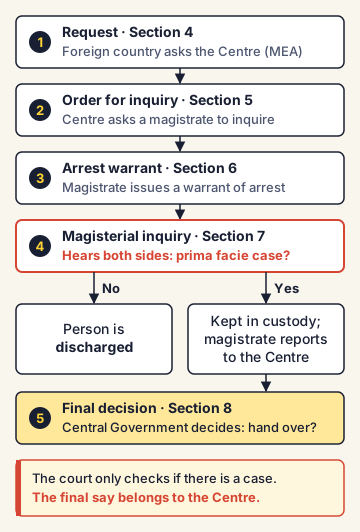
Note that the final decision belongs to the Central Government, not the court. The court only checks whether there is a case to answer.
When must India refuse? (Section 31)
A fugitive shall not be handed over:
- if the offence is of a political character, or the person proves the request is really meant to punish them for a political offence;
- if prosecution is time-barred under the requesting country's law;
- unless the foreign law or treaty ensures the person will be tried only for the offence for which they were handed over (the rule of specialty);
- if the person is already facing trial or serving a sentence in India for another offence, until that is over;
- until 15 days have passed after the person is committed to prison by the magistrate.
Section 31(2), added in 1993, lets the government notify a list of offences that will not be treated as political for a given treaty country.
Other important sections
- Section 29: The Central Government can stop proceedings and discharge the person at any time if the case is trivial, or the request is not made in good faith or in the interests of justice, "or for political reasons or otherwise".
- Section 34A: If India refuses extradition, it may prosecute the person in India itself.
- Section 34B: Provisional arrest on an urgent request; release after 60 days if no formal request arrives.
- Section 34C: If India gets a person back from a country that has no death penalty, the person can get at most life imprisonment for an offence punishable with death in India.
- Section 3: The Act applies to a foreign country through a notified order of the Central Government.
India's position and examples
As of December 2024, the government told Parliament that India has extradition treaties with 48 countries and extradition arrangements with 12 countries. India can also extradite to a country with no treaty, on the basis of international conventions or reciprocity, under the Act. A famous case is Abu Salem, extradited from Portugal on 11 November 2005 after India assured Portugal he would not get the death penalty or more than 25 years in jail.
In July 2022, the Supreme Court held that India is bound to honour that assurance. In April 2025, Tahawwur Rana, an accused in the 2008 Mumbai attacks, was extradited to India from the United States.
Commonly confused concepts
- Extradition Act, 1962 vs Fugitive Economic Offenders Act, 2018: The 1962 Act brings a person back (or sends one out). The 2018 Act lets courts declare a person who fled India to avoid trial in economic offences of ₹100 crore or more a "fugitive economic offender" and confiscate their property; it does not bring the person back.
- Interpol Red Notice vs extradition: A Red Notice is a request to police worldwide to locate and provisionally arrest a person pending extradition. It is not an arrest warrant and does not force any country to extradite. In India, the CBI is the national contact body for Interpol.
- Section 29 vs Section 31: Section 31 lists situations where India must not hand over a person. Section 29 gives the government a broad discretion to drop a case even when Section 31 does not apply.
Issues, criticism and the way forward
- Slow process: Extradition from abroad often takes years because of appeals in foreign courts, human rights arguments and concerns about prison conditions.
- Wide executive discretion: Section 29's words "for political reasons or otherwise" give the government a lot of room. Supporters say this protects India's diplomatic interests; critics say it makes outcomes less predictable.
- Undefined "political offence": Neither the Act nor most treaties define a political offence; they only list what is not political. Courts decide case by case.
- Way forward: Experts suggest more treaties with countries where fugitives often go, better prison conditions to answer foreign court objections, and faster, well-documented requests.
Concepts to Know
- Fugitive: A person who has run away to avoid arrest, trial or punishment.
- Prima facie case: A case that looks strong enough at first sight to need a full trial.
- Rule of specialty: The rule that a person handed over can be tried only for the crime named in the extradition request.
- Notified order: A government order published in the Official Gazette, which gives it legal force.
- Reciprocity: "You help us, we help you". Countries without a treaty may still cooperate on the promise of doing the same in return.
- Act 34 of 1962; in force from 5 January 1963; major amendment by Act 66 of 1993 (w.e.f. 18 December 1993)
- Section 2(c): non-treaty extradition offence = punishable with at least 1 year
- Sections 4 to 8: request → magisterial inquiry → arrest → prima facie check → Central Government decision
- Section 29: government may discharge if trivial, not in good faith or for political reasons
- Section 31: bars extradition for political offences, time-barred cases; rule of specialty
- Section 34B: provisional arrest, 60-day limit; Section 34C: life imprisonment instead of death for persons returned from non-death-penalty countries
- India: 48 extradition treaties, 12 arrangements (as of December 2024)
- MEA's CPV Division is India's nodal unit for extradition
● Tracked since August 18, 2026 · last seen November 08, 2026 · updates as the daily brief publishes