Question Hour and Zero Hour in Parliament
Question Hour is the time in Parliament when MPs ask ministers questions about their work, and ministers must answer. Zero Hour is the time, right after Question Hour in the Lok Sabha, when MPs can raise urgent public issues without giving the usual advance notice. Both are tools that let Parliament keep a daily check on the government. You can think of Question Hour as a daily "exam" the government must sit before the people's representatives.
Why do they exist?
In India's parliamentary system, the government (the Council of Ministers) is collectively responsible to the Lok Sabha under Article 75(3). This means it must keep the support of the House and answer to it. But how does an MP actually hold a minister accountable on an ordinary day? Mainly by asking questions. A question forces the ministry to collect facts, put them on record and explain its decisions.
Zero Hour adds speed: when a flood, a crop failure or an accident happens, MPs cannot wait 15 days for a formal question.
Where did they come from?
Asking questions of the government is an old practice in Britain's Parliament. In India, it started under British rule: the Indian Councils Act of 1892 first allowed members to ask questions, with restrictions. Today, Question Hour is governed by Rules 32 to 54 of the Rules of Procedure and Conduct of Business in Lok Sabha, plus directions by the Speaker.
Zero Hour is not in any rule book. It is an Indian innovation that grew informally in the early 1960s (commonly dated to 1962). It got its name because it starts at about 12 noon, the "zero" hour, right after Question Hour ends.
How does Question Hour work in the Lok Sabha?
- Timing: The first hour of every sitting (11 am to 12 noon) is Question Hour, unless the Speaker decides otherwise.
- Notice: An MP normally gives at least 15 clear days' notice of a question. The Speaker can relax this.
- Limit per MP: Each MP can give up to five question notices for one day.
- Ballot: So many notices come in that a ballot (draw of lots) decides which ones are listed.
- Daily limits: At most 20 starred questions (for oral answers) and 230 unstarred questions (for written answers) are listed per day.
- Answer: The minister answers starred questions orally on the floor. The MP who asked, and others, may then ask supplementary questions (follow-up questions).
In practice, only a handful of the 20 starred questions get answered orally in one hour, because supplementaries take time.
The types of questions
This is a favourite Prelims area:
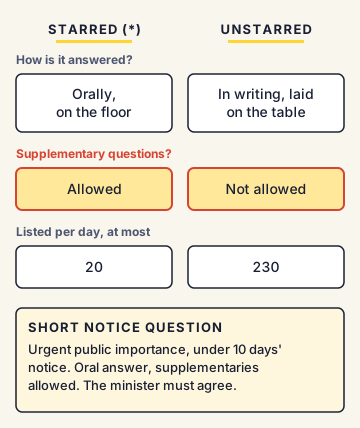
- Starred question: marked with a star (). Answered orally. Supplementary questions allowed.*
- Unstarred question: answered in writing. The answer is laid on the table of the House. No supplementaries.
- Short notice question: asked on a matter of urgent public importance with less than the normal notice (less than 10 days). Answered orally, and supplementaries are allowed. The minister must agree to answer at short notice.
- Question to a private member: asked to an MP who is not a minister, about a bill, resolution or other matter in the House for which that member is responsible.
What happens when an answer is not enough?
If an MP feels the answer to a question was unclear or incomplete, a Half-an-Hour Discussion can be held on a matter of public importance arising from that answer. Ministers also give assurances ("I will look into it"), and a Committee on Government Assurances checks whether they are kept.
How does Zero Hour work?
Zero Hour has no formal procedure in the rules. MPs give notice to the Speaker on the same morning, and the Speaker decides who may speak and for how long. Each MP gets only a few minutes. Ministers are not bound to reply on the spot. Some differences between the two Houses:
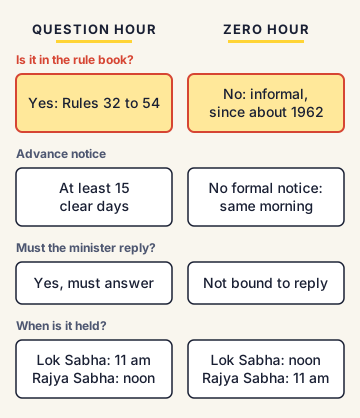
- Lok Sabha: Question Hour first (11 am), then Zero Hour (about 12 noon).
- Rajya Sabha: the order is reversed. Since 2014, when Chairman Hamid Ansari moved Question Hour to 12 noon, the Rajya Sabha takes up Zero Hour first at 11 am.
- There are also formal channels for raising issues: matters under Rule 377 in the Lok Sabha and Special Mentions in the Rajya Sabha. These are listed in advance, unlike Zero Hour.
India's experience
Question Hour has been dropped only rarely. It was not held in the Monsoon Session of 2020 because of COVID-19 (only written answers to unstarred questions were allowed), and it returned in the Budget Session of 2021. Disruptions are the bigger problem. According to PRS Legislative Research, during the 17th Lok Sabha (2019-24) Question Hour functioned for only 60% of its scheduled time in the Lok Sabha and 52% in the Rajya Sabha.
Commonly confused concepts
- Starred vs unstarred: Starred = oral answer + supplementaries. Unstarred = written answer + no supplementaries.
- Question Hour vs Zero Hour: Question Hour is in the rules, needs 15 days' notice, and the minister must answer. Zero Hour is not in the rules, needs no advance notice of the usual kind, and the minister need not reply.
- Zero Hour vs Rule 377 / Special Mention: Rule 377 matters (Lok Sabha) and Special Mentions (Rajya Sabha) are formal, listed in advance and read out. Zero Hour is informal.
- Question Hour vs Calling Attention Motion: A calling attention motion (Rule 197 in the Lok Sabha) is also an Indian innovation (from 1954). It draws a minister's attention to an urgent matter, and the minister makes a statement. It is a separate device, not part of Question Hour.
Issues, criticism and the way forward
- Disruptions: Repeated adjournments wipe out Question Hour, which hurts accountability most of all.
- Too many MPs, too little time: With only 20 starred questions a day, an MP's chance of getting an oral answer is already small. A larger House (up to 850) would shrink it further unless sitting time increases.
- No minimum sitting days: The Constitution does not fix how many days Parliament must sit in a year. The National Commission to Review the Working of the Constitution (NCRWC, 2002) recommended at least 120 days for the Lok Sabha and 100 days for the Rajya Sabha.
- Quality of answers: Critics say some written answers are vague or evasive.
- Suggested reforms: protected, non-negotiable time for Question Hour and Zero Hour; compensating lost Question Hour time; more sitting days; and a "Prime Minister's Question Time", similar to the UK practice, has also been suggested by experts.
Concepts to Know
- Collective responsibility: The rule that all ministers together are answerable to the Lok Sabha. If the House loses confidence in them, the whole Council of Ministers must resign.
- Supplementary question: A follow-up question asked after the minister's oral answer to a starred question.
- Ballot (in Parliament): A random draw used to decide which of the many question notices will be listed on a given day.
- Lay on the table: To place a document formally before the House so that it becomes part of the official record.
- Adjournment: Stopping a sitting of the House for a few hours or till the next day.
- Question Hour: first hour of the Lok Sabha sitting (11 am to 12 noon); governed by Rules 32 to 54 of the Lok Sabha Rules
- Notice: at least 15 clear days; up to 5 notices per MP per day
- Daily limit: 20 starred (oral) and 230 unstarred (written) questions
- Short notice question: less than 10 days' notice, urgent public importance, oral answer
- Zero Hour: not in the Rules of Procedure; informal Indian innovation since about 1962; starts around 12 noon in the Lok Sabha
- Rajya Sabha moved Question Hour to 12 noon in 2014; Zero Hour comes first there
- Question Hour was suspended in the 2020 Monsoon Session (COVID-19)
- 17th Lok Sabha: Question Hour worked 60% of scheduled time (Lok Sabha), 52% (Rajya Sabha)
- NCRWC (2002): minimum 120 sittings a year for the Lok Sabha, 100 for the Rajya Sabha
● Tracked since October 18, 2026 · last seen October 18, 2026 · updates as the daily brief publishes