Public Interest Litigation (PIL)
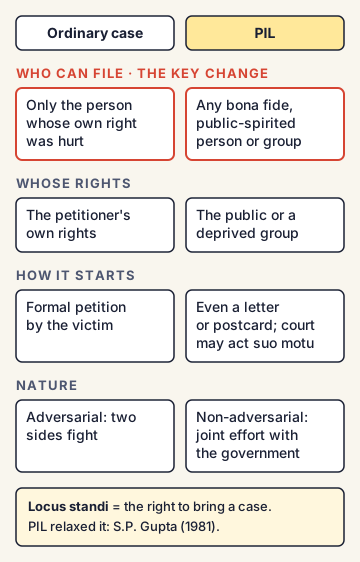
A Public Interest Litigation, or PIL, is a case filed in court to protect the rights of the public or of a group of people, rather than the private rights of the person filing it. Normally, only the person who has been harmed can go to court. In a PIL, any public-spirited person or organisation can approach the court on behalf of people who are too poor, too weak or too unaware to do it themselves.
In India, a PIL can be filed in the Supreme Court under Article 32 or in a High Court under Article 226.
Why does it exist?
Imagine a group of bonded labourers working in a stone quarry far from any city. They cannot read, they have no money for a lawyer, and they may not even know they have rights. Under the old rules, only they could go to court, so in practice nobody did. PIL was created to break this barrier.
It lets a social worker, a journalist, an NGO or even a court itself raise their case. In short, PIL brings justice to people who cannot reach the courts on their own.
What is locus standi, and how did PIL change it?
Locus standi is a Latin phrase meaning "a place to stand". In law, it means the right to bring a case to court. The traditional rule was that only a person whose own legal right was hurt (an "aggrieved person") had locus standi. PIL relaxed this rule. Now, any person acting in good faith (bona fide) and for the public good can file a case for others, provided there is a genuine public wrong and the affected people cannot easily approach the court themselves.
Where did it come from?
PIL grew in India in the late 1970s and 1980s, after the Emergency (1975-77), when the Supreme Court wanted to make rights real for the poor. Two judges, Justice P.N. Bhagwati and Justice V.R. Krishna Iyer, led this change. Key steps:
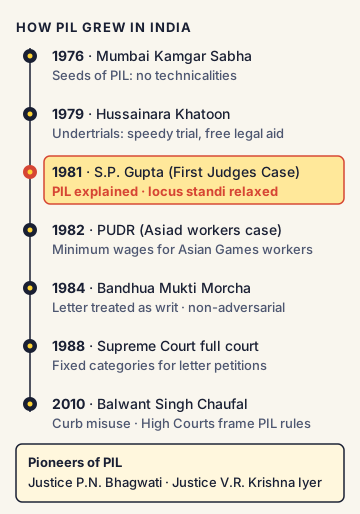
- Mumbai Kamgar Sabha v. Abdulbhai Faizullabhai (1976): Justice Krishna Iyer said procedural technicalities should not block genuine grievances. The judgment is seen as sowing the seeds of PIL, though it did not use the term.
- Hussainara Khatoon v. State of Bihar (1979): A petition about undertrial prisoners kept in Bihar jails for years without trial. The court held that free legal aid and a speedy trial are part of the right to life and liberty. A very large number of undertrials were released as a result.
- S.P. Gupta v. Union of India (1981): Known as the First Judges Case. The Supreme Court formally explained the idea of public interest litigation and relaxed locus standi.
- People's Union for Democratic Rights v. Union of India (1982): The "Asiad workers case", about construction workers at the 1982 Asian Games sites in Delhi who were paid less than the minimum wage and included children.
- Bandhua Mukti Morcha v. Union of India (1984): The court treated a letter about bonded labourers in Faridabad stone quarries as a writ petition. It held that PIL is not adversarial: it is not a fight between two sides, but a joint effort with the government to protect the rights of the deprived.
How does a PIL work?
A PIL is more flexible than an ordinary case.
- Who can file: Any public-spirited citizen or group. Courts can also start a case on their own, which is called suo motu action, often based on a news report.
- Letter petitions: The Supreme Court has even treated letters and postcards as petitions. This is called epistolary jurisdiction (from epistle, meaning letter).
- Fact-finding: Courts can appoint commissions, experts or an amicus curiae (a senior lawyer who helps the court) to find facts on the ground.
- Continuing orders: Courts may keep a case open for years, passing orders and checking whether they are followed. This is called continuing mandamus.
- Remedies: Courts may issue guidelines, direct the government to act, or order compensation.
What does the law say about which matters can be PILs?
Based on a full court decision of the Supreme Court in December 1988 (later updated), letter petitions are entertained as PIL only in certain categories, such as:
- bonded labour and neglected children;
- non-payment of minimum wages;
- harassment by police and atrocities on women, Scheduled Castes and Scheduled Tribes;
- environmental pollution, ecological imbalance, forests and wildlife;
- food adulteration, and maintenance of heritage and culture.
Matters such as landlord-tenant disputes and individual service matters about pension and gratuity are not entertained as PIL.
In State of Uttaranchal v. Balwant Singh Chaufal (2010), the Supreme Court said courts must encourage genuine PILs and firmly discourage those filed for personal gain, publicity or political motives. It asked each High Court to frame its own rules for PIL and asked courts to check the petitioner's credentials and good faith before admitting a case.
India's examples of PIL in action
- M.C. Mehta v. Union of India (Oleum gas leak case, 1987): The court created the rule of absolute liability: an industry doing hazardous work must pay for any harm it causes, with no exceptions.
- Vishaka v. State of Rajasthan (1997): A PIL by women's groups led to the Vishaka Guidelines against sexual harassment at the workplace. They were later replaced by the POSH Act, 2013.
- Environmental PILs have shaped vehicle emission rules, river clean-up and forest protection.
- Tribal and forest-rights cases, such as the petitions on the Great Nicobar project, are often PILs because the affected communities live in remote areas.
Commonly confused concepts
- PIL vs ordinary writ petition: In an ordinary writ, the petitioner seeks relief for a wrong done to themselves. In a PIL, the petitioner seeks relief for the public or for a disadvantaged group.
- Article 32 vs Article 226: Article 32 lets a person go to the Supreme Court only for violation of fundamental rights, and is itself a fundamental right. Article 226 lets a person go to a High Court for fundamental rights and "for any other purpose", such as legal rights under ordinary laws. So Article 226 is wider in scope.
- PIL vs class action: In a class action (common in the United States), people who were all harmed in the same way join together to claim relief, usually money. In a PIL, the petitioner need not be harmed at all.
- Suo motu vs PIL: A suo motu case is started by the court on its own. A PIL is started by a petitioner, though suo motu cases are often run like PILs.
Issues, criticism and the way forward
- Frivolous and motivated PILs: Some PILs are filed for publicity, to settle business or political scores, or to block projects for private gain. Courts now impose costs on such petitioners.
- Judicial overreach: Critics argue that through PIL, courts sometimes step into areas that belong to the executive and legislature, such as policy-making, which strains the separation of powers. Supporters reply that courts step in only when other branches fail to protect rights.
- Burden on courts: PILs add to the already huge number of pending cases.
- Delay to projects: Governments often argue that PILs hold up projects of national importance. Petitioners argue that courts are the only check when legal safeguards, such as tribal consent or environmental clearance, are skipped.
- Weak follow-up: Many court orders in PILs are not fully carried out on the ground.
- Way forward: Experts suggest clear PIL rules in every High Court (as directed in the Chaufal case), strict checks on the petitioner's good faith, costs for misuse, and expert committees to monitor whether orders are implemented.
Concepts to Know
- Writ: A formal order issued by a High Court or the Supreme Court telling a person or authority to do, or stop doing, something. The five writs are habeas corpus, mandamus, prohibition, certiorari and quo warranto.
- Maintainability: Whether a case is legally fit to be heard by the court at all. The court decides this before looking at the main arguments.
- Undertrial prisoner: A person kept in jail while their trial is still going on, without having been found guilty.
- Amicus curiae: Latin for "friend of the court". A lawyer appointed by the court to help it understand a case fairly.
- Mandamus: A writ meaning "we command". It orders a public authority to carry out its legal duty.
- Free legal aid (Article 39A): A Directive Principle, added by the 42nd Amendment Act, 1976, asking the State to provide free legal aid so that no citizen is denied justice because of poverty.
- PIL filed under Article 32 (Supreme Court) or Article 226 (High Courts)
- Pioneers: Justice P.N. Bhagwati and Justice V.R. Krishna Iyer
- Mumbai Kamgar Sabha (1976): seeds of PIL; Hussainara Khatoon (1979): undertrials, speedy trial and legal aid; S.P. Gupta (1981): locus standi relaxed; PUDR (1982): Asiad workers; Bandhua Mukti Morcha (1984): PIL is non-adversarial, letter treated as writ
- Supreme Court PIL guidelines for letter petitions: full court decision of December 1988
- State of Uttaranchal v. Balwant Singh Chaufal (2010): guidelines to curb misuse; High Courts to frame PIL rules
- M.C. Mehta (1987): absolute liability; Vishaka (1997): workplace sexual harassment guidelines
- Article 39A (free legal aid): added by the 42nd Amendment, 1976
● Tracked since February 11, 2026 · last seen October 05, 2026 · updates as the daily brief publishes