Cultural and Educational Rights (Articles 29 and 30)
Cultural and educational rights are fundamental rights in Part III of the Constitution that protect the language, script and culture of different groups, and the right of minorities to run their own schools and colleges. Article 29 protects the right of any section of citizens to conserve its distinct language, script or culture. Article 30 gives religious and linguistic minorities the right to set up and manage their own educational institutions. Together they make sure that India's many communities can keep their identity while being equal citizens.
Why do these rights exist?
India is home to hundreds of languages, many religions and thousands of communities with their own customs. When the Constitution was written, many smaller groups feared that a larger majority might slowly erase their language or way of life, for example by forcing one language in schools. The makers of the Constitution wanted to reassure them. These rights promise that being Indian does not mean giving up your own culture.
What does Article 29 say?
- Article 29(1): Any section of citizens living in India that has a distinct language, script or culture of its own has the right to conserve it.
- Article 29(2): No citizen can be denied admission to an educational institution run by the State or receiving State funds only because of religion, race, caste, language or any of these.
Although the heading of Article 29 says "Protection of interests of minorities", its text says "any section of citizens". The Supreme Court in Ahmedabad St. Xavier's College Society v. State of Gujarat (1974) confirmed that Article 29(1) does not speak only of minorities. So any group with a distinct language, script or culture, whether minority or majority, can claim it. This includes tribal communities with their own languages and ways of life.
What does Article 30 say?
- Article 30(1): All minorities, based on religion or language, have the right to establish and administer educational institutions of their choice.
- Article 30(1A): If the State takes over the property of a minority educational institution by law, the compensation must not be so low that it destroys the minority's right. This clause was added by the 44th Amendment Act, 1978, which also removed the right to property from the list of fundamental rights.
- Article 30(2): When giving aid, the State must not discriminate against an institution just because it is managed by a religious or linguistic minority.
How do Articles 29 and 30 differ?
Students often mix them up, so remember this:
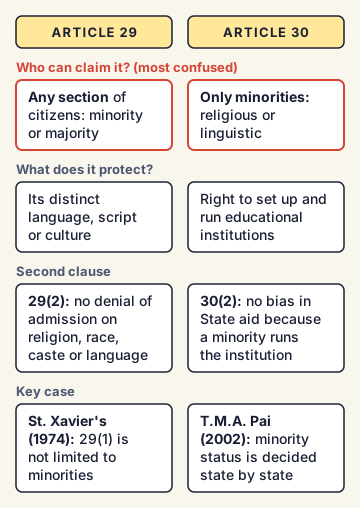
- Article 29(1) protects culture, language and script, and is available to any section of citizens.
- Article 30 protects the right to run educational institutions, and is available only to minorities (religious or linguistic).
- Article 29(2) is an individual right of every citizen against discrimination in admissions.
What have the courts said?
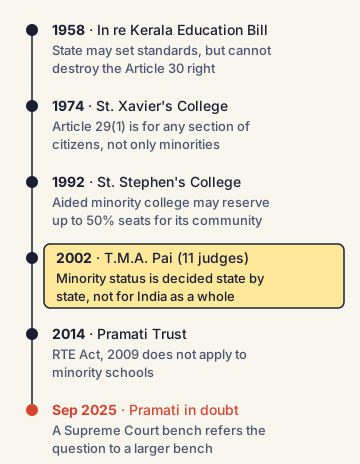
- In re Kerala Education Bill (1958): On a reference by the President under Article 143, the Supreme Court held that the State can make reasonable rules to keep education standards high, but cannot make rules that destroy a minority's right to run its institutions.
- Ahmedabad St. Xavier's College (1974): Article 29(1) is not limited to minorities.
- St. Stephen's College v. University of Delhi (1992): A minority institution receiving State aid may reserve up to 50% of seats for students of its own community, to keep its minority character.
- T.M.A. Pai Foundation v. State of Karnataka (2002): An 11-judge bench held that minority status for Article 30 is decided state by state, not for India as a whole, because states were reorganised on linguistic lines.
- Pramati Educational and Cultural Trust v. Union of India (2014): The Right to Education Act, 2009 does not apply to minority schools. In September 2025, a Supreme Court bench raised doubts about this ruling and referred the question to a larger bench.
Other provisions that protect culture and language
- Article 15(5) (added by the 93rd Amendment, 2005) allows reservation in private educational institutions for backward classes, SCs and STs, but exempts minority institutions under Article 30(1).
- Article 350A: States should provide teaching in the mother tongue at the primary stage for children of linguistic minorities.
- Article 350B: The President appoints a Special Officer for Linguistic Minorities. Both 350A and 350B were added by the 7th Amendment Act, 1956.
- Article 51A(f): It is a fundamental duty of every citizen to value and preserve the rich heritage of our composite culture.
- For tribal communities specifically, the Fifth and Sixth Schedules, the PESA Act, 1996 and the Forest Rights Act, 2006 protect land, customs and community resources.
Who is a "minority"?
The Constitution does not define the word. Under the National Commission for Minorities Act, 1992, the Centre has notified six religious minorities: Muslims, Christians, Sikhs, Buddhists, Parsis and Jains (Jains were added in 2014). Linguistic minorities are decided state by state.
Commonly confused concepts
- Article 29 vs Article 30: Article 29(1) is for any section of citizens and covers culture, language and script. Article 30 is only for religious and linguistic minorities and covers educational institutions.
- Article 29(2) vs Article 15(1): Article 15(1) bars the State from discriminating on grounds of religion, race, caste, sex or place of birth in general. Article 29(2) applies specifically to admissions in State-run or State-aided institutions, and includes language but not sex or place of birth.
- Article 25 vs Article 29: Article 25 protects freedom of religion (to profess, practise and propagate). Article 29 protects culture, language and script, which may or may not be religious.
- Religious minority vs linguistic minority: Religious minorities are notified nationally under the 1992 Act. Linguistic minorities are judged within each state.
Issues, criticism and the way forward
- Integration vs identity: A central debate, especially for isolated tribal groups, is whether development should bring them into the mainstream or protect their separate way of life. Policy for the most isolated groups, such as the Shompen, has generally favoured their own choice and minimal outside interference.
- Development projects and culture: Large projects on tribal land can destroy sacred sites, hunting grounds and villages. Critics argue that the loss of land is also a loss of culture, which Article 29 protects. Governments argue that projects of national importance also serve the public good.
- Misuse of minority status: Some institutions have been accused of claiming minority status mainly to avoid regulation, reservation or the RTE Act.
- Regulation vs autonomy: Courts keep trying to balance the State's interest in education standards with minorities' right to run their institutions.
- Way forward: Experts suggest meaningful consultation with communities before decisions that affect their culture, proper use of the Forest Rights Act and PESA, and clear rules on minority status and regulation.
Concepts to Know
- Part III of the Constitution: The part that lists the Fundamental Rights (Articles 12 to 35). These rights can be enforced in court.
- Script: The writing system used for a language, such as Devanagari, Gurmukhi or Ol Chiki.
- Composite culture: A culture made up of the mixing of many different traditions, languages and religions over time.
- Reference under Article 143: When the President asks the Supreme Court for its advice on a question of law or fact of public importance.
- PESA Act, 1996: The Panchayats (Extension to Scheduled Areas) Act, which gives Gram Sabhas in Fifth Schedule areas strong powers over land, resources and customs.
- Article 29(1): any section of citizens with a distinct language, script or culture can conserve it
- Article 29(2): no denial of admission in State-run or State-aided institutions only on grounds of religion, race, caste or language
- Article 30(1): religious and linguistic minorities can set up and run educational institutions of their choice; Article 30(1A) added by the 44th Amendment, 1978; Article 30(2): no discrimination in State aid
- Kerala Education Bill reference (1958); St. Xavier's (1974); St. Stephen's (1992, up to 50% seats); T.M.A. Pai (2002, 11 judges, state-wise minority status); Pramati (2014, RTE not applicable to minority schools)
- Article 15(5): 93rd Amendment, 2005; minority institutions exempt
- Articles 350A and 350B: 7th Amendment, 1956
- Six notified religious minorities; Jains added in 2014
● Tracked since October 05, 2026 · last seen October 05, 2026 · updates as the daily brief publishes