Price Stabilisation Fund (PSF)
How the Government Fights Food Price Spikes
The Price Stabilisation Fund (PSF) is a government fund used to keep the prices of some key farm products, mainly pulses and onion, from jumping too high for consumers. The government uses this money to buy these crops when they are plentiful and cheap, store them as a buffer stock (a reserve kept for bad times), and then sell them in the market when prices shoot up.
It is a Central Sector Scheme, which means the Centre fully funds and runs it. You can think of it like a family that buys extra onions when the price is ₹20 a kg and stores them, so that it does not have to pay ₹80 a kg a few months later.
Why does it exist?
Many food items in India, especially vegetables and pulses, see sudden and sharp price swings. Onion is the classic example. Most of the crop is harvested in one season, it rots easily, and a bad monsoon or untimely rain can cut supply sharply. When that happens, prices can double within weeks. Such spikes hurt poor families the most, because they spend a large share of their income on food.
The RBI's main tool, the repo rate, cannot fix this. Raising interest rates does not grow more onions. Food price spikes come from the supply side (too little supply), not from too much demand. So the government needs a direct tool that adds supply to the market at the right time. The PSF is that tool.
Where did it come from?
The PSF was announced in the Union Budget 2014-15. The government approved it on 27 March 2015 with a starting corpus (total fund) of ₹500 crore, as a Central Sector Scheme for 2014-15 to 2016-17.
- At the start, it was run by the Department of Agriculture, Cooperation and Farmers Welfare and covered onion and potato.
- Pulses were added later, after a sharp rise in pulse prices in 2015.
- From 1 April 2016, the scheme moved to the Department of Consumer Affairs (DoCA), Ministry of Consumer Affairs, Food and Public Distribution.
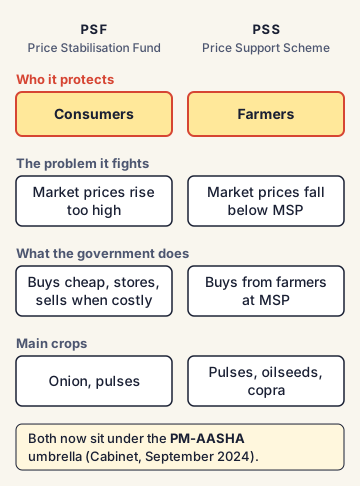
- In September 2024, the Union Cabinet approved the continuation of the PM-AASHA (Pradhan Mantri Annadata Aay SanraksHan Abhiyan) umbrella scheme with an outlay of ₹35,000 crore up to 2025-26. The PSF was brought under this umbrella, along with the Price Support Scheme (PSS), the Price Deficiency Payment Scheme (PDPS) and the Market Intervention Scheme (MIS). The Department of Consumer Affairs continues to run the PSF part.
Do not confuse this with an older, separate Price Stabilisation Fund set up in 2003 by the Ministry of Commerce. That fund helped growers of tea, coffee, natural rubber and tobacco when their prices fell too low. It aimed to protect farmers, while the 2015 PSF mainly aims to protect consumers.
How does it work, step by step?
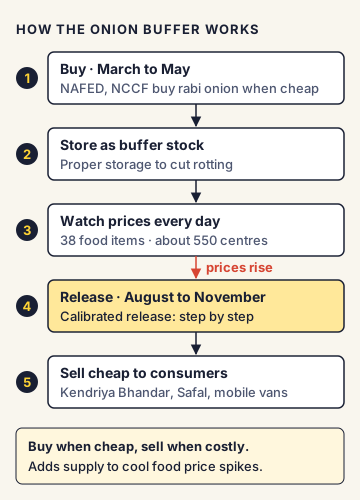
- Buying (procurement): When the crop is harvested and prices are low, central agencies buy the produce. For onion, the agencies are mainly NAFED (National Agricultural Cooperative Marketing Federation of India) and NCCF (National Cooperative Consumers' Federation of India). They buy rabi onion (harvested around March to May), which stores better than other onion crops. They buy directly from farmers or farmer groups, often at market prices.
- Storing: The stock is kept in proper storage to reduce rotting. In 2026-27, the Central Warehousing Corporation was engaged for the first time as the storage agency for the onion buffer.
- Watching prices: The Department of Consumer Affairs tracks daily retail and wholesale prices of 38 essential food items (including onion, pulses, rice, wheat, edible oil, milk and sugar) from about 550 price reporting centres across the country, through a mobile app.
- Releasing stock: When prices start rising, usually from August to November for onion, the government releases the buffer. This is called calibrated release (releasing step by step, in the right places, so that prices cool without crashing). The stock may be sold in wholesale markets (mandis), given to states, or sold directly to people at a fixed low price.
- Retail sale: Cooperative agencies sell the produce at subsidised rates through their outlets, mobile vans and stores such as Kendriya Bhandar and Mother Dairy's Safal booths. Pulses from the buffer have also been sold under the "Bharat" brand (for example, Bharat Dal, launched in 2023).
Key facts about the onion buffer
- India produced about 307 lakh tonnes of onion in 2025-26 (estimate).
- The PSF onion procurement target for 2026-27 was 2 lakh tonnes of rabi onion; buying began on 15 May 2026.
- In 2025-26, onions from the buffer were moved to 16 cities using 86 railway rakes carrying about 88,000 tonnes.
- In late August 2026, buffer onions were being sold at ₹35 per kg through NCCF, NAFED, Kendriya Bhandar and Safal outlets.
How is money shared with the states?
States can set up their own price stabilisation funds for items that matter locally. The Centre gives them an interest-free advance (a loan with no interest) for working capital.
- The Centre and the state contribute in a 50:50 ratio.
- For North-Eastern states, the ratio is 75:25 (Centre 75%).
- If the state's intervention makes a loss, the Centre shares it in the same ratio.
Who manages it?
A Price Stabilisation Fund Management Committee (PSFMC), chaired by the Secretary, Department of Consumer Affairs, runs the fund. It approves all proposals from state governments and central agencies, decides how much to buy, and when and how to release it.
India's position and Indian examples
India is both a huge producer and a huge consumer of onion and pulses, so even small supply gaps move prices sharply.
- The pulses buffer is the largest part of the PSF. It covers tur (arhar), urad, moong, masur and chana. Since the start of the scheme, over 91 lakh tonnes of pulses have been bought for the buffer.
- From 2014-15 to 2023-24, the government gave about ₹27,489 crore in budget support to the PSF.
- The government also uses other tools along with the PSF: stock limits on traders under the Essential Commodities Act, 1955, export restrictions or export duties (onion exports have been curbed several times when prices rose), and lower import duties.
Commonly confused concepts
- PSF vs Price Support Scheme (PSS): PSS protects farmers. The government buys pulses, oilseeds and copra at the Minimum Support Price (MSP) when market prices fall below MSP. PSF protects consumers. It buys produce to release later when market prices rise too high.
- PSF vs Operation Greens: Operation Greens was announced in the Union Budget 2018-19 with ₹500 crore and is run by the Ministry of Food Processing Industries (MoFPI). It started with Tomato, Onion and Potato (TOP) and was expanded to 22 perishable items in Budget 2021-22. It funds long-term fixes like cold storage, processing and farmer producer organisations (FPOs). PSF is a short-term tool: buy, store and release.
- Buffer stock (PSF) vs Central Pool stock (FCI): The Food Corporation of India (FCI) keeps large stocks of rice and wheat for the Public Distribution System and food security. The PSF buffer is mainly onion and pulses, kept for price control.
- Supply-side vs demand-side inflation: PSF fights inflation caused by low supply. The RBI's repo rate mainly fights inflation caused by too much demand.
Issues, criticism and the way forward
- Storage losses: Onion is perishable. Even in good storage, a part of the stock dries up or rots. Losses make the scheme costly.
- Small size compared with the market: A buffer of 2 to 5 lakh tonnes is tiny compared with a crop of about 300 lakh tonnes. So it can calm prices in some cities but cannot fully control national prices.
- Timing and reach: Releases sometimes come late, or reach mainly big cities like Delhi and Mumbai. Rural consumers, who are hit hardest by food inflation, may gain less.
- Farmers' concerns: Farmers' groups argue that releasing cheap buffer stock, along with export curbs, pulls down the price farmers get just when they could earn more.
- Way forward: Experts suggest better scientific storage (like irradiation and controlled-atmosphere storage), more food processing (dehydrated onion), better price forecasting, faster data, and stable trade policies so that both farmers and consumers are protected.
Concepts to Know
- Buffer stock: A reserve of a product that the government keeps aside, to be sold when supply is short and prices are high.
- Central Sector Scheme: A scheme fully paid for and run by the central government, unlike a Centrally Sponsored Scheme where states also share the cost.
- Rabi crop: A crop sown in winter (around October to December) and harvested in spring (around March to May). Rabi onion stays fresh longer than kharif onion.
- NAFED and NCCF: National-level cooperative bodies that buy, store and sell farm produce on behalf of the government.
- Calibrated release: Releasing stock in small, planned amounts at the right places and times, so prices come down gently.
- Minimum Support Price (MSP): A price fixed by the government at which it promises to buy certain crops from farmers, to protect them from a price crash.
- Supply shock: A sudden fall in the supply of a product (for example, because of bad weather), which pushes its price up.
- PSF announced in Union Budget 2014-15; approved on 27 March 2015 with a ₹500 crore corpus
- Central Sector Scheme; moved from the Department of Agriculture to the Department of Consumer Affairs on 1 April 2016
- Brought under the PM-AASHA umbrella (Cabinet, September 2024; ₹35,000 crore up to 2025-26)
- Covers mainly pulses (tur, urad, moong, masur, chana) and onion; started with onion and potato
- Managed by the PSF Management Committee chaired by the Secretary, Department of Consumer Affairs
- State-level PSF: Centre-state sharing 50:50; 75:25 for North-Eastern states; interest-free advance from the Centre
- Agencies: NAFED, NCCF; retail through Kendriya Bhandar, Safal outlets, mobile vans
- Price monitoring of 38 food items from about 550 centres
- Separate 2003 PSF (Ministry of Commerce) covered tea, coffee, natural rubber and tobacco for growers
● Tracked since August 24, 2026 · last seen October 13, 2026 · updates as the daily brief publishes