Prevention of Money Laundering Act (PMLA), 2002
The Prevention of Money Laundering Act, or PMLA, is India's main law against money laundering: the process of making money earned from crime look like clean, legal money. It lets the government trace, freeze and take away such money, and punish those who launder it. The law is enforced mainly by the Enforcement Directorate (ED). It came into force on 1 July 2005.
What is money laundering, in simple words?
Suppose a person takes a big bribe in cash. If he spends it openly, people will ask where it came from. So he passes it through fake companies, buys property in other names, or shows it as profit from a business. After many such steps, the money looks legal. This "washing" of dirty money is money laundering. It usually has three stages:
- Placement: putting the cash into the banking system.
- Layering: moving it through many accounts, firms or countries to hide its origin.
- Integration: bringing it back as apparently clean money, for example as a house or a business investment.
Why does the law exist?
Crimes like drug trafficking, corruption, terror financing and fraud are done mainly for money. If criminals can keep and enjoy that money, punishing them alone does not stop the crime. The PMLA attacks the money itself. It also helps India meet global standards set by the Financial Action Task Force (FATF), the international body that checks how well countries fight money laundering and terror financing.
Where did it come from?
The global push began with the UN Vienna Convention against drug trafficking (1988). In 1998, a special session of the UN General Assembly adopted a Political Declaration asking countries to make anti-money laundering laws. India passed the PMLA in 2002 (it became law in January 2003) and brought it into force on 1 July 2005. It has been amended several times, including in 2009, 2012 and 2019, mostly to widen its reach.
The key idea: a "scheduled offence" must come first
Money laundering is a dependent crime. There must first be a basic crime that produced the money. These basic crimes are listed in the Schedule of the PMLA, so they are called scheduled offences (also called predicate offences). Examples include offences under the Indian Penal Code (now Bharatiya Nyaya Sanhita) like cheating, the Prevention of Corruption Act, the NDPS Act (drugs) and the UAPA (terrorism).
The money earned from such a crime is called "proceeds of crime". The scheduled offence is investigated by its own agency (state police, CBI, Lokayukta). Only the money laundering part is investigated by the ED.
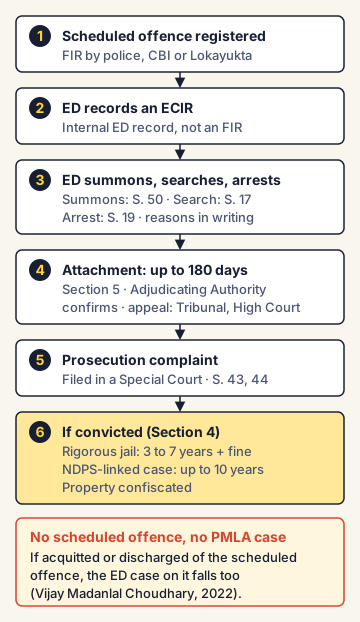
How does a PMLA case work, step by step?
- A scheduled offence is registered by the proper agency, usually through an FIR.
- The ED records an Enforcement Case Information Report (ECIR). This is an internal ED document, not an FIR.
- The ED can summon people and record their statements (Section 50), search and seize (Section 17), and arrest (Section 19), after recording its reasons in writing.
- The ED can provisionally attach (freeze) property believed to be proceeds of crime for up to 180 days (Section 5). An Adjudicating Authority must confirm the attachment. Appeals go to the Appellate Tribunal and then the High Court.
- The ED files a prosecution complaint (similar to a chargesheet) before a Special Court (Sections 43 and 44).
- If convicted, the person faces rigorous imprisonment of 3 to 7 years and a fine (Section 4). If the scheduled offence is under the NDPS Act, the maximum is 10 years. The property can be confiscated by the government.
Other important provisions
- Section 3: defines the offence. Any process or activity connected with proceeds of crime (hiding, possessing, acquiring, using, or claiming them as clean) is money laundering. A 2019 explanation made clear that it is a continuing offence as long as a person keeps enjoying the proceeds.
- Section 12: banks, financial companies and certain professionals (called reporting entities) must verify customers (KYC), keep records and report suspicious transactions to the Financial Intelligence Unit-India (FIU-IND).
- Section 24: the burden of proof is reversed. The court presumes the property is proceeds of crime unless the accused proves otherwise.
- Section 45: twin conditions for bail. The court can grant bail only if it believes the accused is not guilty and is not likely to commit any offence while on bail.
- Section 66(2): if the ED finds that some other law has been broken, it must share that information with the concerned agency for action.
- Section 71: the PMLA overrides other laws where they conflict.
What have the courts said?
- Vijay Madanlal Choudhary v. Union of India (27 July 2022): A three-judge Bench upheld the main PMLA provisions, including arrest, attachment, search, the reversed burden of proof and the twin bail conditions. It held that an ECIR is not an FIR and need not be given to the accused, and that ED officers are not "police officers", so statements made to them under Section 50 can be used in evidence. It also held that if a person is finally discharged or acquitted of the scheduled offence, or the case is quashed, there can be no money laundering case against him on that basis. A review of this judgment was admitted later in 2022.
- Pankaj Bansal v. Union of India (October 2023): The ED must give the grounds of arrest in writing to the arrested person.
- Tarsem Lal v. Directorate of Enforcement (May 2024): Once the Special Court takes cognizance of the ED's complaint, the ED cannot arrest the accused under Section 19. It must apply to the court for custody.
- Directorate of Enforcement v. Bibhu Prasad Acharya (November 2024): Prior government sanction under Section 197 CrPC is needed to prosecute a public servant under the PMLA for acts linked to official duty.
India's position and Indian examples
India is a full member of the FATF (since 2010). The FATF's mutual evaluation of India, adopted in 2024, placed India in the "regular follow-up" category, its best rating. Large PMLA cases have involved bank frauds, chit fund scams, illegal mining and corruption. According to a Finance Ministry reply in the Rajya Sabha (July 2025), the ED took up 5,892 PMLA cases between January 2015 and June 2025, and 15 persons were convicted in that period.
The government has also pointed out that, among cases decided on merits, the conviction rate is above 90%, because most cases are still pending trial.
Commonly confused concepts
- PMLA vs FEMA: The PMLA is a criminal law about laundering proceeds of crime; punishment includes jail. The Foreign Exchange Management Act (FEMA), 1999 is a civil law about foreign exchange rules; violations attract penalties, not jail. The ED enforces both.
- Scheduled offence vs Money laundering: The scheduled offence (for example, bribery) produces the money. Money laundering is what is done with that money. Different agencies investigate each.
- ECIR vs FIR: An FIR is registered by police under criminal procedure law and the accused can get a copy. An ECIR is an internal ED record.
- Prosecution complaint vs Private complaint: A prosecution complaint is the ED's formal charge under Section 44 PMLA for money laundering. A private complaint is filed by any person before a magistrate under Section 223 BNSS to start a case for an ordinary offence.
- FIU-IND vs ED: FIU-IND collects and analyses reports of suspicious transactions. The ED investigates and prosecutes.
Issues, criticism and the way forward
- Low conviction count: Thousands of cases are registered but very few reach a final verdict. Critics say the process itself (arrest, long custody, attached property) becomes the punishment.
- Strict bail: The twin conditions make bail very hard, so accused persons can stay in jail for long periods before trial.
- Self-incrimination concern: Statements recorded under Section 50 can be used as evidence, which critics say weakens the protection of Article 20(3) (no one can be forced to be a witness against himself).
- Federal and political concerns: Several states argue that the ED, a central agency, can enter cases connected with state subjects like police and land. Critics allege selective use; the government's position is that the ED acts on evidence and courts review its actions.
- Courts as the check: Recent rulings on written grounds of arrest, arrest after cognizance, sanction for public servants, and now the Karnataka High Court's ruling on private complaints, all narrow the ED's powers to what the law clearly says.
- Way forward: Faster trials through more Special Courts, clearer timelines for attachment and investigation, and the pending review of Vijay Madanlal Choudhary to settle key questions.
Concepts to Know
- Proceeds of crime: Any property or money that someone gets, directly or indirectly, from a scheduled offence.
- Attachment: A legal order that stops the owner from selling, transferring or using a property until the case is decided.
- Adjudicating Authority: A body under the PMLA that decides whether the ED's freezing of a property should continue.
- Cognizance: The stage when a court formally notices an offence and decides to start proceedings on it.
- Reverse burden of proof: Normally the prosecution must prove guilt. Under a reverse burden, the accused must prove innocence on a certain point.
- FATF: Financial Action Task Force, an international body set up in 1989 that sets anti-money laundering standards and puts weak countries on "grey" or "black" lists.
- PMLA enacted in 2002 (Act 15 of 2003); in force from 1 July 2005; amended in 2005, 2009, 2012, 2019 and later
- Section 3: offence of money laundering; Section 4: 3 to 7 years rigorous imprisonment (up to 10 years for NDPS-linked cases) plus fine
- Section 5: provisional attachment up to 180 days; Section 17: search and seizure; Section 19: arrest
- Section 24: reverse burden of proof; Section 45: twin bail conditions; Section 50: summons and statements
- Section 66(2): ED must share information about other offences with the concerned agency
- Vijay Madanlal Choudhary (27 July 2022): PMLA provisions upheld; ECIR is not an FIR
- Pankaj Bansal (2023): written grounds of arrest; Tarsem Lal (May 2024): no ED arrest after cognizance; Bibhu Prasad Acharya (November 2024): Section 197 CrPC sanction applies
- FIU-IND: receives suspicious transaction reports from banks and other reporting entities
- 5,892 PMLA cases taken up (January 2015 to June 2025), 15 persons convicted (Rajya Sabha reply, July 2025)
● Tracked since February 16, 2026 · last seen November 07, 2026 · updates as the daily brief publishes