Enforcement Directorate (ED)
The Enforcement Directorate, or ED, is India's main agency for investigating economic crimes like money laundering and foreign exchange violations. It works under the Department of Revenue, Ministry of Finance, with its headquarters in New Delhi. It is not a constitutional body. All its powers come from specific laws passed by Parliament, mainly the PMLA, 2002 and FEMA, 1999.
Why does it exist?
Ordinary police are trained for crimes like theft and murder. Financial crimes are different: money moves through many bank accounts, shell companies and countries within days. A specialised agency with financial experts, powers to freeze property, and links to foreign agencies is needed to follow such money trails.
Where did it come from?
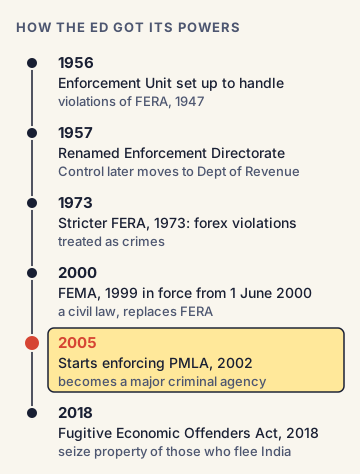
- 1 May 1956: An "Enforcement Unit" was set up in the Department of Economic Affairs to handle violations of the Foreign Exchange Regulation Act (FERA), 1947.
- 1957: It was renamed the Enforcement Directorate. Its control later moved to the Department of Revenue.
- 1973: FERA 1947 was replaced by a stricter FERA 1973, which treated foreign exchange violations as crimes.
- 1999 to 2000: After economic liberalisation, FERA was replaced by FEMA, 1999 (in force from 1 June 2000), a civil law.
- 2005: The ED became the agency to enforce the PMLA, which turned it into a major criminal investigation agency.
- 2018: It was given the Fugitive Economic Offenders Act, 2018, which allows confiscation of property of people who flee India to avoid trial in cases of ₹100 crore or more.
What laws does the ED enforce?
- PMLA, 2002: criminal investigation of money laundering; power to search, arrest, attach property and prosecute.
- FEMA, 1999: civil investigation of foreign exchange violations; leads to penalties.
- Fugitive Economic Offenders Act, 2018: declaring someone a fugitive economic offender and confiscating property.
- COFEPOSA, 1974: the ED is a sponsoring agency for preventive detention in serious foreign exchange cases.
- Old cases under the repealed FERA, 1973.
How is the Director appointed?
The Director of Enforcement is appointed by the Central Government on the recommendation of a committee set up under Section 25 of the Central Vigilance Commission (CVC) Act, 2003. The committee is chaired by the Central Vigilance Commissioner. The Director gets a tenure of at least two years. In 2021, the CVC Act was amended to let the government extend this tenure one year at a time, up to a total of five years.
- In Common Cause v. Union of India (2021), the Supreme Court said extensions should be given only in rare and exceptional cases and for short periods.
- In Dr. Jaya Thakur v. Union of India (11 July 2023), the Supreme Court upheld the 2021 amendments, but held the third extension given to the then Director, Sanjay Kumar Mishra, illegal. He was allowed to continue only for a short transition period.
How does the ED work with other agencies?
The ED does not investigate the basic crime itself. It depends on agencies like the state police, CBI, Income Tax Department, Lokayukta and NIA to register the scheduled offence. When the ED finds evidence of another crime during its work, Section 66(2) of the PMLA requires it to share that information with the concerned agency. It also works with FIU-IND, which passes it reports of suspicious transactions, and with foreign agencies through mutual legal assistance and the Egmont Group network of financial intelligence units.
Commonly confused concepts
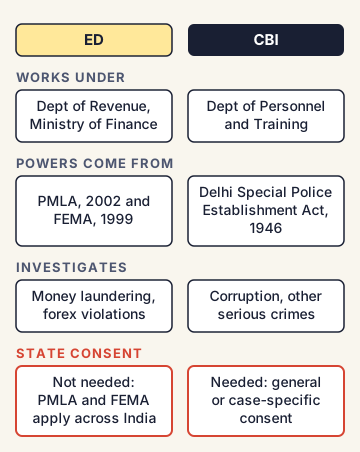
- ED vs CBI: The CBI (Central Bureau of Investigation) is set up under the Delhi Special Police Establishment Act, 1946, works under the Department of Personnel and Training, and investigates corruption and other serious crimes. It needs state consent to work inside a state (general or case-specific consent). The ED works under the Ministry of Finance and gets its powers from the PMLA and FEMA, which apply across India, so it needs no state consent.
- ED vs FIU-IND: FIU-IND (set up in 2004) only collects and analyses financial intelligence. It does not investigate or arrest.
- ED vs DRI: The Directorate of Revenue Intelligence handles customs-related smuggling. The ED handles money laundering and foreign exchange.
- ED officers vs Police officers: Courts have held that ED officers are not "police officers", so the rule that confessions to police cannot be used as evidence does not apply to them.
Issues, criticism and the way forward
- Wide powers, few convictions: The ED registers thousands of cases, but few have reached a final verdict, according to replies given in Parliament.
- Independence: Repeated extensions of a Director's tenure raised concerns that the head of the agency may feel dependent on the government. The Supreme Court's 2021 and 2023 rulings tried to limit this.
- Allegations of selective use: Critics allege that the agency is used against political opponents; the government states that cases are based on evidence and are reviewed by courts.
- Overreach: Courts have repeatedly held that the ED can use only the powers the law gives it. The Karnataka High Court's "not a super cop" ruling is the latest example.
- Way forward: Experts suggest a fixed tenure without extensions for the Director, faster trials, more Special Courts, better staffing with financial experts, and annual public reporting of case outcomes.
Concepts to Know
- Statutory body: A body created by a law of Parliament or a state legislature, not by the Constitution.
- Civil vs Criminal law: A civil law violation leads to fines or penalties. A criminal law violation can lead to jail.
- Preventive detention: Holding a person in custody to stop them from committing a future offence, without a trial for a past offence. It is allowed under Article 22 of the Constitution with safeguards.
- Fugitive economic offender: A person against whom an arrest warrant has been issued for an economic offence of ₹100 crore or more, and who has left India or refuses to return to face trial.
- Egmont Group: A global network of national financial intelligence units that share information to fight money laundering.
- Set up: 1 May 1956 as an "Enforcement Unit" (under FERA, 1947); renamed Enforcement Directorate in 1957
- Works under: Department of Revenue, Ministry of Finance; headquarters New Delhi
- Laws enforced: PMLA 2002, FEMA 1999, Fugitive Economic Offenders Act 2018; sponsoring agency under COFEPOSA 1974
- Director appointed on recommendation of a committee under Section 25 of the CVC Act, 2003, chaired by the Central Vigilance Commissioner
- Tenure: at least 2 years; 2021 amendment allows extension one year at a time up to 5 years in total
- Common Cause (2021) and Dr. Jaya Thakur (11 July 2023): amendments upheld, specific extension struck down
- FEMA came into force on 1 June 2000, replacing FERA, 1973
● Tracked since November 07, 2026 · last seen November 07, 2026 · updates as the daily brief publishes