Pralay Missile
India's Quasi-Ballistic Surface-to-Surface Missile
Updated 6 Nov 2026: Added Pralay's production partners, BDL and BEL, details of the 5 November 2026 test, and its induction status.
Pralay is a short-range, surface-to-surface missile developed by DRDO. "Surface-to-surface" means it is fired from the ground and hits a target on the ground. It can strike targets about 150 to 500 km away with a conventional (non-nuclear) warhead. It is called quasi-ballistic because it mostly follows the path of a ballistic missile but can also change direction in flight, which makes it hard to shoot down.
Why does India need it?
In a war, the armed forces need to destroy important enemy targets behind the front line: radar stations, command centres, airbases, ammunition stores and bridges. Fighter jets can do this, but they risk being shot down. Long-range guns and rockets cannot reach far enough. A missile like Pralay fills this gap. It gives the Army and the Air Force a fast, accurate, non-nuclear way to hit targets a few hundred kilometres away, especially along the borders with China and Pakistan.
Where did it come from?
India's earlier short-range missile was Prithvi, developed under the Integrated Guided Missile Development Programme (IGMDP) started in 1983. Prithvi uses liquid fuel, which takes time to load and makes the missile less ready to fire at short notice. Pralay was designed as a modern successor using solid fuel. Its technology draws on DRDO's earlier missile work, including the Prithvi Defence Vehicle, an interceptor developed for India's ballistic missile defence programme.
Timeline
- 22 December 2021: First flight test from Dr. A.P.J. Abdul Kalam Island
- 23 December 2021: Second test, with a heavier payload and different range
- December 2022: Defence Ministry reportedly cleared about 120 Pralay missiles, with the Indian Air Force to get them first
- September 2023: The Defence Acquisition Council (DAC) cleared a regiment of Pralay for the Indian Army, to be deployed along the Line of Actual Control (LAC) with China and the Line of Control (LoC) with Pakistan
- 28-29 July 2025: Two user evaluation tests, checking the missile at both its minimum and maximum range
- 31 December 2025: Salvo launch: two missiles fired one after the other from the same launcher
- 5 November 2026: Another user evaluation flight test from Dr. A.P.J. Abdul Kalam Island, with all test objectives met
How does it work?
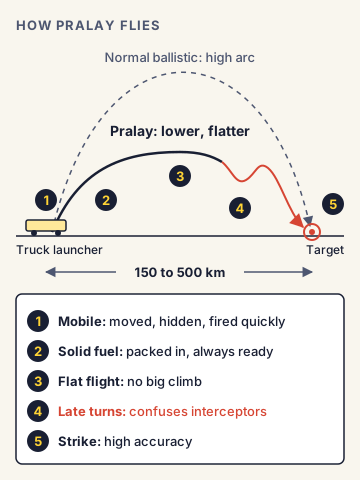
- The missile is carried on a truck-based mobile launcher, so it can be moved and hidden, and fired quickly from different places.
- A solid-propellant rocket motor pushes it up. Solid fuel is already packed inside, like the fuel in a firecracker, so the missile is always ready.
- Instead of climbing very high in a big arc like a normal ballistic missile, it flies a lower, flatter path.
- A guidance system keeps steering it. Near the end, it can manoeuvre (change direction), which confuses enemy air-defence interceptors.
- It strikes the target with high accuracy. Different types of warheads can be fitted for different targets.
Key facts
- Developer: DRDO; Research Centre Imarat (RCI), Hyderabad is the lead lab, with other DRDO labs such as the High Energy Materials Research Laboratory (HEMRL), which developed the propellant
- Production partners: Bharat Dynamics Limited (BDL) and Bharat Electronics Limited (BEL), two government-owned companies. DRDO calls them Development-cum-Production Partners: they join in while the missile is being developed, and then help build it. For example, BDL made the missile used in the November 2026 test.
- Type: Quasi-ballistic, surface-to-surface, short-range
- Range: 150-500 km
- Payload: Reports give different figures, roughly 350 kg to 1,000 kg; a lighter warhead gives a longer range
- Fuel: Solid propellant
- Warhead: Conventional
- Users: Indian Army and Indian Air Force
- Test site: Dr. A.P.J. Abdul Kalam Island (earlier called Wheeler Island), Odisha
- It is reported to be the longest-range conventional surface-to-surface missile planned for the Indian Army
- It is often compared with Russia's Iskander and China's Dong Feng-12, which are also quasi-ballistic missiles
India's position and why it matters
Pralay is part of India's push for Atmanirbharta (self-reliance) in defence. It gives India a conventional strike option that is separate from its nuclear missiles like Agni. This matters because if a missile could carry either a nuclear or a normal warhead, the enemy may not know which is coming, which could cause a dangerous misunderstanding.
Defence experts have also linked Pralay with the idea of a future rocket force, a dedicated unit for conventional missiles. [Unverified: no formal government decision on a separate rocket force has been confirmed.]
Commonly confused concepts
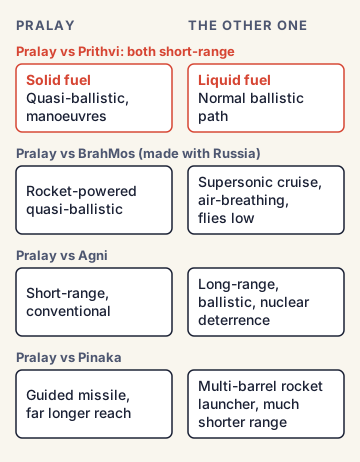
- Pralay vs Prithvi: Both are short-range surface-to-surface missiles. Prithvi uses liquid fuel and flies a normal ballistic path. Pralay uses solid fuel and flies a quasi-ballistic path with manoeuvres.
- Pralay vs BrahMos: BrahMos is a supersonic cruise missile made with Russia. It is powered by an air-breathing engine all the way and flies low. Pralay is a rocket-powered quasi-ballistic missile.
- Pralay vs Agni: Agni missiles are long-range ballistic missiles for nuclear deterrence, run by the Strategic Forces Command. Pralay is a short-range conventional battlefield missile.
- Pralay vs Pinaka: Pinaka is a multi-barrel rocket launcher (artillery rockets with much shorter range). Pralay is a guided missile with a far longer reach.
Issues, criticism and the way forward
- Slow induction: It was first tested in 2021, but induction has taken years. Long gaps between development and use are a common problem in Indian defence projects. As of November 2026, formal induction was still awaited, though reports after the 5 November test called it imminent.
- Cost of conventional missiles: Using an expensive missile with a non-nuclear warhead must be worth it. Planners need clear doctrine on what targets it should hit.
- Escalation risk: Firing missiles near a nuclear-armed neighbour carries the risk of being misread. Clear signalling and separation of conventional and nuclear forces help.
- Way forward: Quick production through Defence Public Sector Undertakings (DPSUs) and private industry, joint planning between the Army and Air Force, and possible exports to friendly countries.
Concepts to Know
- Quasi-ballistic missile: A missile that mostly follows a ballistic path but flies lower and can steer and change direction during flight, making it harder to intercept.
- Conventional warhead: A warhead using normal explosives, not nuclear material.
- Payload: The weight a missile carries to the target, mainly the warhead.
- Solid propellant: Rocket fuel in solid form, packed in the missile in advance. It is ready to fire quickly and is easier to store than liquid fuel.
- User evaluation trials: Tests done with the armed forces that will use a weapon, to confirm it works as they need before they buy and induct it.
- Salvo launch: Firing two or more missiles quickly one after another, to overwhelm enemy defences.
- Interceptor: A defensive missile that tries to destroy an incoming missile in the air.
- Defence Acquisition Council (DAC): The top body in the Ministry of Defence, chaired by the Defence Minister, that approves the buying of weapons for the armed forces.
- Developer: DRDO, lead lab Research Centre Imarat (RCI), Hyderabad; production partners: Bharat Dynamics Limited and Bharat Electronics Limited
- Range: 150-500 km; solid-propellant; conventional warhead; mobile launcher
- First tests: 22 and 23 December 2021, from Dr. A.P.J. Abdul Kalam Island, Odisha
- December 2022: about 120 missiles cleared, Air Force first; September 2023: DAC cleared an Army regiment for LAC and LoC
- July 2025: min and max range user trials; 31 December 2025: salvo launch of two missiles from one launcher
- 5 November 2026: further user evaluation flight test, all objectives met
- 6 Nov 2026Added Pralay's production partners, BDL and BEL, details of the 5 November 2026 test, and its induction status.
● Tracked since November 05, 2026 · last seen November 05, 2026 · updates as the daily brief publishes